Alkene Reactions: Anti Dihydroxylation using RCO₃H and H₃O⁺
Anti Dihydroxylation of Alkenes with RCO3H and H3O+
Peracids such as mCPBA transform alkenes into epoxides via the Prilezhaev epoxidation, and those rings can then be opened under acidic conditions to furnish vicinal diols that are anti and Markovnikov-selective. The peracid donates an oxygen atom in a concerted transfer, and the resulting epoxide is protonated by hydronium. Water then attacks the more substituted carbon from the backside (anti to the leaving oxygen), establishing the regiochemical preference. A final deprotonation gives the neutral anti diol. Because the reaction proceeds through a bridged epoxide/oxonium, rearrangements are avoided and the stereochemical outcome is predictable.
Introduction
Peracid/acidic hydrolysis sequences convert alkenes into anti-1,2-diols in two steps. First, a peracid (RCO₃H) delivers an electrophilic oxygen to the alkene, building an epoxide while expelling a carboxylate. Protonation by H₃O⁺ activates the epoxide toward backside attack. Water, acting as the nucleophile, opens the protonated epoxide at the more substituted carbon, giving Markovnikov placement of the hydroxyl group. Deprotonation by water or the carboxylate completes the anti diol. Because each step proceeds through bridged intermediates, carbocation rearrangements do not occur and products are formed as enantiomeric pairs when two stereocenters are generated.
Quick Summary
- Reagents: Peracid (e.g., mCPBA or RCO₃H) followed by aqueous acid (H₃O⁺) or simply peracid in acidic medium.
- Outcome: Anti vicinal diol; OH occupies the more substituted carbon (Markovnikov), the original epoxide oxygen lands on the less substituted carbon.
- Mechanism: Concerted epoxidation → protonated oxonium → anti water attack → deprotonation.
- Stereochemistry: Epoxidation is stereospecific (cis → cis, trans → trans); acidic opening is anti at Cβ (more substituted carbon), giving a trans-1,2-diol with inversion at the attacked center and enantiomeric pairs when both stereocenters form.
- Rearrangements: None; the epoxide/oxonium bridge blocks shifts.
- Common pitfalls: Forgetting to protonate the epoxide, drawing syn addition, or omitting the final deprotonation.
Mechanism (Anti Dihydroxylation)
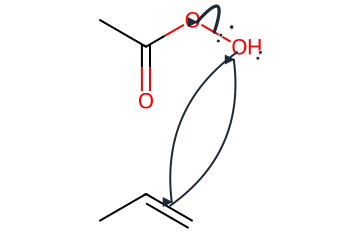
Step 1 — Epoxidation. The alkene undergoes Prilezhaev epoxidation: a concerted “butterfly” set of curved arrows delivers the terminal peroxy oxygen (Ot) to the C=C, breaks the O–O σ bond, shifts the carbonyl lone pair to grab the acidic proton, and closes the three-membered epoxide ring. The peracid leaves as the corresponding carboxylic acid, and alkene geometry is retained (cis → cis, trans → trans).
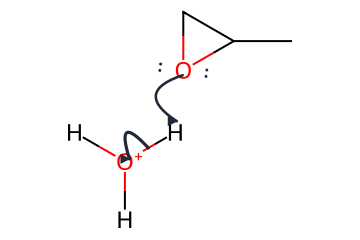
Step 2 — Protonation. Hydronium donates a proton to the epoxide oxygen, generating an oxonium ion. Protonation increases ring strain and sets up a good leaving group for the upcoming ring opening.
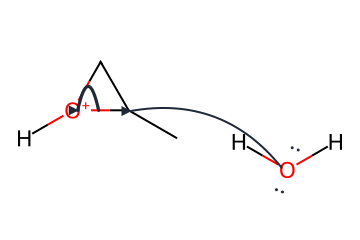
Step 3 — Nucleophilic attack. Water approaches from the backside (anti) relative to the leaving oxygen and attacks the more substituted carbon. The ring opens in an SN2-like fashion, guaranteeing inversion at the attacked carbon and establishing the anti relationship between the two oxygens.
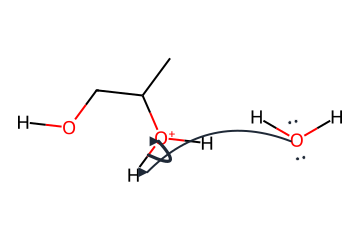
Step 4 — Deprotonation. A second equivalent of water (or the expelled carboxylate) deprotonates the oxonium, yielding the neutral trans diol. Because the attack was anti, the two C–O bonds end up anti to each other.
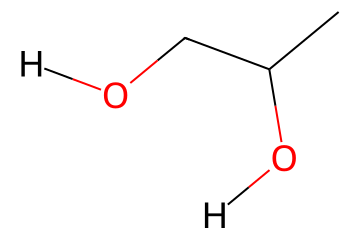
Step 5 — Product view. The final diol displays anti stereochemistry and Markovnikov regiochemistry (OH on the more substituted carbon). Expect enantiomeric pairs when both carbons become stereogenic.
Mechanistic Checklist (Exam Focus)
- Draw the peracid transfer as a cyclic, concerted step that forms the epoxide and carboxylate simultaneously.
- Protonate the epoxide before water attacks; the oxonium is the electrophile.
- Show backside attack by water at the more substituted carbon (SN2-like, anti opening).
- Include the deprotonation that delivers the neutral diol.
- Highlight anti stereochemistry and Markovnikov placement of the hydroxyl group.
- Note that rearrangements do not occur because no free carbocation is formed.
Worked Examples
Example A — Anti Dihydroxylation of 1-Methylcyclohexene
- Substrate: 1-Methylcyclohexene.
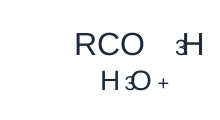
- Reagents: RCO₃H (e.g., mCPBA), followed by aqueous acid (H₃O⁺).
- Pathway: Epoxidation → oxonium formation → anti water attack at the tertiary carbon → deprotonation.
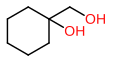
- Outcome: Trans-1,2-diol with OH at the tertiary carbon (Markovnikov) and the original epoxide oxygen on the adjacent secondary carbon; the two hydroxyls are anti.

When Multiple Alkenes Are Present
Peracids target the most electron-rich alkene. During the acidic opening, water still attacks the more substituted carbon of the protonated epoxide. If multiple alkenes epoxidize, the most substituted epoxide typically opens fastest, but mixtures can form. Compare this pathway with alternatives such as osmylation (syn dihydroxylation) or halohydrin formation depending on the substrate and stereochemical goals. For related anti additions that install different heteroatoms, see the bromohydrin formation guide.
Practical Tips & Pitfalls
- Two-step control: Isolate the epoxide or run the sequence one-pot; ensure an acidic aqueous workup to drive ring opening.
- Solvent: Conduct epoxidation in an inert solvent (e.g., CH₂Cl₂), then add dilute acid (H₂O/H₃O⁺) for the opening step.
- Temperature: Maintain 0–25 °C to avoid side reactions and to preserve stereochemistry.
- Alternative nucleophiles: In the presence of alcohols or halides, the protonated epoxide can be opened by those nucleophiles instead of water — adjust conditions accordingly.
- Reagent handling: mCPBA and other peracids are oxidizing; store cold and neutralize residues carefully.
- Quench: After epoxidation, aqueous base (NaHCO₃) can remove benzoic acids before the acidic hydrolysis stage.
- Regiochemistry reminder: Acidic openings attack the more substituted carbon (Cβ); under basic conditions the nucleophile goes to the less substituted carbon — a different outcome from the sequence covered here.
Exam-Style Summary
- Draw the peracid epoxidation, protonated epoxide, and anti SN2 opening.
- Anti diol: hydroxyl groups end up trans; expect enantiomeric products when both carbons become stereocenters.
- Regiochemistry is Markovnikov for the incoming water; the original epoxide oxygen resides on the less substituted carbon.
- No carbocation rearrangements; do not depict hydride or alkyl shifts.
- Compare with syn dihydroxylation (OsO₄) and bromohydrin formation to emphasize stereochemical contrasts.
Interactive Toolbox
- Practice anti vs syn dihydroxylation outcomes in the Reaction Solver.
- Drill regiochemistry choices vs. hydroboration and oxymercuration using spaced-repetition decks.
- Use mechanism builders to visualize epoxide opening pathways with different nucleophiles.
FAQ / Exam Notes
- Does the order matter? Yes. Perform the epoxidation before introducing strong acid; otherwise the alkene may be protonated instead of epoxidized.
- What if base is present? Basic opening of an epoxide gives syn addition (via intramolecular attack avoidance), so stick with acidic conditions for anti diols.
- Can other nucleophiles open the epoxide? Alcohols, halides, or carboxylates can substitute for water, yielding ether or halo-alcohol products; control the solvent to favor diols.
- Are meso products possible? Only when the diol substituents are identical (e.g., syn additions via OsO₄). This anti pathway gives enantiomeric pairs because the two OH groups differ in their origins.