Pinacol Rearrangement: 1,2-Diol to Ketone
The pinacol rearrangement converts a 1,2-diol (vicinal diol) to a ketone or aldehyde through acid-catalyzed carbocation formation and 1,2-alkyl or aryl migration. Named after the classic substrate pinacol (2,3-dimethyl-2,3-butanediol), which rearranges to pinacolone (3,3-dimethyl-2-butanone), this transformation exemplifies Wagner–Meerwein 1,2-shifts in carbonyl synthesis. For oxidative diol cleavage without rearrangement, compare the NaIO₄ Malaprade cleavage, and for diol installation see the OsO₄ syn-dihydroxylation playbook.
Quick Summary
- Reagents & conditions: Strong acid (H₂SO₄, HCl, H₃PO₄) with heat; aqueous or anhydrous.
- Outcome logic: One hydroxyl leaves as water; the adjacent group migrates to the resulting carbocation; deprotonation yields the carbonyl product.
- Regioselectivity: The hydroxyl that leaves is the one generating the more stable carbocation (3° > 2° > 1°; benzylic/allylic stabilization applies).
- Migratory aptitude: aryl > H > 3° alkyl > 2° alkyl > 1° alkyl > methyl — the group that migrates best "wins" when multiple options exist.
- Comparisons: NaIO₄ cleaves diols oxidatively (no rearrangement); acid dehydration of simple alcohols forms alkenes, not carbonyls.
Mechanism — Pinacol Rearrangement
Step 1 — Protonation of hydroxyl group
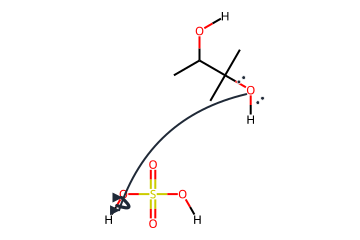
Acid protonates one of the hydroxyl groups, converting it into a good leaving group (water). The hydroxyl that gets protonated is the one whose departure generates the more stable carbocation.
Step 2 — Water departs
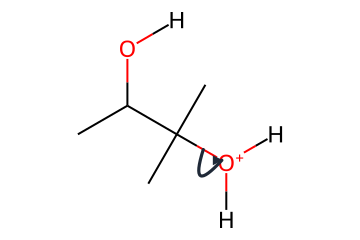
The protonated hydroxyl (OH₂⁺) departs as water, leaving behind a carbocation on the adjacent carbon. The C–O bond breaks heterolytically with both electrons going to oxygen.
Step 3 — 1,2-Alkyl migration
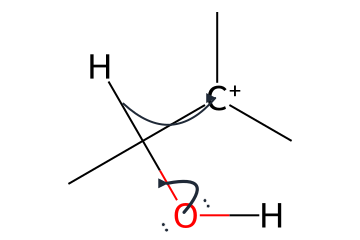
An adjacent alkyl (or aryl) group migrates with its bonding electrons to the carbocation center in a 1,2-shift. Simultaneously, the lone pair on the remaining hydroxyl oxygen forms a double bond, generating an oxonium ion intermediate.
Step 4 — Deprotonation by conjugate base
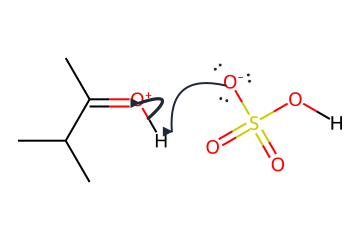
The conjugate base of the acid (e.g., HSO₄⁻) abstracts the proton from the oxonium oxygen. This proton transfer regenerates the acid catalyst and reduces the positive charge on oxygen.
Step 5 — Ketone product formed
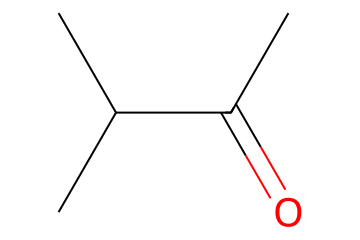
The neutral ketone (or aldehyde) product is formed. The oxygen that originally bore the non-leaving hydroxyl is now the carbonyl oxygen. The acid catalyst is regenerated and can protonate another substrate molecule.
Mechanistic Checklist
- Identify the vicinal diol — both hydroxyl groups must be on adjacent carbons.
- Determine which hydroxyl leaves by comparing carbocation stability at each carbon (consider 3° vs 2° vs 1°, benzylic/allylic stabilization).
- Identify the migrating group using migratory aptitude: aryl > H > 3° alkyl > 2° alkyl > 1° alkyl > methyl.
- Draw the concerted mechanism: protonation → water loss with simultaneous 1,2-shift → deprotonation.
- The migrating group retains its configuration (migration with retention).
Worked Examples
Molecule names were cross-checked with the IUPAC Namer.
Pinacol → Pinacolone (Classic Example)
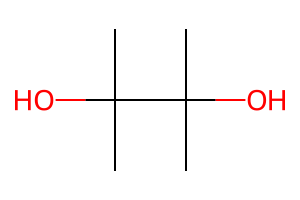
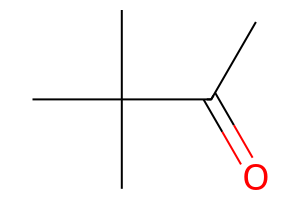
Both carbons are equivalent (tertiary). A methyl group migrates to give 3,3-dimethyl-2-butanone.
2,3-Butanediol → 2-Butanone
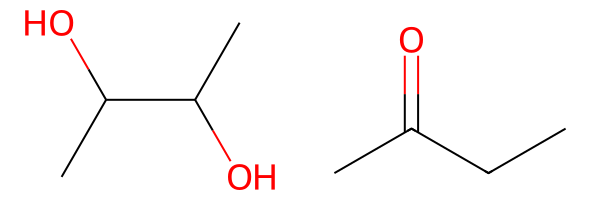
Simple secondary diol rearranges to methyl ethyl ketone (MEK).
Phenyl Migration (Aryl > Alkyl)
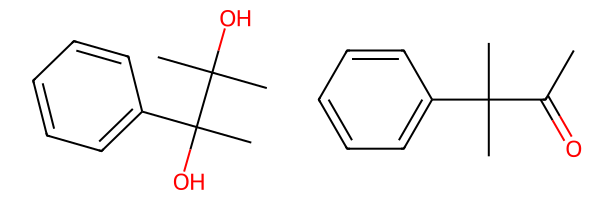
Phenyl migrates preferentially over methyl due to higher migratory aptitude (aryl > alkyl).
Ring Expansion (Spiro Diol)
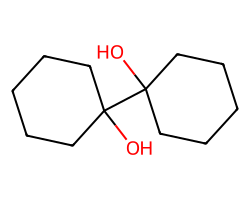
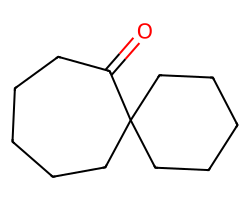
When a ring carbon migrates in a spiro diol, the ring expands by one carbon (6-membered → 7-membered).
Scope & Limitations
- Excellent: Symmetrical diols (both carbons equivalent), tertiary diols, benzylic diols.
- Good: Unsymmetrical diols with clear carbocation stability difference, aryl-substituted diols.
- Ring systems: Cyclic and spiro diols undergo ring expansion or contraction — a ring carbon migrates, changing ring size by one carbon.
- Challenging: Diols where both carbocations are similarly stable — mixtures may result.
- Not applicable: 1,3-diols, 1,4-diols, or isolated alcohols — the vicinal relationship is required.
Edge Cases & Exam Traps
- Symmetric diols: Both carbons are equivalent, so either OH can leave — product is the same regardless.
- Unsymmetric diols: The more substituted carbocation forms preferentially; predict regioselectivity accordingly.
- Aryl vs alkyl competition: Aryl groups migrate faster — when phenyl competes with methyl, phenyl wins.
- Hydrogen migration: In some substrates, hydride shifts can occur — H has higher migratory aptitude than primary alkyl.
- Ring expansion/contraction: In spiro or bicyclic diols, a ring carbon migrates into the adjacent ring, changing ring size (e.g., 6-membered → 7-membered). Count carbons in both rings before and after.
- Don't confuse with NaIO₄: Periodate cleaves diols to two carbonyl fragments; pinacol rearranges to one carbonyl with skeletal change.
Practical Tips
- Use concentrated H₂SO₄ or HCl with gentle heating (50–100 °C).
- For substrates prone to elimination, milder Lewis acids (ZnCl₂, BF₃·Et₂O) may improve selectivity.
- Monitor by TLC or GC — the product ketone has different polarity than the diol starting material.
- Aqueous workup extracts the ketone product; wash with base to remove residual acid.
Exam-Style Summary
The pinacol rearrangement converts vicinal diols to ketones/aldehydes via acid-catalyzed carbocation formation and 1,2-migration. Protonation of one hydroxyl creates water as leaving group; the adjacent substituent migrates concertedly to the carbocation center; deprotonation delivers the carbonyl. Regioselectivity follows carbocation stability (3° > 2° > 1°); migratory aptitude follows aryl > H > 3° alkyl > 2° alkyl > 1° alkyl > methyl.
Interactive Toolbox
- IUPAC Namer — verify systematic names for diol substrates and ketone products.