Alkene Reactions: Bromothiol Formation using Br2 and H2S
Bromothiol formation converts alkenes into vicinal Br/SH products using Br₂ dissolved in hydrogen sulfide (or reagents that release H₂S). The alkene polarizes Br₂ to form a three-membered bromonium ion while Br⁻ is generated. Hydrogen sulfide then attacks the more substituted carbon from the backside (anti), giving Markovnikov placement of SH (with Br on the less substituted carbon). Deprotonation of the sulfonium intermediate furnishes the neutral bromothiol. Because no free carbocation appears, rearrangements are suppressed and the anti relationship of Br and SH is predictable. Note: Br₂ can oxidize H₂S (H₂S + Br₂ → 2 HBr + S); in practice add Br₂ slowly to an H₂S- or HS⁻-containing alkene solution (or use NBS/NaHS) to maintain low free Br₂ and favor bromothiol formation.
Introduction
Br₂/H₂S reacts with alkenes to produce bromothiols through anti addition. The alkene π bond polarizes Br₂, forming a bromonium ion while releasing Br⁻. Hydrogen sulfide, acting as a soft nucleophile, attacks the more substituted carbon from the backside, opening the bridge. Rapid deprotonation yields the neutral bromothiol with SH installed at the Markovnikov position and Br on the less substituted carbon. The absence of discrete carbocations prevents rearrangements, and the anti relationship between Br and SH provides clear stereochemical outcomes.
Quick Summary
- Reagents: Br₂ with H₂S (or sources of Br⁺/Br⁻ in the presence of hydrogen sulfide).
- Outcome: Anti addition of Br and SH; SH occupies the more substituted carbon (Markovnikov), Br the less substituted carbon.
- Mechanism: Bromonium ion formation → H₂S anti attack → deprotonation of the sulfonium intermediate.
- Rearrangements: None (bridged bromonium prevents shifts).
- Stereochemistry: Anti addition ensures Br and SH are trans; when two stereocenters form, enantiomeric pairs result.
- Common pitfalls: Forgetting sulfonium intermediates, predicting syn addition, or omitting the need for a proton-transfer step to reveal the thiol.
Mechanism (Bromothiol Formation)
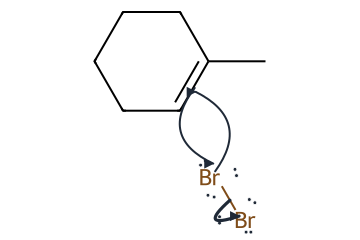
The alkene π bond polarizes Br₂; the Br–Br bond heterolyzes to Br⁻ as a three-membered bromonium ion forms.

H₂S attacks from the backside (SN2-like) at the more substituted bromonium carbon, generating a protonated sulfur (sulfonium) intermediate.

Br⁻, H₂S, or solvent base removes a proton from sulfur to furnish the neutral anti bromothiol (SH on the more substituted carbon, Br on the less).
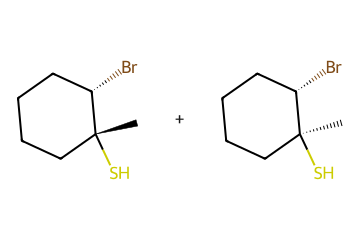
Step 4 — Product formation. The anti bromothiol appears with SH at the more substituted carbon and Br at the less substituted carbon.
Mechanistic Checklist (Exam Focus)
- Draw the bromonium ion explicitly; no free carbocation.
- Show H₂S attacking anti to the bridge at the more substituted carbon.
- Include deprotonation of the sulfonium to reveal the thiol (base = Br⁻/H₂S/solvent).
- Highlight Markovnikov regiochemistry (SH to the more substituted carbon) and anti stereochemistry.
- Note that the absence of H₂S (e.g., in dry solvent) leads to vicinal dibromide instead of bromothiol.
Worked Examples
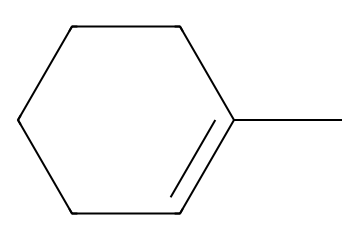
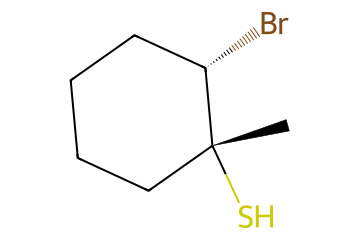
Example A — Bromothiol Formation from 1-Methylcyclohexene
- Substrate: 1-Methylcyclohexene.
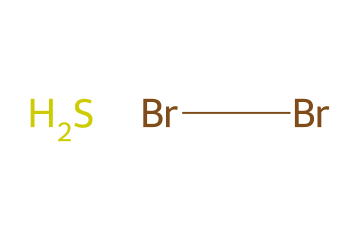
- Reagents: Br₂ with dissolved H₂S.
- Pathway: Br₂ forms a bromonium ion; H₂S attacks the tertiary carbon anti to Br; deprotonation yields the bromothiol.
- Outcome: Markovnikov bromothiol with SH at the tertiary ring carbon and Br on the adjacent, less substituted ring carbon; Br/SH anti.
When Multiple Alkenes Are Present
- The most substituted alkene typically reacts fastest.
- Conjugated alkenes can react competitively; bromonium formation is electrophilic and regioselective for the alkene that best stabilizes the positive charge.
- If several alkenes are available, expect mixtures unless steric or conformational factors heavily favor one site.
Practical Tips & Pitfalls
- Maintain a source of hydrogen sulfide (gaseous H₂S, NaSH/HBr, or thioacids that generate H₂S in situ).
- Using NaHS (aqueous or biphasic) in place of gaseous H₂S often provides cleaner bromothiol formation under Br₂ or NBS feeds.
- Neutral H₂S and HS⁻ both open the bromonium anti; however, strongly basic media can consume Br₂ and increase by-products—use neutral to mildly acidic conditions or controlled NaHS.
- Water/alcohols compete as nucleophiles (bromohydrin/haloether). Dry the medium or use H₂S/HS⁻ in excess to suppress these paths.
- Watch for oxidation of thiols to disulfides; exclude oxygen during workup or add a trace antioxidant (e.g., BHT).
Exam-Style Summary
- Draw the bromonium ion, anti attack by H₂S, sulfonium intermediate, and deprotonation.
- Regiochemistry: SH to the more substituted carbon (Markovnikov).
- Stereochemistry: Br/SH anti; enantiomeric products for asymmetrical alkenes.
- No carbocation rearrangements.
- Eliminating H₂S in the solvent switches the outcome to vicinal dibromide.
Interactive Toolbox
- Use the OrgoSolver Mechanism Solver to visualize bromothiol formation with step-by-step electron pushing.
- Use the OrgoSolver Reaction Solver to test this reaction and others!.
- Compare to bromohydrin formation to see parallels between H₂S and H₂O nucleophiles.
FAQ / Exam Notes
- Does H₂S attack faster than water? Yes, sulfur is softer and more polarizable, so in mixed solvents the thiol often dominates. HS⁻ is faster still; controlling basicity helps tune selectivity.
- Can Br⁻ open the bromonium instead? Without H₂S present, yes—leading to dibromide. With H₂S available, the thiol usually prevails.
- What about stereochemistry in cyclic substrates? Expect trans-diaxial relationships in chair conformations, mirroring bromohydrin outcomes but with SH replacing OH.
- Does oxidation occur during the mechanism? Not in the core steps; oxidation of the thiol product is a separate side process needing oxygen or other oxidants.
- Can I substitute NaHS for gaseous H₂S? Yes—NaHS (aq or biphasic) plus Br₂ or NBS often gives cleaner bromothiols while controlling H₂S delivery.
- How do I protect the thiol product? Keep oxygen out or include a trace antioxidant (e.g., BHT) to limit disulfide formation.