Alkene Reactions: Oxidative cleavage with hot KMnO4, then H3O+ (heat)
Hot, concentrated permanganate snaps an alkene across the double bond, oxidising both vinylic carbons. Any site that still carries a hydrogen is marched all the way to a carboxylic acid during acidic workup, while fully substituted centers stop at ketones. Terminal =CH2 fragments are over-oxidized to carbon dioxide. The entry step mirrors the syn manganate addition you see under cold, dilute KMnO4, but the high-temperature, strongly oxidising conditions force C–C bond cleavage instead of diol isolation. No radicals, no rearrangements—just closed-shell oxidations all the way through.
Quick Summary
- Reagents/conditions: Hot, concentrated KMnO4 (classically aqueous base, Δ) followed by hot H3O+ to release neutral products; acidified hot KMnO4 also works.
- Outcome rules:
- Vinylic carbon with ≥1 H → carboxylic acid after workup.
- Vinylic carbon with 0 H → ketone.
- Terminal =CH₂ fragment → CO₂.
- Stereochemistry: Lost after cleavage; rings open to chains bearing carbonyls.
- Comparison: Same product map as ozonolysis with oxidative workup (O₃/H₂O₂).
- Observation: Purple MnO₄⁻ bleaches and often leaves brown MnO₂ precipitate before acidification.
Mechanism (5 Steps)
Class: Closed-shell oxidation via manganate ester, over-oxidation, and C–C bond cleavage.
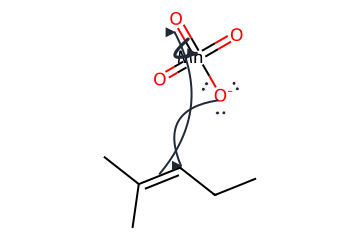
Two equatorial oxygens on permanganate attack the π bond in a concerted fashion, giving the familiar five-membered cyclic manganate ester. The metal centre accepts electron density from the double bond, setting up syn delivery to both carbons.
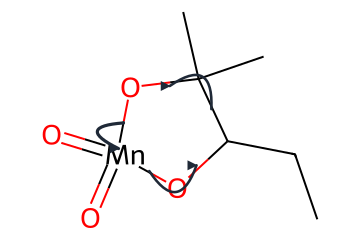
The C–O bonds reorganise to the syn diol-like manifold. Under milder (cold) conditions this is where you would stop; here the strongly oxidising environment keeps pushing forward.
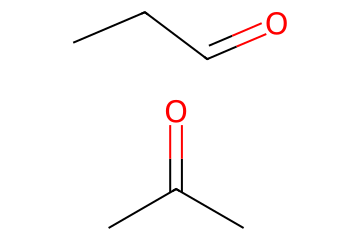
Electron flow from the newly formed C–O bonds cleaves the former alkene C–C bond. Each vinylic carbon becomes the carbonyl carbon of a fragment still associated with the manganese centre.
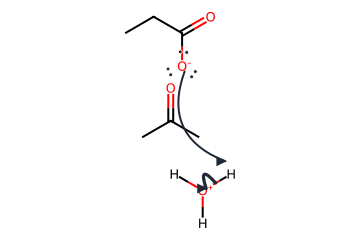
Any fragment that briefly resembles an aldehyde is pushed on to a carboxylate. Hydronium delivers the proton and collapses the O–H bond back onto oxygen, while a terminal =CH₂ fragment is driven all the way to CO₂. Fully substituted carbons remain as ketones.
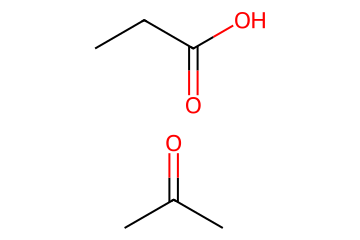
The acidic workup protonates each carboxylate to its corresponding carboxylic acid. Ketone fragments survive, and CO₂ is released as a gas. The mixture now reflects the familiar permanganate cleavage rules.
Mechanistic Checklist
- Treat the reaction as double-bond cleavage: regiochemistry and stereochemistry of the original alkene do not survive.
- Assign each vinylic carbon by substitution before drawing products (vinylic H → acid, no H → ketone, terminal =CH₂ → CO₂).
- No radicals or carbocations are formed—everything proceeds through closed-shell polar steps.
- Cold, dilute KMnO₄ (or OsO₄) gives syn diols instead; only hot, concentrated permanganate pushes to cleavage.
- Rings will open; watch for symmetry so you do not double-count identical fragments.
Worked Examples
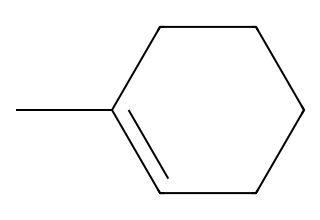
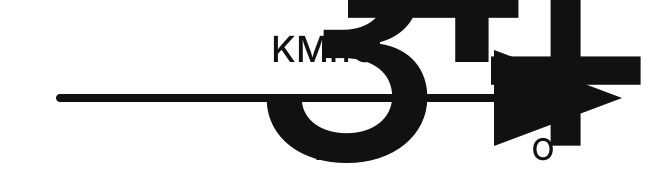
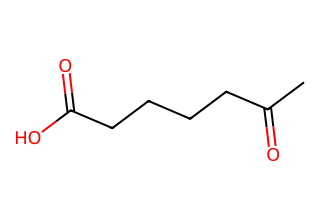
- Example A: 1-methylcyclohex-1-ene → 6-oxoheptanoic acid (one ketone side, one acid side).
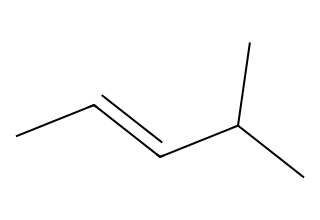
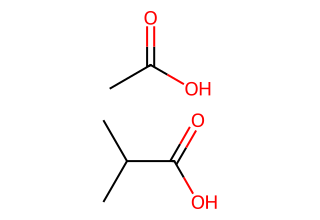
- Example B: 4-methylpent-2-ene → 2-methylpropanoic acid + acetic acid.
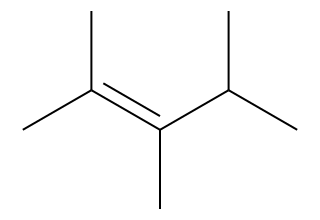
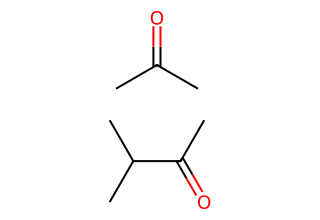
- Example C: 2,3,4-trimethylpent-2-ene → 3-methylbutan-2-one + propan-2-one.
Multiple Alkenes & Selectivity
- KMnO₄ is unforgiving—given time, every accessible C=C in the molecule will be cleaved.
- Electron-rich and less hindered alkenes usually react first, but the oxidant keeps going; stopping the reaction early is the only way to preserve other alkenes.
- For complex molecules, staged ozonolysis (O₃), followed by a chosen workup, offers better selectivity and temperature control.
Practical Tips & Pitfalls
- Conditions: Hot aqueous KMnO4 under basic conditions (NaOH/KOH) is classic; acidify hot with H3O+ to obtain neutral carboxylic acids.
- Observation: The deep purple permanganate fades; insoluble brown MnO2 commonly precipitates—filter before acidification.
- Functional groups: Allylic alcohols, aldehydes, and sulfides are also oxidized; protect or use a milder method if sensitive groups are present.
- Safety: KMnO₄ is a strong oxidizer—add slowly, control exotherms, and handle manganese-containing waste appropriately.
Exam-Style Summary
- Hot KMnO₄ cleaves alkenes. After H₃O⁺/Δ workup: vinylic H → carboxylic acid, no vinylic H → ketone, terminal =CH₂ → CO₂.
- Same product logic as oxidative ozonolysis (O₃/H₂O₂).
- Rings open; stereochemistry of the starting alkene is erased.
- Cold permanganate stops at syn diols—remember which conditions you are using.
Interactive Toolbox
- Use the Mechanism Solver to export the five-step KMnO₄ sequence for any substrate you want to practice.
- Check predicted products with the Reaction Solver; choose the oxidative KMnO₄ mode to see acids vs. ketones vs. CO₂ assignments instantly.
- Pair this lesson with the ozonolysis + H₂O₂ guide to compare oxidative workups side by side.
FAQ / Exam Notes
- Do radicals form? No—permanganate operates through polar, closed-shell pathways in this context.
- Can I halt oxidation at the diol? Only with cold, dilute KMnO₄ (or OsO₄). Hot, concentrated permanganate will march on to cleavage.
- What happens to aldehydes? They do not survive; permanganate over-oxidizes them to carboxylates before the acid workup.
- Why CO₂ from terminal alkenes? A terminal =CH₂ is oxidized from the aldehyde stage directly to carbonate/CO₂ under these harsh conditions.