Epoxide Ring Opening with Grignard Reagents (RMgBr → H₃O⁺)
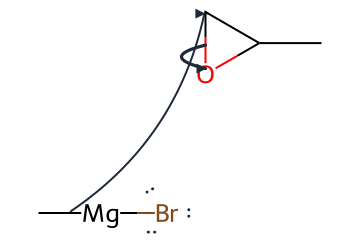
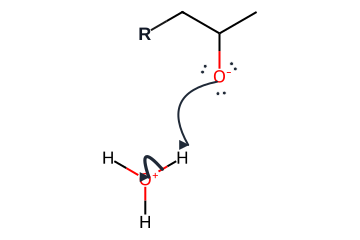
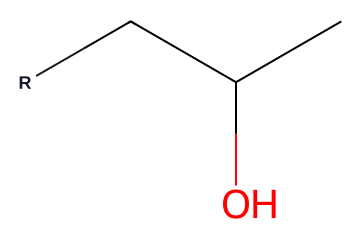
Grignard reagents (RMgBr) are strong nucleophiles/bases that open epoxides under basic conditions. The carbanion equivalent R⁻ attacks the less substituted epoxide carbon (SN2-like), the three-membered ring opens to a magnesium alkoxide, and a separate acidic workup (H₃O⁺) protonates the alkoxide to furnish an alcohol. The opening is anti relative to the oxygen: the attacked carbon inverts while the untouched carbon keeps its configuration. Using ethylene oxide is the classic two-carbon chain extension that installs –CH₂–CH₂–OH at the Grignard carbon.
Implementation note (Mechanism Solver): Render the primary reagent as RMgBr (Br is the example halide) and show the H₃O⁺ workup in a separate panel. RMgBr overlays should make the Lewis-acid coordination explicit before the attack arrow.
Introduction
- Regiochemistry (basic RMgBr): attack the less substituted epoxide carbon (primary over secondary) because the transition state is SN2-like. Only symmetry can override this rule.
- Stereochemistry: backside attack opens the epoxide anti; the attacked carbon inverts, while the untouched carbon retains its configuration.
- Workup: protonate with H₃O⁺ after the RMgBr step. The magnesium alkoxide survives only until the acidic quench.
- Chain extension: ethylene oxide always adds –CH₂–CH₂–OH to the Grignard carbon, giving a primary alcohol.
- Compatibility: RMgBr reacts with any electrophile that is “better” than an epoxide. Protect or avoid protic/electrophilic groups (–OH, –NH, –COOH, C=O) unless they are the intended target.
Quick Summary
- Reagents/conditions: 1) RMgBr in dry ether/THF (0–25 °C, inert atmosphere); 2) H₃O⁺ quench.
- Outcome: C–C bond formation at the less substituted epoxide carbon; anti opening; alcohol after workup.
- Selectivity: contrasts with acid-catalysed openings, which prefer the more substituted carbon.
- Chain extension: ethylene oxide + RMgBr → “add two carbons” ending in a primary alcohol.
- Functional-group caution: Grignards are killed by protic media or competitive electrophiles—keep the substrate protected and the reaction anhydrous.
Mechanism (3 Steps)
Mechanistic Checklist (Exam Focus)
- Under basic RMgBr conditions, attack the less substituted epoxide carbon.
- Depict anti opening with inversion at the attacked center only.
- Show the O–MgBr alkoxide intermediate; protonate with H₃O⁺ to reach the alcohol.
- Ethylene oxide gives a reliable +2 carbon extension ending in a primary alcohol.
- Contrast with acid-catalysed openings (more substituted carbon, carbocation-like).
Worked Examples
Seafoam-teal Color 1 atoms highlight the fragment supplied directly by RMgBr.
Reactant
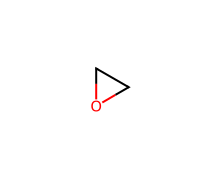
Ethylene oxide (chain-extension electrophile)
Reagent

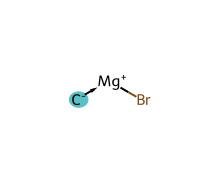
MeMgBr (seafoam-teal Color 1 carbon = methyl nucleophile)
Product
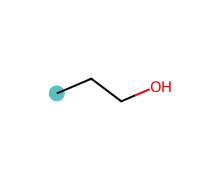
1-Propanol (seafoam-teal Color 1 chain = Me + two-carbon extension)
Reactant
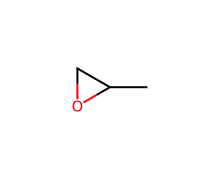
Propylene oxide (less vs more substituted carbons)
Reagent
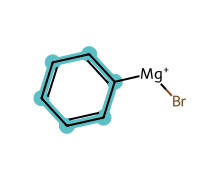
PhMgBr (seafoam-teal Color 1 ring = incoming phenyl group)
Product
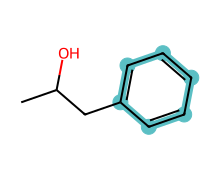
2-Phenyl-1-propanol (seafoam-teal Color 1 phenyl = R group)
For cyclic epoxides (e.g., cyclohexene oxide) the same logic applies: RMgBr attacks the less hindered carbon and the product is trans (R and OH anti). Use bulky n-Bu or Ph reagents to build stereodefined substituents onto the ring.
Scope, Selectivity & Edge Cases
- Unsymmetrical epoxides: prefer primary over secondary carbons. When both ends are equivalent, either site is fine.
- Cyclic epoxides: give trans products; draw the chair to enforce backside attack.
- Aryl/vinyl-substituted epoxides: still obey the less-substituted rule unless chelation/directing effects intervene.
- Competing electrophiles: C=O, acid chlorides, or activated halides will intercept RMgBr faster than an epoxide—protect or sequence additions.
- Functional groups that quench RMgBr: –OH, –NH, –COOH, water, alcohol solvents. Keep everything rigorously dry.
Practical Tips & Pitfalls
- Dryness matters: use Et₂O or THF, inert atmosphere, oven-dried glassware.
- Order of addition: add epoxide to a cooled Grignard (or vice versa) to control exotherms, then warm gently.
- Stoichiometry: 1.1–1.5 equiv RMgBr is typical; internal epoxides may need slight excess.
- Visualization: always draw backside attack with inversion; highlight the anti relationship between R and OH.
- Compare to acid opening: swapping RMgBr for H⁺/Nu means reversing the regio rule (acid attacks the more substituted carbon).
Exam-Style Summary
Epoxide + RMgBr (dry ether) → SN2-like attack at the less substituted carbon → magnesium alkoxide (anti arrangement) → H₃O⁺ workup → alcohol (R and OH trans). Ethylene oxide adds two carbons ending in a primary alcohol.
Interactive Toolbox
Use these study tools to connect the article back to the interactive apps:
- Mechanism Solver — pick the RMgBr button, choose an epoxide, and replay each RDKit-rendered step with overlays.
- Reaction Solver — predict the product for a custom epoxide + RMgBr and confirm regiochemistry.
- IUPAC Namer — check the alcohol’s systematic name without copying SMILES into your notes.
Related Reading
- Grignard Addition to Aldehydes/Ketones — 1,2-addition scope, product class logic, and pitfalls.
- Grignard + Esters → Alcohols — twice-addition pathway through a ketone intermediate.
- Grignard Reagent Formation (Mg Insertion) — how to build RMgX from alkyl/aryl/vinyl halides under dry ether.