Ester to Aldehyde (DIBAL-H, -78 C)
Exam Answer
- Reagents
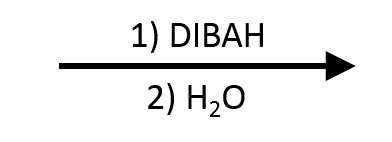
- 1) DIBAL-H (cold) 2) H3O+
- Major outcome
- Ester to aldehyde (controlled)
- Selectivity
- Stopping point depends on temperature/equivalents/workup
Common traps
- Warm conditions or excess reagent can over-reduce to alcohol
- Do not confuse with LiAlH4 (ester to alcohol)
- Workup timing matters in stepwise problems
Ester reduction outcomes by reagent
Jump to full playbook| Reagent | Major product | Notes |
|---|---|---|
| DIBAL-H (-78 C, about 1 eq) | aldehyde | controlled stop |
| LiAlH4 | primary alcohol | strong; no stop at aldehyde |
| NaBH4 | no ester reduction | typical exam assumption |
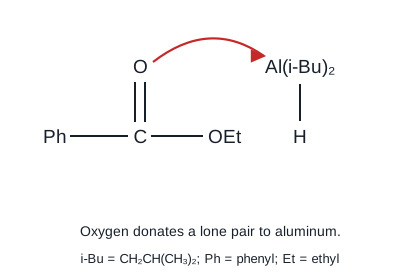
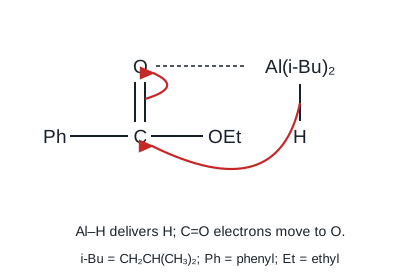
Diisobutylaluminum hydride (DIBAL-H, DIBAH, i-Bu₂AlH) converts esters into aldehydes when the reaction is run cold (typically −78 °C in toluene, hexanes, Et₂O, or THF), the hydride charge is limited to ~1 equiv, and the quench is kept cold. DIBAL-H acts as both a Lewis acid and hydride donor: Al coordinates the carbonyl oxygen, a single hydride forms a tetrahedral Al–alkoxide complex (“hemiacetalate”), and a cold protic quench fragments the complex to release the aldehyde while the alkoxy fragment becomes an alcohol. If the mixture warms or excess hydride remains, a second hydride reduces the newly formed aldehyde to the primary alcohol.
Key Points
- Temperature + equivalents control selectivity. Esters (and lactones) stop at aldehydes/lactols with ~1.0–1.2 equiv DIBAL-H at −78 °C plus a cold quench. Warming before quenching active hydride or using excess reagent increases over-reduction to alcohols/diols.
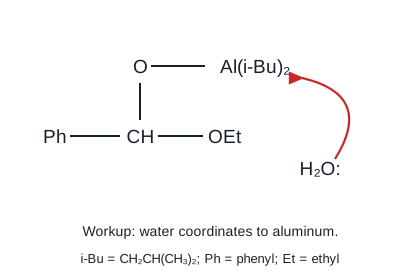
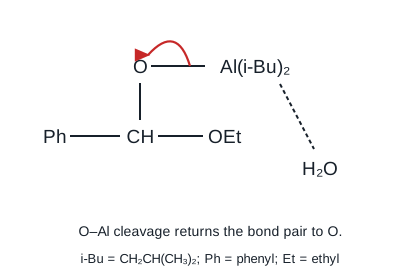
- Mechanistic picture. Al–O coordination activates the ester; one hydride generates a tetrahedral Al–alkoxide complex that remains “frozen” at −78 °C. Cold MeOH followed by cold aqueous NH₄Cl collapses the complex to aldehyde + ROH while Al becomes insoluble salts.
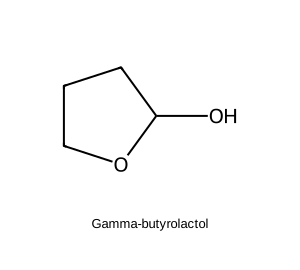
- Scope cues. Lactones become lactols (cyclic hemiacetals), which can equilibrate with their open-chain hydroxyaldehydes. Acid chlorides can also stop at aldehydes with cold DIBAL-H, but those belong in the acyl chloride playbook.
Quick Summary
- Reagents/conditions: DIBAL-H (1.0–1.2 equiv), toluene/hexanes/Et₂O/THF, −78 °C; slow addition to the cold ester solution; quench at −78 °C with MeOH (or i-PrOH), then cold aqueous NH₄Cl or Rochelle’s salt.
- Outcome: R–C(=O)OR′ → R–CHO + R′OH on quench. Lactones give lactols (hemiacetals).
- Over-reduction risk: Excess DIBAL-H or warming while active hydride remains can reduce the aldehyde further to the primary alcohol. There is no universal equivalent cutoff.
- Comparison: LiAlH₄ reduces esters directly to alcohols; NaBH₄ is generally too mild. DIBAL-H sits between them—strong hydride, but single equivalent can be “frozen” at the aldehyde stage.
Mechanism — Partial Reduction and Quench Release


Mechanistic Checklist (Exam Focus)
- Show Al–O coordination followed by a single Al–H hydride arrow to the carbonyl carbon.
- The tetrahedral Al–alkoxide intermediate is the “frozen” species at −78 °C.
- Quench order matters: alcohol (MeOH/i-PrOH) at −78 °C, then cold aqueous NH₄Cl/dilute acid. Draw both steps or annotate them clearly.
- Track the leaving-group fragment: OR′ becomes R′OH on workup; in lactones the OR′ is part of the same ring, so the product is a lactol.
- Include the over-reduction trap: warm temperatures or excess hydride reduce the aldehyde further to the primary alcohol/diol.
Worked Examples



Scope & Limitations
- Works best: Many aliphatic and aromatic esters can be partially reduced under controlled conditions. Lactones give lactols; selectivity must be checked for the specific substrate.
- Functional groups tolerated (pre-quench): Al–H reagents demand strictly aprotic, oxygen-free setups. Protect alcohols/phenols if they would react with DIBAL-H; nitriles can be reduced to imines (which hydrolyze to aldehydes) but that is a different substrate class.
- Temperature: Keep ≤−60 °C until after the first protic quench to avoid runaway hydride transfer.
- Over-reduction: Excess active hydride and warming before it is quenched increase alcohol/diol formation; neither 1.5 equiv nor a single temperature is a universal boundary.
Edge Cases & Exam Traps
- Warm quench: Letting the mixture warm before residual hydride is destroyed increases over-reduction risk. Warming after hydride destruction does not by itself reduce an aldehyde.
- Excess reagent: Stock DIBAL-H solutions are often >1.0 M; miscalculations lead to >1.5 equiv and over-reduction.
- Lactone misassignment: A lactol is a cyclic hemiacetal, not another name for the open-chain hydroxyaldehyde. The two forms can interconvert.
- Protic solvent before quench: EtOH, MeOH, and water consume Al–H before reduction. Halogenated solvents are not protic; solvent compatibility must be checked separately. Toluene or hexanes are typical choices.
Practical Tips
- Calibrate the reagent. Verify the actual concentration of the DIBAL-H solution and charge only 1.0–1.2 equiv for aldehyde stops.
- Add to cold substrate. Cool the ester solution to −78 °C first, then add DIBAL-H slowly while monitoring (TLC/GC when possible).
- Two-stage, cold quench: At −78 °C add a few equiv MeOH (or i-PrOH) to destroy excess hydride, then add cold aqueous NH₄Cl (or Rochelle’s salt/dilute acid). Warm only after Al salts appear.
- Workup: Filter off Al salts (Celite) before concentration to minimize redox side reactions.
- Safety: DIBAL-H is pyrophoric; work behind a blast shield, maintain positive N₂ flow, and vent carefully during quench.
Exam-Style Summary
Ester + DIBAL-H (≈1.0 equiv, −78 °C) → tetrahedral Al–alkoxide (frozen) → cold MeOH then cold NH₄Cl → aldehyde + ROH. Excess active hydride or warming before quench can give the primary alcohol/diol. Lactones give lactols under the cold protocol.
Interactive Toolbox
- Mechanism Solver — Open the tool to check its available reaction templates.
- Reaction Solver — Open the Classic tool to draw a substrate and choose from supported reagents; this link does not preload a solved example.
- IUPAC Namer — Check product names from structures you enter.