Alkene Reactions: Simmons Reaction - Cyclopropane Formation
Simmons–Smith reaction – cyclopropanation of alkenes
Diiodomethane and an activated zinc–copper couple assemble the zinc carbenoid iodomethylzinc iodide (ICH2ZnI). That closed-shell reagent adds syn across an alkene, preserving the relative stereochemistry (E → trans, Z → cis). The result is a cyclopropane that inherits the alkene’s substitution pattern without rearrangement or radical side chemistry.
Quick Summary
- Reagents/conditions: CH₂I₂ with activated Zn(Cu) (or Et₂Zn/CH₂I₂, Furukawa modification) in ethereal solvents at 0–25 °C.
- Outcome: Concerted syn transfer of CH₂; alkene configuration is retained (E → trans cyclopropane, Z → cis).
- Mechanistic spine: Zinc inserts into CH₂I₂ → zinc carbenoid aligns with C=C → syn delivery of CH₂ as ZnI₂ departs.
- Selectivity: Allylic alcohols coordinate the zinc, steering addition to the OH face.
- Safety: CH₂I₂ is toxic and dense; handle behind a shield with efficient ventilation.
Mechanism (4 Steps)
Class: Closed-shell carbenoid addition (concerted syn cycloaddition).
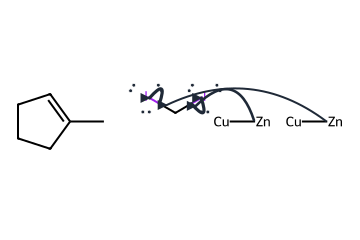
The zinc–copper couple converts CH₂I₂ to the zinc carbenoid iodomethylzinc iodide (ICH₂ZnI); no free-radical methylene is involved.
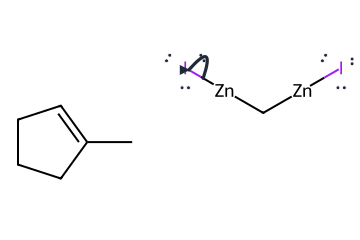
Zinc remains bound to iodide while the methylene carbon positions above the alkene π cloud. Both alkene carbons see the same face of the reagent, pre-setting the syn relationship.
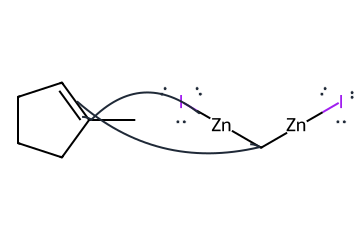
The π bond supplies both electrons needed to forge the new C–C bonds as ZnI₂ departs, completing the syn cyclopropanation.
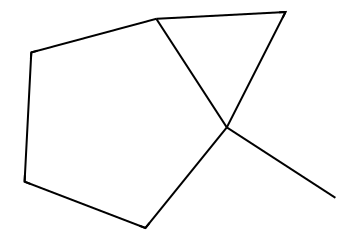
The alkene carbons now share a single bond to the methylene carbon, forming a cyclopropane. Zinc leaves as ZnI₂, closing the concerted syn addition.
Mechanistic Checklist
- Zn(Cu) inserts into CH₂I₂ to make the ICH₂ZnI carbenoid — no free radicals are produced.
- The carbenoid approaches the alkene from a single face; both new C–C bonds form syn.
- Electron flow is polar; ZnI₂ is expelled during bond formation.
- Alkene configuration is preserved (E → trans, Z → cis cyclopropane).
- Allylic alcohols coordinate to zinc, steering addition to the OH-bearing face.
Worked Examples
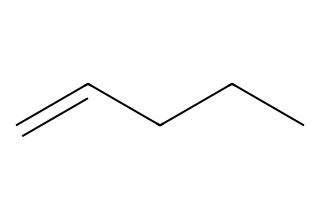
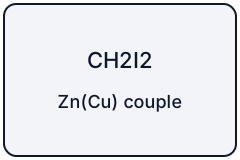
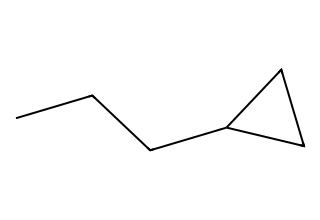
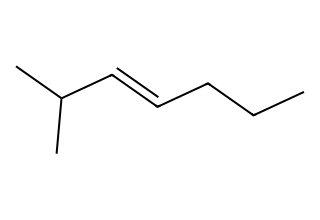
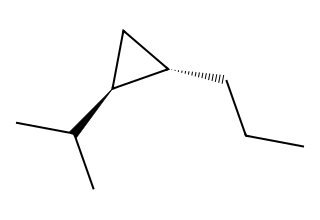
Multiple Alkenes & Selectivity
- Simmons–Smith is highly chemoselective for C=C bonds; isolated alkenes cyclopropanate sequentially if present.
- Allylic alcohols coordinate zinc and direct delivery to the OH face; the Et₂Zn/CH₂I₂ (Furukawa) variant enhances this effect.
- Functional-group tolerance is generally good, but strongly coordinating heteroatoms can sequester zinc and slow the reaction.
Practical Tips & Pitfalls
- Activate zinc dust with dilute acid rinse, then copper(II) sulfate to create the Zn(Cu) couple immediately before use.
- Keep CH₂I₂ cold and capped — it is dense, volatile, and toxic (moderate skin absorption risk).
- Et₂Zn/CH₂I₂ (Furukawa reagent) is hotter and more reactive; add slowly and watch for exotherms.
- Moisture quenches reactivity; run under inert atmosphere with dry etheral solvents.
- Workups typically include saturated ammonium chloride to dissolve Zn salts and trap residual carbenoid.
Exam-Style Summary
- Reagents: CH₂I₂ + Zn(Cu) (or Et₂Zn/CH₂I₂).
- Mechanism: carbenoid formation → syn cyclopropanation → ZnI₂ departure.
- Stereochemistry: syn addition; alkene configuration retained (E → trans, Z → cis).
- Products: Cyclopropanes bearing the original substituent pattern; no rearrangements.
- Control: Allylic alcohols direct delivery to the OH face.
Interactive Toolbox
- Explore variations and stereochemical outcomes in the Reaction Solver.
- Generate additional practice problems with the Mechanism Explorer.
FAQ / Exam Notes
Why is the addition stereospecific? The ICH₂ZnI carbenoid engages the alkene in a concerted, closed-shell transition state; both C–C bonds form on the same face, locking in syn delivery.
How does the Furukawa modification differ? Et₂Zn/CH₂I₂ forms a more reactive carbenoid that is especially effective for allylic alcohols, but the outcome (syn cyclopropanation, ZnI₂ by-product) is the same.
Can the reaction create new stereocenters? Yes — newly formed cyclopropane stereocenters are set syn relative to one another, matching the starting alkene geometry and any directing groups (e.g., allylic OH).