Alkene Reactions: Epoxidation with mCPBA (Prilezhaev)
The Prilezhaev epoxidation uses a peracid such as m‑chloroperoxybenzoic acid (mCPBA) to convert an alkene directly into an epoxide by concerted oxygen transfer. In a cyclic transition state, the alkene donates to the terminal peroxy oxygen, the O–O bond cleaves, and the peracid carbonyl oxygen simultaneously accepts the acidic proton. Because the step is concerted, alkene geometry is retained (cis → cis epoxide; trans → trans epoxide), and no carbocation intermediates or rearrangements are involved.
Introduction
Peracid epoxidation is a single-step oxidation: the alkene π bond engages the electrophilic terminal oxygen of the peracid while the peroxy O–O bond breaks and the proton transfers internally to the carbonyl. The synchronous, closed-shell process preserves the stereochemical information of the starting alkene and produces an epoxide plus the corresponding benzoic acid.
Quick Summary
- Reagent: Peracid (commonly mCPBA).
- Outcome: Epoxide formation with retention of alkene geometry (stereospecific; syn delivery of oxygen to both vinylic carbons).
- Mechanism: Concerted peracid oxygen transfer (textbook “butterfly” transition state) with internal proton transfer to the carbonyl.
- Electronic effects: More electron-rich alkenes react faster, guiding selectivity when multiple double bonds are present.
- Workup: Neutral/mildly basic wash (e.g., NaHCO₃) removes the m‑chlorobenzoic acid by-product.
Mechanism (mCPBA Epoxidation)
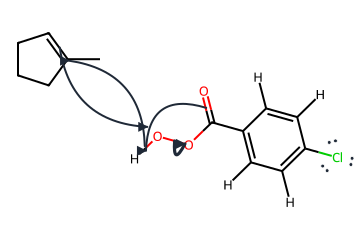
Curved-arrow description (all in one step): π(C=C) → Ot; σ(Ot–Oa) → Oa; lone pair on the carbonyl oxygen → H on Ot; σ(Ot–H) → the second alkene carbon. Products: the epoxide (oxygen originates from Ot) plus m‑chlorobenzoic acid. The process is stereospecific: cis alkenes give cis epoxides, and trans alkenes give trans epoxides.
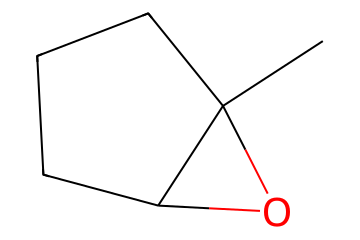
The resulting epoxide preserves the original alkene configuration and can be opened later under acidic, basic, or nucleophilic conditions.
Mechanistic Checklist (Exam Focus)
- Draw all four concerted arrows listed above; do not propose stepwise ionic or radical intermediates.
- Emphasize that proton transfer to the peracid carbonyl oxygen occurs within the same concerted step.
- Show that alkene geometry is retained in the product epoxide.
Worked Example — Epoxidation of an Electron-Poor Alkene
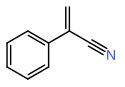
- Substrate: Cinnamylonitrile (trans-3-phenyl-2-propenenitrile; an α,β-unsaturated nitrile).
- Reagent: mCPBA (CH₂Cl₂, 0–25 °C).
- Pathway: The alkene undergoes the concerted Prilezhaev epoxidation without passing through a discrete carbocation; the reaction is slower than with electron-rich alkenes but still proceeds under standard peracid conditions.
- Outcome: Epoxide retaining the original E/Z geometry of the double bond.


When Multiple Alkenes Are Present
Peracid epoxidation occurs preferentially at the more electron-rich (often more substituted) or less hindered double bond. Use these electronic trends to predict chemoselectivity when several alkenes are present; mixtures can form if the electronics are similar.
Practical Tips & Pitfalls
- Solvent: CH₂Cl₂ (or similar). Keep conditions anhydrous to avoid premature epoxide openings.
- Temperature: 0–25 °C is typical.
- Workup: Wash the organic layer with aqueous NaHCO₃ to remove m‑chlorobenzoic acid.
- Safety: Peracids are strong oxidants; store cold, avoid metal contamination, and follow oxidizer handling protocols.
- Common errors: Drawing stepwise carbocations, losing stereochemical information, or forgetting that oxygen delivery is syn while alkene geometry is retained.
Exam-Style Summary
- Concerted Prilezhaev epoxidation of alkenes by peracids (e.g., mCPBA).
- Stereospecific: cis → cis epoxide; trans → trans epoxide.
- Selectivity trend: electron-rich alkenes epoxidize faster.
- No rearrangements because no carbocations are formed.
Interactive Toolbox
- Practice Prilezhaev epoxidations in the Reaction Solver (compare rates when multiple alkenes compete).
- Use the Mechanism Solver to drill the four-arrow concerted diagram for flashcards.
FAQ / Exam Notes
- Is the addition syn or anti? Both new C–O bonds form on the same face of the double bond (syn), and alkene geometry is retained (cis→cis, trans→trans).
- Which double bond reacts first? The more electron-rich one, typically the more substituted alkene.
- Will the epoxide open during workup? Keep conditions neutral/weakly basic and dry; otherwise epoxides can open under acid/wet conditions (see the epoxide-opening guides).