Kinetic vs Thermodynamic: 1,2 vs 1,4 Addition (RLi/RMgX)
Hard nucleophiles like organolithium reagents (RLi) and Grignard reagents (RMgX) can add to alpha,beta-unsaturated carbonyls (enones, enals) at either the carbonyl carbon (1,2-addition) or the beta-carbon (1,4-addition). Temperature controls which pathway dominates: cold conditions favor the kinetic product (1,2-addition), while heat favors the thermodynamic product (1,4-addition).
Quick Summary
- Reagents/conditions: RLi or RMgX with alpha,beta-unsaturated carbonyl; then H3O+ workup.
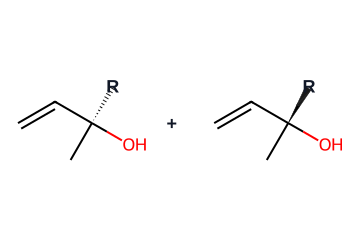
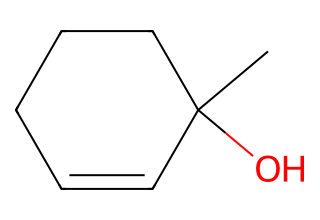
- Cold (kinetic): 1,2-addition to carbonyl C; product is an allylic alcohol (C=C preserved).
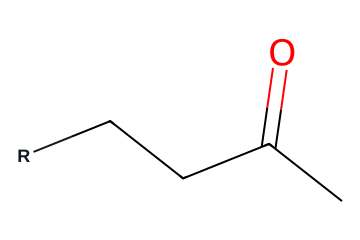
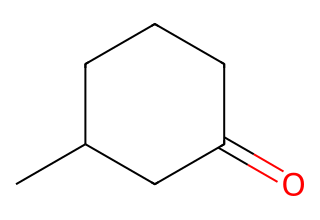
- Heat (thermodynamic): 1,4-addition to beta-C; product is a saturated carbonyl (C=C consumed).
- Key contrast: Cuprates (R2CuLi) always do 1,4-addition regardless of temperature; hard nucleophiles (RLi, RMgX) can do either, depending on conditions.
- Selectivity rule: Low temperature = fast, less stable product; high temperature = equilibration to more stable product.
1,2-Addition Mechanism (Cold, Kinetic Control)
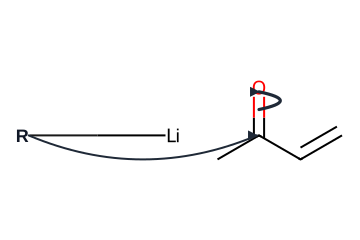
At low temperatures (-78 C to 0 C), the reaction is under kinetic control. The nucleophile attacks the more electrophilic carbonyl carbon directly, giving the 1,2-addition product (allylic alcohol).
Step 1 - Nucleophilic attack on carbonyl carbon
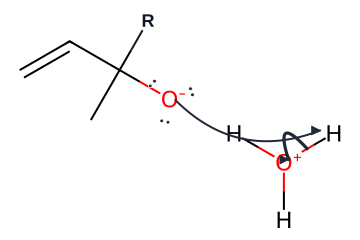
Step 2 - Aqueous workup (protonation)
Product - Allylic alcohol
1,4-Addition Mechanism (Heat, Thermodynamic Control)
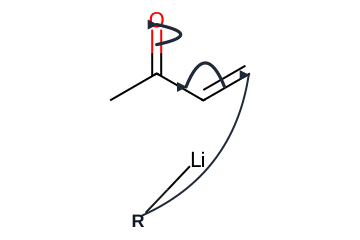
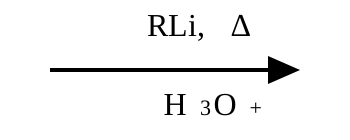
At elevated temperatures (reflux, heat), the reaction is under thermodynamic control. Even though 1,2-addition is faster, the system equilibrates to the more stable 1,4-addition product (saturated carbonyl).
Step 1 - Conjugate attack on beta-carbon
Step 2 - Enolate intermediate
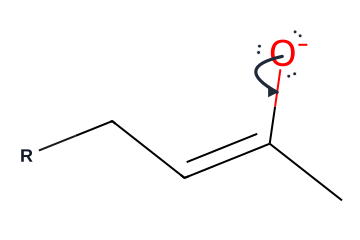
Step 3 - Aqueous workup (protonation at alpha-carbon)
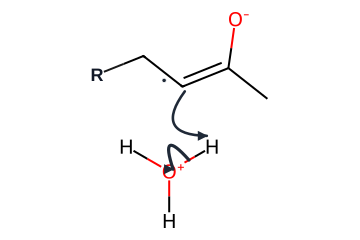
Product - Saturated carbonyl
Mechanistic Checklist (Exam Focus)
- Kinetic vs Thermodynamic: Cold = kinetic (1,2-addition, faster); Heat = thermodynamic (1,4-addition, more stable).
- Hard vs Soft nucleophiles: RLi and RMgX are hard nucleophiles that can do either 1,2 or 1,4 depending on temperature. R2CuLi (cuprates) are soft and always do 1,4.
- Product identification: 1,2 = allylic alcohol (C=C preserved); 1,4 = saturated carbonyl (C=C consumed).
- Enolate intermediate: 1,4-addition goes through an enolate that is protonated at the alpha-carbon.
- Reversibility: At high temperatures, the reaction can equilibrate; the thermodynamic product (1,4) is favored because the C=O is stronger than the C=C.
Worked Examples
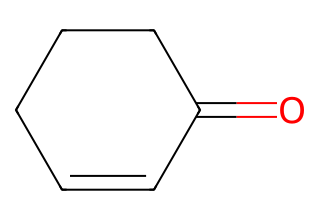
Reactant
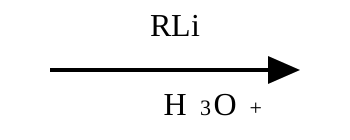
Reagent (Cold)
Product
Reactant
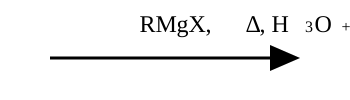
Reagent (Heat)
Product
Reactant
Reagent (Heat)
Product
Scope & Limitations
- Works well: Enones (alpha,beta-unsaturated ketones), enals (alpha,beta-unsaturated aldehydes), and some enoates.
- Best substrates: Simple enones like methyl vinyl ketone, cyclohexenone, chalcone.
- Reagent choice: Both RLi and RMgX show this temperature-dependent selectivity. Cuprates (R2CuLi) bypass this entirely and always give 1,4.
- Steric effects: Bulky R groups or hindered beta-carbons may favor 1,2-addition even at higher temperatures.
- Not this reaction: Simple (non-conjugated) aldehydes/ketones always give 1,2-addition regardless of temperature.
Edge Cases & Exam Traps
- Confusing selectivity with cuprates: R2CuLi always does 1,4 regardless of temperature. Only RLi/RMgX show temperature-dependent selectivity.
- Forgetting the enolate: In 1,4-addition, the immediate product is an enolate, not the final carbonyl. Workup is required.
- Wrong product structure: 1,2-product has R on the former carbonyl C with C=C intact; 1,4-product has R on beta-C with C=O restored.
- Assuming temperature is given: If a problem says "RMgX, cold" assume 1,2; if it says "RMgX, heat" or "RMgX, reflux" assume 1,4.
- Non-conjugated substrates: Temperature control only matters for conjugated systems. Simple carbonyls always do 1,2.
Practical Tips
- For 1,2-addition: Use RLi or RMgX at -78 C to 0 C in dry ether or THF.
- For 1,4-addition: Use RLi or RMgX at reflux/heat in ether or THF; alternatively, just use R2CuLi for guaranteed 1,4.
- Workup: Both pathways require aqueous acid (H3O+) to protonate the alkoxide or enolate.
- Solvent: Dry, anhydrous ether or THF is essential for both reactions.
- When in doubt: If you need guaranteed 1,4-addition, use cuprates. If you need 1,2, use cold conditions.
Exam-Style Summary
RLi/RMgX + alpha,beta-unsaturated carbonyl:
- Cold: 1,2-addition (kinetic) -> allylic alcohol (C=C preserved)
- Heat: 1,4-addition (thermodynamic) -> saturated carbonyl (C=C consumed)
Cuprates (R2CuLi) always give 1,4-addition regardless of temperature.
Related Reading
- Gilman (R2CuLi) 1,4-Addition to alpha,beta-Unsaturated Carbonyls - soft nucleophile that always does 1,4-addition.
- Aldehyde/Ketone to Alcohol with Grignard (RMgBr, then H3O+) - 1,2-addition to simple (non-conjugated) carbonyls.
Interactive Toolbox
- Mechanism Solver - choose the RLi, H3O+ (cold) or RLi, heat, H3O+ (heat) button to watch the RDKit-rendered addition steps.
- Reaction Solver - plug in an enone and select the appropriate reagent to preview the expected 1,2 or 1,4 outcome.
- IUPAC Namer - generate names for the reactants or products shown in the worked examples.
FAQ
Why does temperature control the outcome with RLi/RMgX but not with cuprates? RLi and RMgX are hard nucleophiles that can attack either site. At low temperatures, the faster (kinetic) pathway to the carbonyl carbon dominates. At high temperatures, the system equilibrates to the more stable (thermodynamic) 1,4-product. Cuprates are soft nucleophiles that inherently prefer the softer beta-carbon, so temperature doesn't change their selectivity.
Which product is more stable - 1,2 or 1,4? The 1,4-addition product is more stable because it retains the C=O double bond, which is stronger than the C=C double bond. The allylic alcohol (1,2-product) is higher in energy.
How do I know if I have a conjugated substrate? Look for C=C-C=O connectivity. The C=C must be directly adjacent to the C=O with a single bond between them (alpha,beta-unsaturation). Examples: cyclohexenone, methyl vinyl ketone, cinnamaldehyde.
Can I get mixtures of 1,2 and 1,4 products? Yes, especially at intermediate temperatures. For clean results, use very low temperatures for 1,2 or use cuprates for guaranteed 1,4.
Do aldehydes and ketones behave the same way? Yes, both alpha,beta-unsaturated aldehydes (enals) and ketones (enones) show this temperature-dependent selectivity with RLi/RMgX.