Alkyl Halide Reactions: Direct Amination with NH₃
Direct amination converts an alkyl halide (R–X) into a primary amine (R–NH₂) using ammonia as the nucleophile. The reaction follows an SN2 pathway: ammonia attacks the electrophilic carbon from the backside, displacing the halide with Walden inversion. The immediate product is an ammonium salt (R–NH₃⁺ X⁻), which is deprotonated by excess ammonia to yield the free amine.
For selective primary amine synthesis, the Gabriel synthesis (phthalimide route) or azide reduction (NaN₃ then LiAlH₄) are strongly preferred.
Quick Summary
- Synthetic utility: ⚠️ Poor method — use Gabriel synthesis or azide reduction instead.
- Mechanism class: Concerted SN2 backside displacement.
- Nucleophile: Ammonia (NH₃) — neutral, moderate nucleophile.
- Immediate product: Ammonium salt (R–NH₃⁺ X⁻).
- Final product: Mixture of primary (R–NH₂), secondary (R₂NH), tertiary (R₃N) amines and quaternary salts (R₄N⁺).
- Stereochemistry: Walden inversion at the reacting stereocenter.
- Substrate scope: Methyl > primary > secondary (limited); tertiary does not undergo SN2.
- Major problem: Over-alkylation — the amine product is a better nucleophile than NH₃ and reacts further.
Mechanism
The reaction proceeds in three stages:
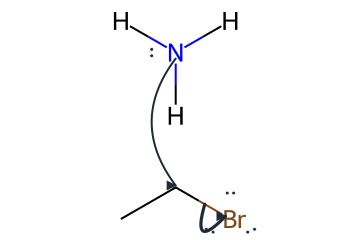
Step 1 — SN2 Attack
Ammonia approaches from the backside of the C–X bond. Its lone pair attacks the electrophilic carbon while the halide departs as X⁻. This is a concerted, single-step process with Walden inversion.
Step 2 — Deprotonation
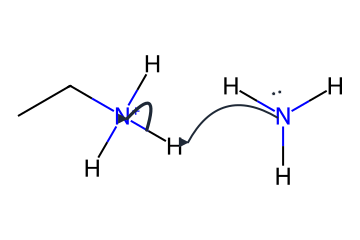
The immediate product is an ammonium cation (R–NH₃⁺). This is acidic and must be deprotonated. Excess ammonia acts as a base, abstracting a proton from the ammonium intermediate.
Product — Primary Amine
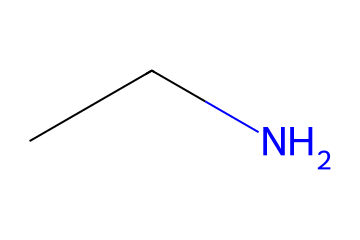
After deprotonation, the free primary amine (R–NH₂) is obtained with Walden inversion at the α-carbon.
The Over-Alkylation Problem
The primary amine product (R–NH₂) is actually a better nucleophile than the starting ammonia because alkyl groups are electron-donating. This means the product can react with another equivalent of alkyl halide:
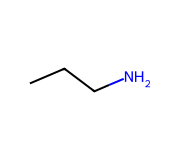
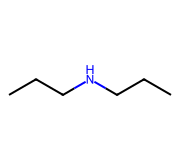
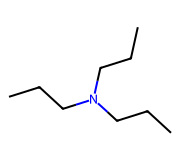
R–X + NH₃ → R–NH₂ (primary amine)
R–X + R–NH₂ → R₂NH (secondary amine)
R–X + R₂NH → R₃N (tertiary amine)
R–X + R₃N → R₄N⁺ X⁻ (quaternary ammonium salt)
Result: Even with excess ammonia, you often get a mixture of products rather than pure primary amine.
Solutions to Over-Alkylation
-
Use a large excess of ammonia — Statistically favors the first substitution, but mixtures still occur.
-
Gabriel synthesis — Uses potassium phthalimide as a protected nitrogen source. After SN2 alkylation, hydrazinolysis releases a pure primary amine. See the Gabriel Synthesis guide.
-
Azide reduction — React R–X with NaN₃ to form an alkyl azide (R–N₃), then reduce to the amine (e.g., with LiAlH₄ or catalytic hydrogenation). Azide cannot over-alkylate.
-
Reductive amination — For aldehydes/ketones, reductive amination with NH₃/NaBH₃CN gives controlled amine formation.
Worked Examples
Example 1: Methyl Iodide + NH₃
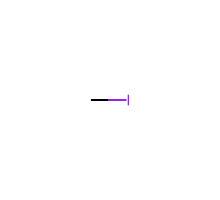

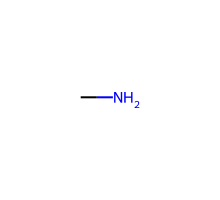
Methyl halides are the fastest SN2 substrates. With excess NH₃, methylamine is the major product, but dimethylamine and trimethylamine are also formed.
Example 2: 1-Bromobutane + NH₃
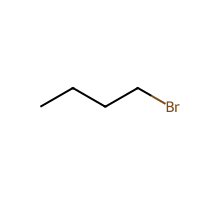
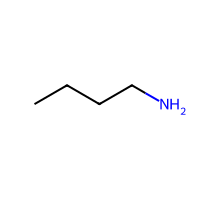
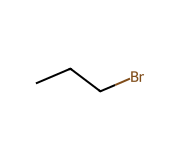
Primary halides react well via SN2. The product mixture includes butylamine, dibutylamine, and tributylamine.
Example 3: Benzyl Chloride + NH₃
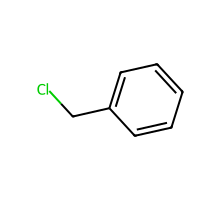
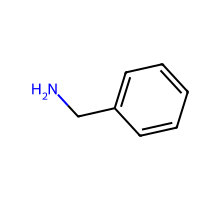
Benzylic halides are excellent SN2 substrates due to resonance stabilization of the transition state.
Scope & Limitations
| Substrate Type | SN2 Rate | Notes |
|---|---|---|
| Methyl | Excellent | Fastest; some over-alkylation |
| Primary | Good | Standard SN2 |
| Secondary | Slow | E2 competition; poor yields |
| Tertiary | None | SN2 forbidden |
| Allylic | Excellent | May show SN2′ |
| Benzylic | Excellent | Resonance-stabilized TS |
| Neopentyl | Very slow | Steric hindrance |
Tertiary halides + NH₃ → E2 elimination (alkene), not amination. The backside attack required for SN2 is completely blocked by the three substituents. NH₃ acts as a base instead, abstracting a β-hydrogen to give an alkene via E2.
Secondary halides + NH₃ → Slow SN2 with significant E2 competition. Poor yields of amine; often get mixtures of amine + alkene. Not a practical synthetic method.
If you see tertiary halide + NH₃ on an exam, predict elimination (Zaitsev alkene), not substitution!
Leaving groups: I > Br > Cl >> F (fluoride too strong a bond for SN2)
Solvents: Polar protic solvents (alcohols, water) or liquid ammonia are typically used. The reaction can also be run in sealed tubes under pressure.
Practical Tips & Pitfalls
-
Expect mixtures — Unless you use Gabriel synthesis or azide/reduction, direct amination rarely gives pure primary amine.
-
Use excess NH₃ — A large excess (5–10 equivalents) shifts equilibrium toward the primary amine, but doesn't eliminate over-alkylation entirely.
-
Sealed tubes/pressure — NH₃ boils at −33 °C, so reactions are often run in sealed vessels or with ammonia dissolved in alcohol.
-
Avoid secondary halides — E2 elimination competes strongly; yields are poor.
-
Consider alternatives — For clean primary amine synthesis:
- Gabriel synthesis (phthalimide route)
- Azide substitution + reduction
- Reductive amination (for carbonyls)
-
Quaternary salts are useful — If you intentionally want R₄N⁺ X⁻ (e.g., phase-transfer catalysts), direct alkylation is the way to go.
Exam-Style Summary
Direct amination of alkyl halides with ammonia proceeds via SN2 for methyl and primary substrates. Ammonia attacks from the backside, displacing the halide with inversion. The immediate product is an ammonium salt, which excess ammonia deprotonates to give the primary amine.
Key pitfalls to remember:
- Over-alkylation — The amine product is a better nucleophile than NH₃ and reacts further, giving mixtures of 1°, 2°, 3° amines and quaternary salts.
- Tertiary halides — SN2 is impossible; predict E2 elimination (Zaitsev alkene) instead.
- Secondary halides — E2 competes strongly; expect poor yields.
- Neopentyl halides — Extremely slow due to steric hindrance, despite being "primary."
For selective primary amine synthesis, Gabriel synthesis or azide reduction are preferred.
Other Niche Cases
- Vinyl halides (C=C–X): Cannot undergo SN2 — the sp² carbon is not electrophilic in the right geometry.
- Aryl halides: Require SNAr mechanism with electron-withdrawing groups (see Meisenheimer complex).
- Allylic halides: Fast SN2; may also show SN2′ (attack at the γ-carbon with double bond migration).
Interactive Toolbox
- Mechanism Solver — draw an alkyl halide and select NH₃. Primary halides show SN2 amination; tertiary halides automatically show E2 elimination.
- Reaction Solver — predict products from substrates and reagents.
- IUPAC Namer — practice naming amines.