Alkyl Halide Reactions: Generic SN2 (NaOCH3 / NaOEt / NaOH / NaSH / NaSR)
This guide covers concerted SN2 substitution on alkyl halides (R–X; X = Cl, Br, I) with NaOCH₃, NaOEt, NaOH, NaSH, and NaSR, plus cyanide, azide and iodide examples. Backside attack and leaving-group departure occur in one step through a single transition state, with inversion when the reacting carbon is stereogenic. Unhindered primary substrates generally react readily; secondary substrates face more elimination competition, and tertiary substrates do not undergo ordinary SN2. Allylic halides can also give SN2′ substitution with double-bond migration; benzylic substrates can undergo rapid substitution but are not generically SN2′ cases.
Quick Summary
- Mechanism class: Concerted SN2 backside displacement (single transition state, no carbocation).
- Stereochemistry: Walden inversion at the reacting stereocenter.
- Substrate scope: Methyl ≫ primary > secondary (condition-dependent); tertiary ≠ SN2. Allylic/benzylic excellent; beware neopentyl slowdown.
- Leaving group hierarchy: I > Br ≫ Cl ≫ F; sulfonates (OTs/OMs/OTf) behave like superb halides.
- Solvent: Polar aprotic (DMSO, DMF, MeCN, acetone) accelerates SN2; protic solvents solvate anions and can slow SN2; SN1/E1 also require a substrate capable of ionization.
- Competition: Strong bases + heat push E2; ionizing media favor SN1/E1. NaSH/NaSR usually reduce E2 competition because they are less basic than alkoxides.
Mechanism (Shared SN2 Template)
Each reagent is illustrated in two panels: the concerted electron flow and the resulting product. The panels do not represent separate elementary steps.
- Backside attack & leaving-group departure – Nu⁻ attacks anti to the C–X bond while the leaving group departs in the same step (single concerted event).
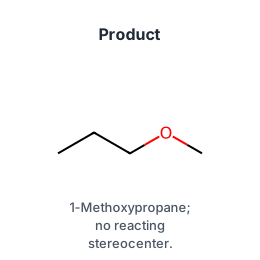
Illustration: /assets/reaction-library/alkyl-halide-sn2-naome/alkyl-halide-sn2-naome-step-01.svg - Product – Only the substituted product is shown; the halide is omitted. Inversion is observable when substitution occurs at a stereogenic carbon; an attacked CH₂ or a carbon with two identical groups is not a stereocenter.
Illustration: /assets/reaction-library/alkyl-halide-sn2-naome/alkyl-halide-sn2-naome-step-02.svg
NaOEt (Δ) reminder: Heating with a strong alkoxide can increase elimination competition; emphasize temperature control when you prefer substitution.
Allylic option: Allylic halides can access SN2′ pathways with double-bond migration.
Reagent-specific steps
The figures below show the nucleophile and product for each reagent. All illustrate the same concerted SN2 electron flow.
NaOCH₃ (primary SN2)


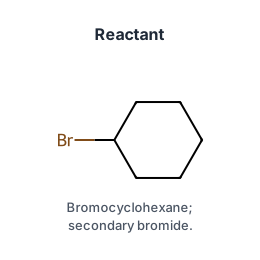
NaOEt (secondary SN2 with E2 risk)


NaOH (aqueous substitution)


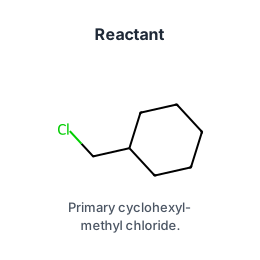
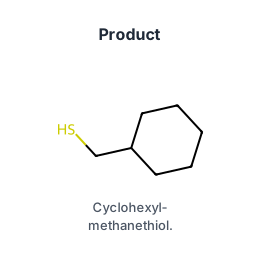
NaSH (thiol formation)


NaSR (generic thiolate)


NaCN (ambident substitution)


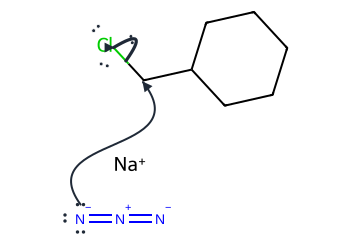
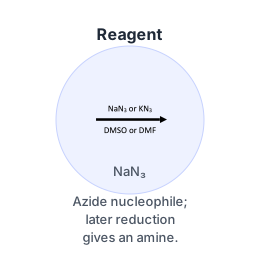
NaN₃ (latent amine handle)

NaI (acetone) — halide exchange


- Draw a single step illustration: Nu⁻ arrow into Cα, Cα–X bond pushing electrons onto X.
- At a stereogenic reacting carbon, show inversion with the appropriate wedge/dash; do not assign inversion to an achiral CH₂.
- Unhindered primary halides often react readily; secondary require careful solvent/temperature; tertiary cannot do SN2.
- Polar aprotic solvents accelerate substitution; protic solvents can slow anionic SN2; SN1/E1 require suitable ionization-prone substrates.
- Allylic halides may give SN2′ products; the ratio depends on the nucleophile, substrate and conditions. Benzylic substitution is a separate case.
- Strong base plus heat (as with NaOEt under reflux) raises the chance of E2; less basic nucleophiles such as NaSH, NaSR, NaCN and NaN₃ often favor substitution on accessible substrates.
- Halide exchange with iodide (NaI in acetone) upgrades sluggish chlorides or bromides before further transformations.
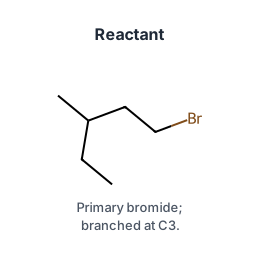
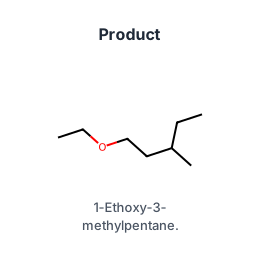
Worked Examples




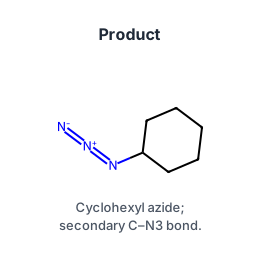
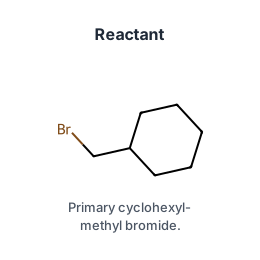

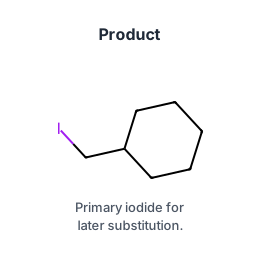
Scope & Limitations
- Best substrates: Methyl, unhindered primary, benzylic, allylic. Secondary workable with control.
- Poor substrates: Tertiary (SN2 forbidden), heavily β-branched, neopentyl (extremely slow).
- Leaving groups: I > Br ≫ Cl; convert chlorides to bromides/iodides first if necessary.
- Nucleophile strength & basicity:
- Alkoxides/hydroxide: strong nucleophiles, strong bases → E2 competition rises with temperature.
- Hydrosulfide/thiolates: good nucleophiles, less basic than alkoxides → often favor SN2 on accessible substrates.
- Solvents: Polar aprotic accelerate SN2; protic solvents solvate anionic nucleophiles; competition also depends on substrate and basicity.
- Allylic/benzylic: Rapid SN2; note potential SN2′ (allylic) or SN1 (benzylic in protic solvent).
- Vinyl/aryl halides: Do not undergo ordinary SN2 at sp² carbon.
Practical Tips & Pitfalls
- Cool, polar aprotic conditions can favor substitution on suitable secondary halides, but solvent and temperature do not remove E2 competition from strong bases.
- Label inversion explicitly for stereochemical questions.
- For NaOEt/heat, assess the substrate and β-hydrogens: heating can increase E2 competition but is not an elimination-only switch.
- NaSH/NaSR solutions smell; mention lab safety (closed setups, proper waste).
- Alkoxide reactions often use dry apparatus and solvent. Water changes alkoxide/hydroxide speciation and solvation; it does not remove all nucleophilicity.
- Neopentyl substrates remain strongly hindered even with a better leaving group; changing to a sulfonate does not remove the β-branching.
- A suitable halide exchange, such as NaI in acetone, can replace a chloride or bromide; account for the substrate and salt solubility.
Exam-Style Summary
SN2 on alkyl halides is a one-step backside displacement that inverts configuration at a stereogenic reacting carbon. Methyl and unhindered primary substrates generally react readily; secondary depend on solvent, base strength, and temperature; tertiary do not undergo SN2. NaOEt can promote E2, including without heating; NaSH/NaSR are less basic and often favor substitution on accessible substrates. Draw the single concerted arrow push, mark inversion, and comment on competing pathways.
Interactive Toolbox
- Mechanism Solver — try this example with 1-bromopropane and NaOCH₃, or explore reaction mechanisms.
- Reaction Solver — explore reaction predictions for alkyl halides.
- IUPAC Namer — practice naming ethers, alcohols, thioethers, and azides produced by these substitutions.
Related Reading
- Alkyl Halide Reactions: Generic SN1 Solvolysis — carbocation capture by H₂O/ROH/AgNO₃.
- Alkyl Halide Reactions: E1 Elimination via Hot Solvolysis — β-deprotonation after ionization.
- Alkyl Halide Reactions: E2 Zaitsev (Strong, Small Bases) — small, strong bases favor internal alkenes.
- Alkyl Halide Reactions: E2 Hofmann (Bulky Bases) — bulky bases favor terminal alkenes.