Hofmann Rearrangement: Primary Amide → Primary Amine (Br₂/NaOH)
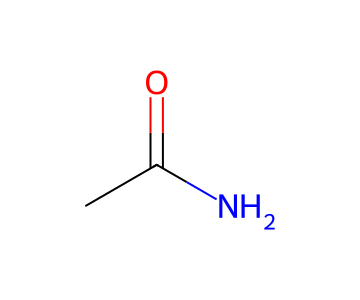
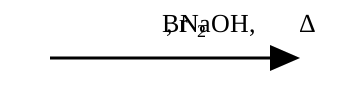
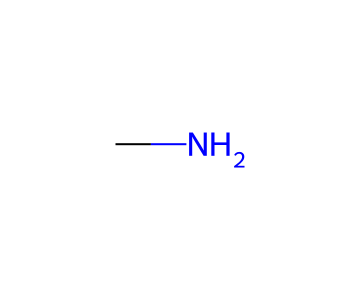
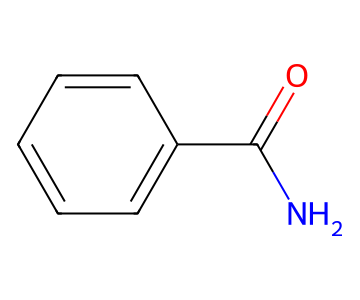
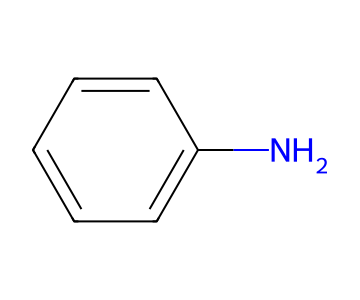
The Hofmann rearrangement (or Hofmann degradation) converts a primary amide into a primary amine with one fewer carbon using Br2/NaOH (or Cl2/NaOH). The carbonyl carbon is lost as CO2, and the R group migrates from the carbonyl carbon to nitrogen via an isocyanate intermediate.
Overall: R-C(=O)-NH2 + Br2/NaOH --> R-NH2 + CO2
Key Emphasis (Teaching Pivots)
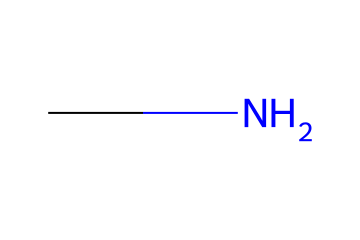
- One fewer carbon. The product amine has one fewer carbon than the starting amide. The carbonyl carbon is lost as CO2.
- Primary amides only. The reaction requires a primary amide (RCONH2). N-substituted amides do not undergo this rearrangement.
- Isocyanate intermediate. The key intermediate is an isocyanate (R-N=C=O), formed by 1,2-migration of R from carbonyl to nitrogen.
- Migration with retention. If the migrating carbon is stereogenic, it typically retains configuration during migration.
- Don't confuse with LiAlH4 reduction. LiAlH4 reduces amides to amines but preserves all carbons. Hofmann removes one carbon.
Quick Summary
What "moves" in the rearrangement
- The R group migrates from the carbonyl carbon to the nitrogen (1,2-shift).
- The migrating group keeps its configuration if it's a chiral carbon (stereoretentive migration).
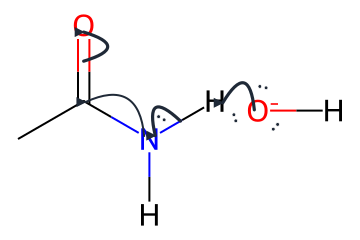
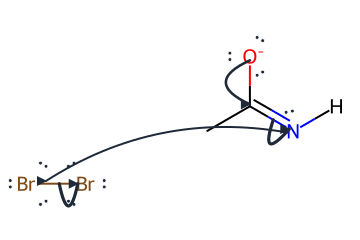
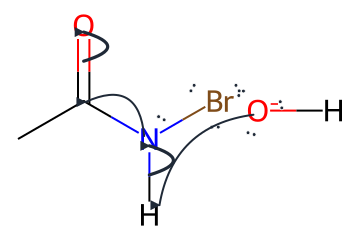
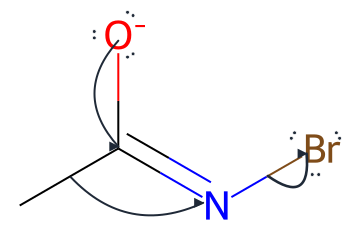
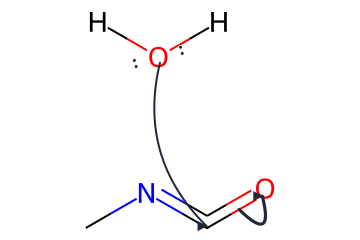
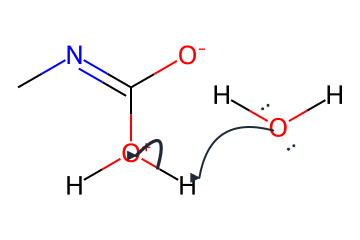
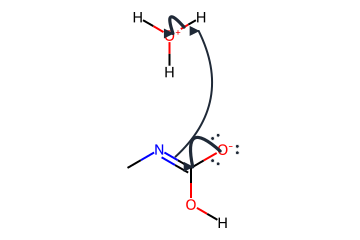
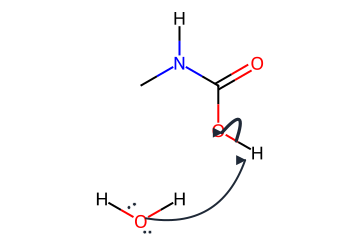
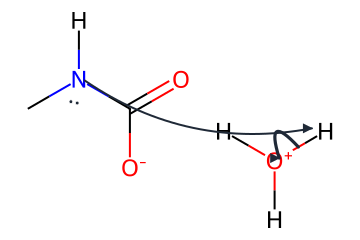
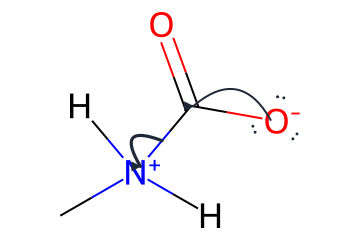
Mechanism - Hofmann Rearrangement (11 Steps)
Conditions: Br2, NaOH (aq), heat
The mechanism proceeds through: (1) N-halogenation to form N-bromoamide, (2) rearrangement to an isocyanate intermediate, and (3) hydrolysis followed by decarboxylation to give the amine product.
Worked Examples
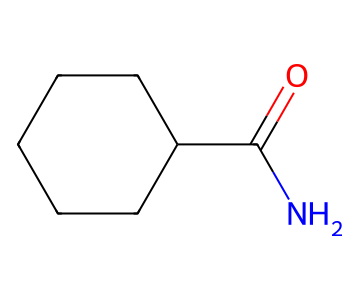
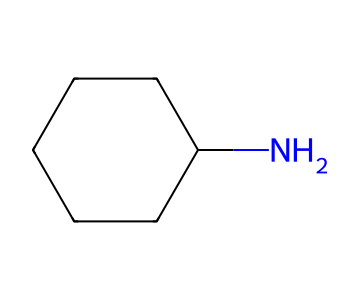
Scope & Limitations
- Primary amides only. Secondary and tertiary amides do not undergo this rearrangement (they lack the required N-H protons).
- Basic/oxidizing conditions. The reaction uses strong base (NaOH) and oxidizing halogen (Br2). Acid-labile groups survive, but base-sensitive groups may react.
- Lactams. Cyclic amides (lactams) can rearrange to give ring-contracted amines (one fewer carbon in the ring).
- Migration stereochemistry. If the migrating carbon is a stereocenter, it typically migrates with retention of configuration.
- Cl2/NaOH alternative. Chlorine can be used instead of bromine; the mechanism is the same.
Edge Cases & Exam Traps
1) "One fewer carbon" is the key trap
Students often draw RCONH2 --> RCH2NH2 (that's LiAlH4 reduction logic, not Hofmann). Hofmann rearrangement removes the carbonyl carbon: RCONH2 --> RNH2.
2) Migration stereochemistry
If the migrating carbon is stereogenic, the migration is typically retention (the carbon migrates as a group, not via a planar carbocation).
3) Cyclic amides (lactams) give ring contraction
A lactam can rearrange to give a ring-contracted amine (one fewer carbon in the ring). If you see a lactam + Br2/NaOH, expect a smaller ring amine.
4) Not the right reagent for N-substituted amides
If the amide is secondary or tertiary (N-substituted), expect no Hofmann product. The reaction requires two N-H protons.
5) Don't confuse with Curtius or Schmidt rearrangements
These other rearrangements also convert acyl compounds to amines via isocyanates, but use different starting materials (acyl azides for Curtius, carboxylic acids + HN3 for Schmidt).
Product Prediction Checklist
- Confirm primary amide: The substrate must be RCONH2.
- Delete the carbonyl carbon: Product skeleton is R-NH2.
- CO2 is the "lost carbon" (conceptually).
- Check for lactams: If cyclic, expect ring contraction.
- Check for stereocenters: Migration is typically stereoretentive.
Exam-Style Summary
- Substrate: Primary amide (RCONH2) only
- Reagents: Br2/NaOH (or Cl2/NaOH), heat
- Product: Primary amine with one fewer carbon
- Key intermediate: Isocyanate (R-N=C=O)
- Byproduct: CO2 (the carbonyl carbon)
- Mechanism: 11 steps via N-bromination, rearrangement to isocyanate, hydrolysis, and decarboxylation
- Common trap: Don't confuse with LiAlH4 reduction (which preserves all carbons)
Interactive Toolbox
- Mechanism Solver - Enter any primary amide and see the full Hofmann rearrangement mechanism.
- Reaction Solver - Predict the amine product from any primary amide.
- IUPAC Namer - Name your starting amides and product amines.