Aromatic Reactions: Birch Reduction (Na / NH₃(l) / ROH)
Birch reduction is a dissolving-metal reduction that converts an aromatic ring into a 1,4-cyclohexadiene using an alkali metal (Na, Li, or K) in liquid ammonia with a proton source (ROH). Net result: the arene gains two electrons and two protons, but stops at the nonconjugated diene rather than going all the way to cyclohexane under typical conditions.
Quick Summary
What it does
- Transforms: Ar–H → 1,4-cyclohexadiene (partial reduction of the aromatic ring)
- Reagent set: Na / NH₃(l) / ROH (also Li or K; ROH often EtOH or t-BuOH)
- Reaction class: dissolving-metal reduction (stepwise e⁻ / H⁺ additions)
Net change (high-yield mental model)
- Add 2 electrons + 2 protons to the ring.
- Aromaticity is lost, but the product is an unconjugated (1,4) diene under typical Birch conditions.
Viability and Exam Traps
Birch conditions are strongly reducing. Whether you get "clean Birch on the ring" depends on what else is present.
Common "this won't behave like a normal Birch" flags
- Nitro (–NO₂): often reduced under dissolving-metal conditions (so "Birch on the ring" is not the dominant storyline in many course problems).
- Easily reduced functional groups (course-level warning): nitro and some carbonyl-type situations can compete or change the outcome.
- No effective proton source: the electron-transfer steps can occur, but without controlled protonation the intended sequence stalls or diverges.
What is not a "blocking group" (but does change regiochemistry)
- Many electron-withdrawing substituents (e.g., esters) do not "shut off" Birch; they primarily control where the new hydrogens land.
Mechanism — Standard (5 Steps)
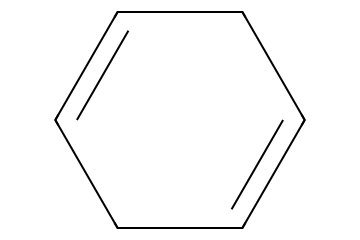
The canonical Birch mechanism is e⁻ → H⁺ → e⁻ → H⁺ → product (benzene → radical anion → protonation → second SET → final protonation → 1,4-cyclohexadiene).
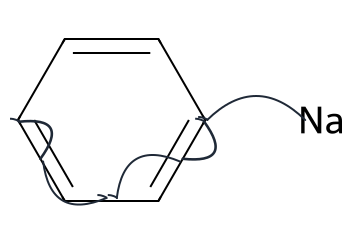
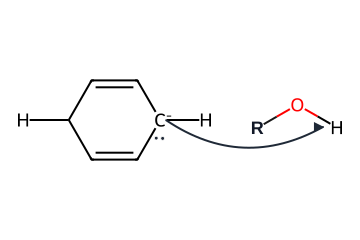
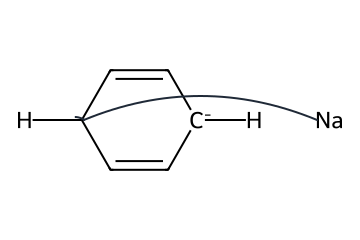
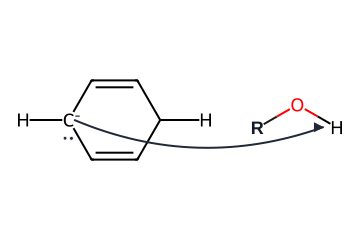
Regiochemistry Rules (EDG vs EWG)
For substituted aromatic rings, Birch regiochemistry is best predicted by where protonation occurs in the radical anion / anion intermediates. At the exam level, use the following rule set:
Rule A — Electron-withdrawing groups (EWG)
EWG promote ipso/para reduction. Meaning: new hydrogens tend to add at the ipso carbon (bearing the substituent) and the para carbon (relative to that substituent). In the product, the double bonds end up away from ipso/para (commonly at the 2–3 and 5–6 positions if you number the substituent as C1).
Typical EWG (course-level): carbonyl-derived substituents and related groups (e.g., –CO₂R, –COR, –CONR₂, –CN).
Rule B — Electron-donating groups (EDG)
EDG promote ortho/meta reduction. Meaning: new hydrogens tend to add at the ortho and meta positions. In the product, the ipso carbon is commonly left sp² (part of a remaining double bond).
Typical EDG: alkyl, –OR, –NR₂ (note: anilines have special behavior; see fringe cases).
Practical shortcut (what many students actually draw)
- EWG: substituent-bearing carbon is often reduced (sp³) in the Birch product.
- EDG: substituent-bearing carbon is often not reduced (sp²) in the Birch product.
Fringe Exam Cases
1) Anilines don't "stay Birch-clean"
Amines can lead to isomerization during the reaction, and the outcome can shift toward conjugated diene products rather than the standard unconjugated Birch diene. If you see an aniline (–NH₂, –NHR, –NR₂), treat "conjugation scrambling" as a realistic exam twist.
2) Nitrobenzene is a classic "not a Birch-on-the-ring" substrate
Nitro groups are commonly reduced under dissolving-metal conditions, so problems may expect nitro reduction to dominate rather than selective aromatic-ring Birch reduction.
3) "Where did the conjugated diene come from?"
Even when Birch gives the unconjugated diene, it can be isomerized to a conjugated diene under acidic conditions. If a problem shows acid after Birch, expect possible double-bond migration into conjugation.
4) Polycyclic aromatics can behave differently
Fused aromatics (e.g., naphthalene) are often easier to reduce than benzene and may show ring selectivity or deeper reduction patterns, depending on conditions and course scope.
Worked Examples
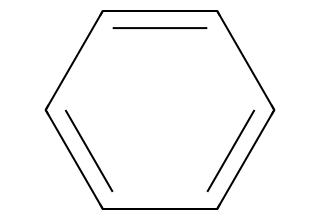
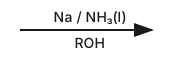
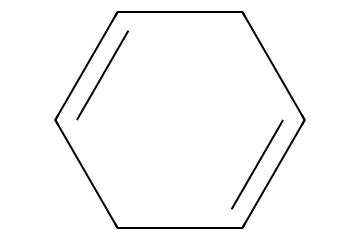
The baseline Birch: benzene is partially reduced to the unconjugated 1,4-cyclohexadiene.
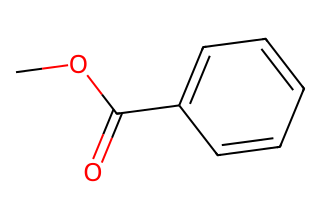
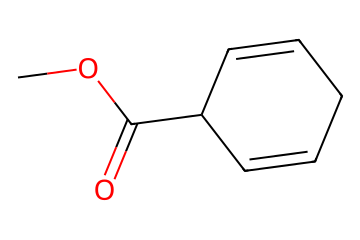
EWG rule: The ester withdraws electrons; ipso and para carbons are reduced. Double bonds remain at C2–C3 and C5–C6.
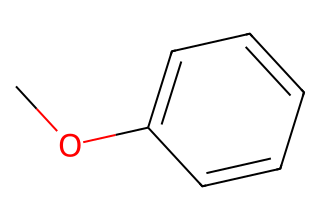
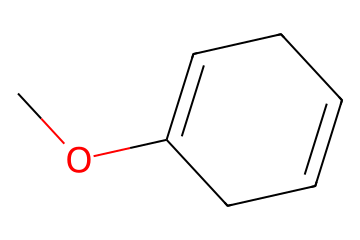
EDG rule: The methoxy group donates electrons; ortho and meta carbons are reduced. The ipso carbon remains sp² (part of a double bond).
Product Prediction Checklist
- Scan for "will Birch be selective?"
- Nitro present? Expect competing reduction.
- No proton source? The intended sequence is compromised.
- Identify the strongest substituent effect on the ring
- Classify major substituent as EWG or EDG.
- Apply Birch regiochemistry
- EWG: ipso/para reduction favored.
- EDG: ortho/meta reduction favored.
- Draw the 1,4-diene
- Make sure the final product is the unconjugated Birch diene unless the problem explicitly drives isomerization.
- Check for special twists
- Anilines: expect isomerization behavior to appear in some curricula.
- Acid after Birch: possible double-bond migration into conjugation.
Exam Summary
- Birch reduction partially reduces aromatic rings to 1,4-cyclohexadienes under Na/NH₃/ROH conditions.
- Mechanism is stepwise: SET → protonation → SET → protonation.
- Regiochemistry depends on substituents:
- EWG: ipso/para reduction
- EDG: ortho/meta reduction
- Fringe cases to watch:
- Nitro groups often get reduced (selectivity shifts).
- Anilines can give conjugated products due to isomerization.
- Acid workups can isomerize the unconjugated Birch diene.
Interactive Toolbox
- Mechanism Solver — Step through the e⁻/H⁺/e⁻/H⁺ sequence with different substrates and see how substituents affect regiochemistry.
- Reaction Solver — Predict Birch reduction products for substituted arenes and verify EDG vs EWG patterns.
- IUPAC Namer — Practice naming cyclohexadiene products with correct locant placement.