Aromatic Reactions: Kolbe–Schmitt Carboxylation of Phenols
The Kolbe–Schmitt reaction converts phenols into hydroxybenzoic acids by deprotonating the phenol, pushing CO₂ into the activated ring at ortho and/or para positions under heat/pressure, rearomatizing under basic conditions, and finally protonating every oxygen during acidic workup. Classic NaOH/CO₂ conditions favor salicylic acid, while blocking groups, potassium cations, or hotter profiles bias para. Because the electrophile is CO₂ (not a carbocation), no rearrangements occur; orientation is controlled entirely by the phenoxide ion pair and any pre-existing substituents.
Key Emphasis (Teaching Pivots)
- Activation first: Phenol must be deprotonated to the phenoxide/alkali-metal ion pair before CO₂ insertion is feasible.
- CO₂ is the electrophile: The aryl carbon donates into CO₂ (no carbocation); the σ-complex is purely polar.
- Ortho vs para control: Na⁺ plus moderate T pushes ortho; bulkier cations, hotter/longer profiles, or ortho blocking boost para.
- Rearomatization/base relay: Phenoxide (or another base) removes the benzylic proton to reform the aromatic system while leaving a carboxylate salt.
- Acidic workup is mandatory: Both the phenoxide and the carboxylate must be protonated to isolate hydroxybenzoic acids.
Quick Summary
- Reagents/conditions: NaOH or KOH (dry) → phenoxide; CO₂ (several bar, 100–170 °C) → σ-complex; aqueous acid workup → hydroxybenzoic acids.
- Outcome: o-Hydroxybenzoic acid (salicylic acid) dominates for free ortho positions; para product grows if ortho sites are blocked or K⁺/higher T is used.
- Mechanism: Base deprotonation → CO₂ attack (σ-complex) → base-assisted rearomatization → protonate both oxygens on workup.
- Orientation knobs: Metal cation, temperature/pressure profile, and steric blocking near ortho positions.
- Common pitfalls: Forgetting to form phenoxide, drawing carbocation-style intermediates, or omitting the final protonations.
Mechanism — Kolbe–Schmitt (5 Frames)


Mechanistic Checklist
- Start from phenoxide (show the base removing the phenolic proton).
- Depict CO₂ insertion at ortho/para, not O-carboxylation.
- Include the σ-complex and base-assisted rearomatization step.
- Finish with protonation of both the phenoxide and the carboxylate.
- Mention the selectivity knobs (cation, temperature/pressure, blocking groups).
Worked Examples
1. Phenol → Salicylic Acid (major) + p-Hydroxybenzoic Acid (minor)

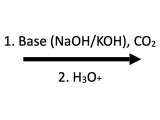
Classic Kolbe–Schmitt conditions (NaOH → CO₂, 100–150 °C, pressure) furnish salicylic acid predominantly, with a para co-product.
2. o-Methylphenol (one ortho blocked) → Para-biased product


Blocking one ortho site pushes CO₂ to the para position, boosting the p-isomer at the expense of salicylic acid.
3. 2,6-Dimethylphenol (both ortho blocked) → Para only


With both ortho sites blocked, para is the sole accessible site—exactly what the router enforces.
4. 3,5-Dimethylphenol → Single accessible site


Only one para site is open, so the router funnels CO₂ there—useful when teaching steric gating.
5. Potassium Phenoxide + Higher T → Para-leaning mixture


Bulkier cations plus higher temperature bias para even without steric blocks—handy for process knobs questions.
Scope & Limitations
- Substrates: Phenols and phenoxide salts; aromatic rings must retain at least one ortho/para hydrogen.
- Selectivity tuning: Na⁺ + 120–140 °C → ortho; K⁺/Rb⁺, 150 °C+, or bulky ortho substituents → para.
- Functional tolerance: Strongly deactivating groups (–NO₂, –CF₃, –SO₃H) slow or halt the sequence. Protect amines/alcohols that would be protonated or destroyed under base/heat.
- Steric blocking: Two ortho blocks enforce para; one block makes para competitive; para block (e.g., p-cresol) funnels reaction to the remaining ortho slot.
- Process constraints: Requires dry base, pressure-rated CO₂ equipment, and carefully staged acid workup.
Edge Cases & Exam Traps
- Forgetting phenoxide formation → no carboxylation.
- Drawing a carbocation intermediate → incorrect (CO₂ is electrophile; ring is nucleophile).
- Claiming ortho attack after both ortho sites are blocked.
- Skipping acid workup → leaves salts (ArO⁻/ArCO₂⁻) rather than the named hydroxybenzoic acids.
- Assuming para is always minor: with K⁺ or strongly hindered ortho sites, para can dominate.
Practical Tips
- Dry the phenoxide salt and purge moisture before charging with CO₂.
- Pre-pressurize with CO₂ before heating to avoid solvent bumping.
- Monitor ortho/para ratio by NMR (intramolecular H-bond of salicylic acid gives a diagnostic downfield OH).
- Cool and depressurize before acidifying; then protonate both oxygens with mineral acid to ensure neutral product isolation.
Exam-Style Summary
Phenol + strong base → phenoxide. The ring carbon donates into CO₂ to give an ortho/para σ-complex. Base removes the adjacent proton to restore aromaticity, leaving an aryl carboxylate salt. Acidic workup protonates both oxygens to release salicylic acid (ortho) and/or p-hydroxybenzoic acid. Ortho is favored under Na⁺/moderate T; para grows when ortho is blocked or when hotter K⁺ conditions are used. No rearrangements or carbocations are involved.
Interactive Toolbox
- Use Mechanism Solver to step through phenoxide activation, CO₂ insertion, base-induced rearomatization, and acid workup with tunable cation/temperature controls.
- Use Reaction Solver to predict whether ortho, para, or “no reaction” is routed for a given phenol, including warnings for deactivation or blocked sites.
- Use IUPAC Namer to confirm names such as 2-hydroxybenzoic acid, 4-hydroxybenzoic acid, or p-hydroxy-3,5-dimethylbenzoic acid.