Esters + NaOR: Transesterification vs Claisen
NaOR reagents toggle between two archetypal ester pathways:
- Base-catalyzed transesterification (OR swap): catalytic NaOR in the matching ROH swaps –OR′ for –OR without forming new C–C bonds. Equilibrium-driven; push with excess ROH or removal of R′OH.
- Claisen condensation (β-keto ester formation): stoichiometric NaOR (OR matches the ester’s leaving group), normally requires at least two α-H on the enolate donor in the classic NaOR reaction, and ends as an enolate until H₃O⁺ workup delivers the β-dicarbonyl product.
Exam pivots: Match OR for Claisen to avoid scrambling, remember the Claisen enolate consumes base until quench, and treat transesterification as an equilibrium process controlled by Le Châtelier (excess ROH or distilling R′OH).
The key distinction is the role of alkoxide: nucleophilic acyl substitution exchanges OR groups, while enolate formation enables the carbon–carbon bond formation of Claisen condensation.
Seafoam teal Color 1 (RGB 93,190,197; hex #5DBEC5) highlights selected groups in the worked examples. In transesterification it tracks the incoming OR group; in the Claisen product it highlights the β-dicarbonyl arm, not atoms supplied by the base.
Quick Summary
| Pathway | Conditions | Outcome |
|---|---|---|
| Transesterification | Cat. NaOMe/MeOH or NaOEt/EtOH, excess ROH, rt–reflux. | OR′ exchange only (R′COOR″ → R′COOR). Equilibrium; no net C–C change. |
| Claisen condensation | ≥1 eq NaOR (OR matches ester OR′), an ester donor with at least two α-H, ROH solvent, then H₃O⁺. | β-keto ester (or cyclic Dieckmann) plus expulsion of OR′. Product deprotonation drives equilibrium; matching OR minimizes exchange. |
Mechanism — Path A: Transesterification
Transesterification is catalytic in base and reversible.
- RO⁻ attack: NaOR (dissolved in its matching ROH) adds to the ester carbonyl to form a tetrahedral alkoxide.
- Collapse: The carbonyl reforms and expels the original OR″ as R″O⁻.
- Catalyst regeneration: Proton transfers between ROH and R″O⁻ regenerate RO⁻. Drive the equilibrium with excess ROH or by removing R″OH.
Keep NaOR loadings catalytic (≈5–10 mol%) and maintain anhydrous conditions to avoid saponification.
Mechanism — Path B: Claisen Condensation
The classic NaOR Claisen uses stoichiometric base and normally an ester donor with at least two α-hydrogens, so the β-keto ester can lose its remaining central proton. This product deprotonation drives the equilibrium and leaves an enolate until workup.
- Enolate formation: NaOR reversibly deprotonates the ester α-carbon, giving a small equilibrium population of enolate.
- C–C bond formation: The enolate attacks a second ester, creating a tetrahedral adduct.
- Collapse and product deprotonation: O⁻ collapses back to C=O and expels the electrophile ester’s OR group. Base then removes the highly acidic proton between the two product carbonyls, giving the enolate that drives the equilibrium.
- Acidic workup: H₃O⁺ protonates the β-dicarbonyl enolate to give the neutral β-keto ester (or cyclic Dieckmann product) with the full electrophile carbon chain.
Dieckmann condensation follows the same logic intramolecularly.
Step-by-Step Comparison
| Transesterification | Claisen Condensation |
|---|---|
|
Step 1 — RO⁻ attack. 
|
Step 1 — Enolate formation. 
|
|
Step 2 — Collapse. 
|
Step 2 — C–C bond formation. 
|
|
Step 3 — Neutral ester after catalyst regeneration. 
|
Step 3 — Collapse & OR departure. 
|
|
Transesterification stops here (neutral ester product). |
Step 4 — Product after H₃O⁺ workup. 
|
Mechanistic Checklist (Exam Focus)
- Transesterification: Show RO⁻ addition → tetrahedral → collapse → catalyst regeneration; emphasize equilibrium control (excess ROH or distill R″OH). Avoid confusing NaOR with NaOH (saponification).
- Claisen: The classic NaOR donor normally needs at least two α-H; matching OR′ limits scrambling. Depict enolate generation → addition → collapse/OR departure → product deprotonation → H₃O⁺ quench. The comparison figure shows collapse and the final neutral product; the intervening product deprotonation is not pictured.
- Dieckmann: Same logic intramolecular (5–6 membered rings most favorable). Mechanistically analogous to intermolecular Claisen.
- Mixed Claisen: Use a non-enolizable ester electrophile (e.g., an aryl formate) with a suitable enolizable donor to limit competing enolate sources.
Worked Examples
| Scenario | Inputs | Key Output / Highlight |
|---|---|---|
| Example 1 — Transesterification | Methyl isobutyrate + NaOCy (C₆H₁₁ONa) in cyclohexanol, catalytic base, excess ROH. | Cyclohexyl isobutyrate; seafoam-teal Color 1 shows the incoming cyclohexyloxy group installed by NaOCy. |
| Example 2 — Claisen condensation | Ethyl acetate + NaOEt (1.1 eq) in EtOH; β-dicarbonyl enolate quenched with H₃O⁺. | Ethyl acetoacetate; seafoam-teal Color 1 traces the β-dicarbonyl arm formed during C–C bond construction. |
Reactant

Methyl isobutyrate
Reagent
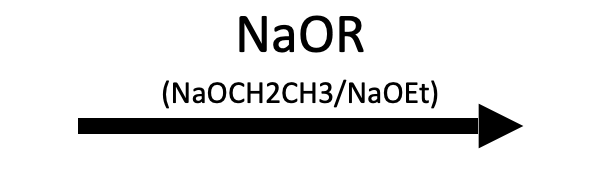

NaOCy (seafoam teal Color 1 = incoming OR)
Product

Cyclohexyl isobutyrate (seafoam teal Color 1 CyO group)
Reactant

Ethyl acetate
Reagents
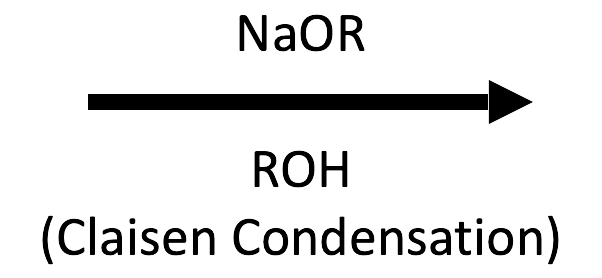


NaOEt (seafoam teal Color 1 EtO⁻) and EtOH solvent
Product

Ethyl acetoacetate (seafoam-teal Color 1 β-dicarbonyl)
Scope, Selectivity & Edge Cases
- Transesterification: Equilibrium-limited; best when R′OH is volatile/removed. Avoid strong base loading or α-H activation if Claisen is undesired.
- Claisen: The classic NaOR donor normally needs at least two α-H. Match the base OR to the ester leaving group (NaOEt with ethyl esters) to minimize exchange; a mismatch does not categorically prevent condensation. Bulky esters react slower; a non-enolizable ester can serve as the electrophile in mixed Claisen.
- Dieckmann: 5–6 member rings favored; 4- or 7+ membered rings are disfavored due to ring strain/entropic cost.
- Functional group tolerance: Both manifolds are strongly basic. Protect base-sensitive moieties (e.g., carbonyls prone to enolate formation) accordingly.
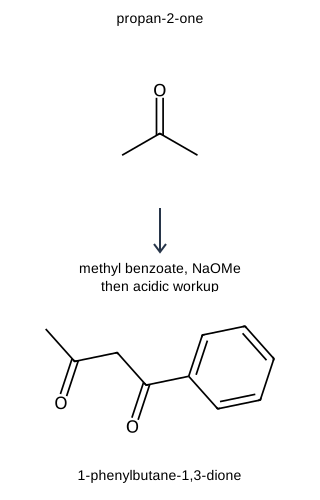
A ketone donor in a crossed Claisen reaction
A ketone enolate can acylate an ester to give a 1,3-diketone. Propan-2-one and methyl benzoate, with matching methoxide followed by acid workup, give 1-phenylbutane-1,3-dione. The ketone supplies the nucleophilic alpha carbon; methyl benzoate supplies the new benzoyl group.
After addition to the ester carbonyl, collapse expels methoxide. Deprotonation between the two carbonyls helps drive the condensation; acid workup returns the neutral product. Methyl benzoate has no enolizable alpha hydrogen, so it cannot compete as an enolate donor. The figure shows the diketo constitution; keto–enol equilibrium does not have a fixed ratio implied by this drawing.
Practical Tips & Pitfalls
- Transesterification: Use ~5–10 mol% NaOR in the matching ROH. Remove volatile R″OH by an appropriate distillation method when feasible. Monitor to avoid unintended Claisen if the ester has α-H and the base accumulates.
- Claisen: Use ≥1 eq NaOR, matching OR′. Cool during base addition. NaOR/ROH forms ester enolate reversibly; subsequent product deprotonation pulls the condensation forward. Cold H₃O⁺ workup protonates that enolate and stops the base chemistry.
- Avoiding saponification: Water or NaOH shifts to irreversible hydrolysis (different mechanism). Keep conditions anhydrous unless the endpoint is hydrolysis.
Exam-Style Summary
| Condition | Expectation |
|---|---|
| Cat. NaOR in ROH + excess ROH | Transesterification (OR swap). |
| Stoichiometric NaOR (matched) + donor with ≥2 α-H + H₃O⁺ | Claisen condensation → β-keto ester (or cyclic Dieckmann). |
| No α-H in either ester | No enolate donor for self-Claisen; OR exchange may occur. |
FAQ
Does Claisen absolutely require the base OR to match the ester’s OR′?
Matching minimizes alkoxy exchange and product scrambling. It is preferred for a clean textbook prediction, but a mismatched base does not make every Claisen impossible.
Can I explore hypothetical alkoxides (allylic, benzylic, etc.)?
Changing the alkoxide changes its steric and nucleophilic properties and may change alkoxy exchange. Identify whether it is acting mainly as a nucleophile or as a base before predicting the product.
What if my ester lacks an α-hydrogen?
That ester cannot supply its own enolate. It can still be an electrophile for a suitable enolizable donor in a mixed Claisen. For the classic NaOR pathway, the donor normally needs two α-H so product deprotonation can drive the reaction.
How does Dieckmann condensation relate to Claisen?
Dieckmann is an intramolecular Claisen condensation. The same addition, leaving-group departure and product-deprotonation logic applies, with ring size influencing feasibility.
Interactive Toolbox
- Mechanism Solver for exploring reaction mechanisms.
- Reaction Solver for exploring reactions.
- IUPAC Namer for naming practice.