Ether Cleavage with HI or HBr (Heat)
Ethers are surprisingly stable under most conditions—but strong HI or HBr with heat will cleave them via protonation of oxygen followed by nucleophilic attack by the halide. The mechanism is either SN2 (primary/secondary carbons) or SN1 (tertiary/benzylic carbons). This reaction is commonly tested in Orgo I and is easy once you recognize the pattern.
Quick Summary
How to predict products:
- Identify the ether oxygen and the two carbons attached to it.
- Protonate the oxygen — this converts the poor leaving group (RO⁻) into a good one (ROH).
- Halide attacks the less-hindered carbon (SN2) or the more-stable carbocation forms (SN1).
- Products: one alkyl halide (R–X) + one alcohol (R′–OH).
| Ether Type | Pathway | Products |
|---|---|---|
| Both carbons primary/secondary | SN2 | R–X + R′–OH (attack at less hindered) |
| One carbon tertiary or benzylic | SN1 | Tertiary/benzylic halide + alcohol |
| Aryl ether (anisole-type) | SN2 on alkyl side | Ar–OH + alkyl halide |
Conditions at a Glance
| Reagent | Conditions | Reactivity |
|---|---|---|
| HI | Heat (Δ) | Most reactive (I⁻ best nucleophile) |
| HBr | Heat (Δ) | Common alternative |
| HCl | Heat (Δ) | Rarely used (Cl⁻ weakest nucleophile) |
Note: HI > HBr > HCl in reactivity because iodide is the best nucleophile.
Mechanism
SN2 Pathway (Primary/Secondary Ethers)
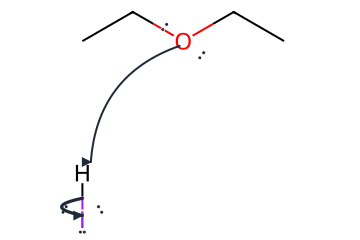
Step 1: Protonate the ether oxygen
The acid protonates the ether oxygen, converting the poor leaving group (RO⁻) into a good one (ROH).
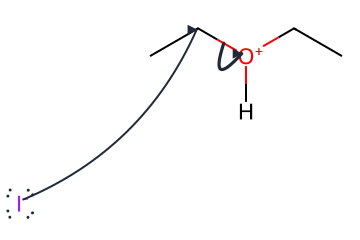
Step 2: Halide attacks (SN2)
The halide ion (I⁻ or Br⁻) attacks the less-hindered carbon in an SN2 reaction, displacing the alcohol.
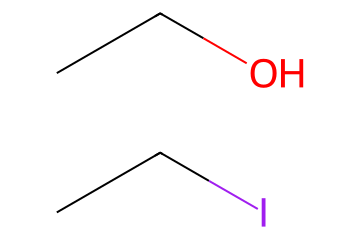
Step 3: Products form
The C–O bond breaks, giving an alkyl halide + an alcohol.
SN1 Pathway (Tertiary/Benzylic Ethers)
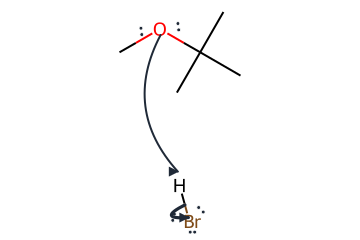
Step 1: Protonate the ether oxygen
Same as SN2—the oxygen is protonated to make a good leaving group.
Step 2: Carbocation forms; halide attacks
The C–O bond breaks heterolytically, forming a stable carbocation (tertiary or benzylic). The halide nucleophile immediately captures the carbocation.
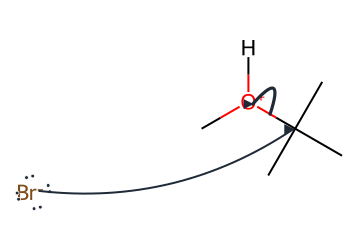
Step 3: Products form
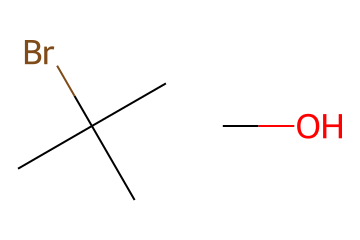
Products: tertiary/benzylic halide + alcohol.
Worked Examples
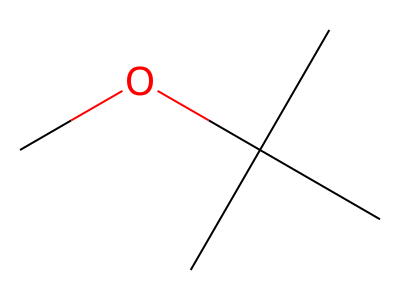
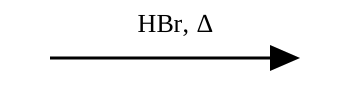
Example A: MTBE (tert-Butyl Methyl Ether) + HBr, Δ
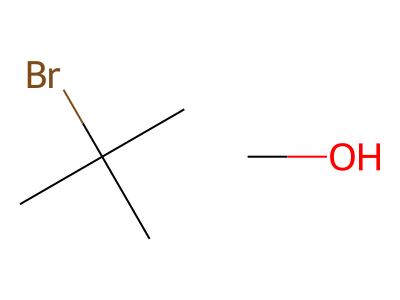
Analysis:
- Tertiary carbon → SN1 pathway
- Carbocation forms on the tertiary carbon (more stable)
- Products: tert-butyl bromide + methanol
Example B: Anisole (Methoxybenzene) + HI, Δ
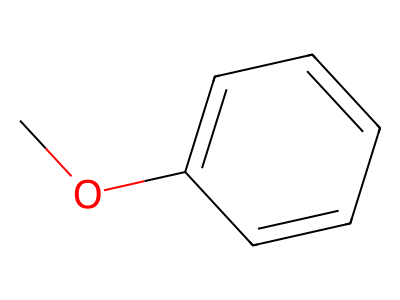
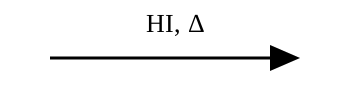
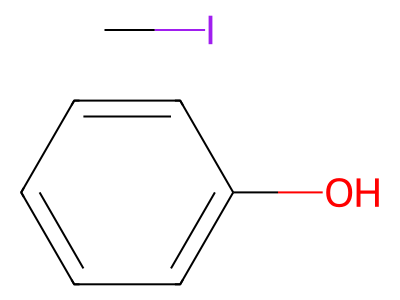
Analysis:
- Aryl C–O bond does NOT cleave (sp² carbon, no SN2, unstable phenyl cation)
- Cleavage occurs on the methyl side (SN2)
- Products: phenol + methyl iodide
Example C: THF (Tetrahydrofuran) + HI, Δ
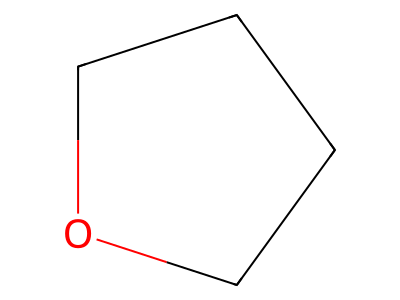
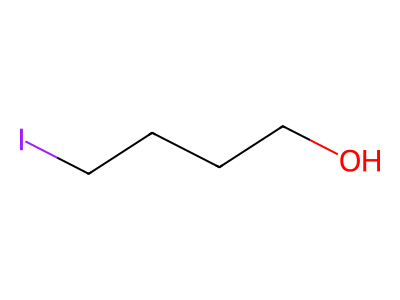
Analysis:
- Cyclic ether (5-membered ring)
- SN2 opens the ring
- Product: 4-iodo-1-butanol (ring-opened haloalcohol)
Exam Quick Reference
SN1 vs SN2 Decision
| If one carbon is... | Pathway | Halide ends up on... |
|---|---|---|
| 3° (tertiary) | SN1 | Tertiary carbon |
| Benzylic | SN1 | Benzylic carbon |
| Both 1°/2° | SN2 | Less-hindered carbon |
| Aryl (phenyl) | SN2 on other side | Alkyl carbon (NOT aryl) |
Exam Fringe Cases & Traps
| Scenario | Outcome |
|---|---|
| Aryl ether (anisole) | Only the alkyl C–O breaks; phenyl cation is too unstable |
| Vinyl ether | Only alkyl C–O breaks; vinyl cation is too unstable |
| Epoxide + HX | Different mechanism (ring strain); covered separately |
| Excess HX | With heat, both alcohols can convert to halides (2 eq HX → 2 R–X) |
| Symmetrical ether | Either C–O can break; same product either way |
Checklist for Predicting Products
- Is it actually an ether (C–O–C with no carbonyl adjacent)?
- Identify both carbons attached to oxygen.
- Rank carbons: 3° > benzylic > 2° > 1° > methyl > aryl/vinyl (never cleaved)
- Pick pathway (SN1 if 3°/benzylic, else SN2).
- Write: R–X (halide on attacked carbon) + R′–OH (alcohol from other side).
Interactive Toolbox

Use HI (heat) for the most reactive ether cleavage (I⁻ is the best nucleophile).

Use HBr (heat) as a common alternative for ether cleavage.
- Mechanism Solver — step through ether cleavage with electron-pushing arrows.
- Reaction Solver — draw an ether and predict cleavage products with HI or HBr.
- IUPAC Namer — name the alkyl halide and alcohol products.
Related Reading
- Williamson Ether Synthesis — Making ethers (the reverse concept)
- Epoxide Ring Opening (Acid) — Related but different mechanism (ring strain)
- SN1 vs SN2 Overview — General substitution comparison