Nitrile Reactions: Acid Hydrolysis to Carboxylic Acid
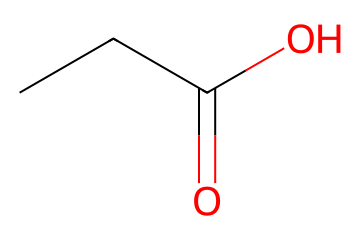
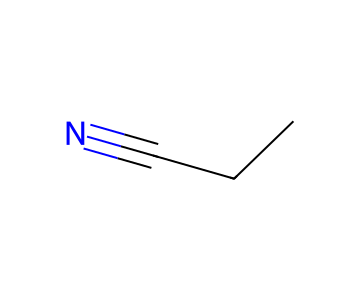
Treatment of a nitrile (R-CN) with aqueous acid and heat converts the C≡N triple bond completely to a carboxylic acid (R-COOH) plus ammonium ion (NH4+). The mechanism proceeds through two sequential addition-elimination sequences: first, water adds to the protonated nitrile to form an amide intermediate; then, a second water molecule adds to the protonated amide, which collapses to release ammonia and produce the carboxylic acid. This is a reliable, high-yielding transformation used to convert cyano groups installed via nucleophilic substitution into carboxylic acids.
Key Emphasis (Teaching Pivots)
- Full hydrolysis requires heat. Unlike milder conditions that stop at the amide, acid + heat drives the reaction all the way to the carboxylic acid.
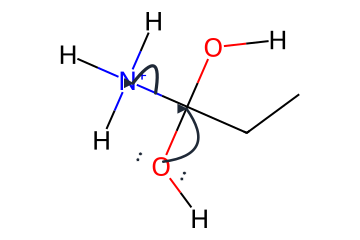
- Amide is an intermediate. The mechanism passes through a protonated amide (imidic acid → amide → tetrahedral intermediate → carboxylic acid). This two-stage hydrolysis is key to understanding the full mechanism.
- Nitrogen leaves as NH4+. The nitrile nitrogen is released as ammonia, which is immediately protonated to ammonium ion under acidic conditions.
- Compare to base hydrolysis. OH-/heat also hydrolyzes nitriles to carboxylic acids (as carboxylate salts), but the mechanism differs: base attacks directly rather than requiring protonation first.
Quick Summary
| Feature | Details |
|---|---|
| Transforms | R-CN → R-COOH |
| Reagents | H3O+, heat (or conc. H2SO4/H2O, reflux) |
| Product | Carboxylic acid + NH4+ |
| Key feature | Amide intermediate; two hydrolysis stages |
- Reagents/conditions: Dilute or concentrated aqueous acid (HCl, H2SO4), reflux/heat.
- Outcome: R-CN + 2 H2O + H+ → R-COOH + NH4+. The nitrile is fully hydrolyzed.
- Intermediate: The reaction passes through an amide stage, but under acidic heat conditions this is not isolated.
- Comparison: NaOH/heat also works (gives carboxylate salt); DIBAL-H stops at aldehyde; LiAlH4 gives primary amine.
Mechanism - Two-Stage Hydrolysis (7 Steps)
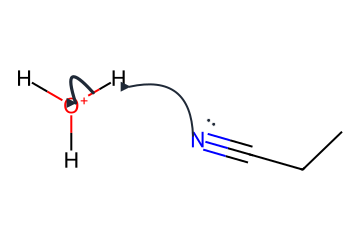
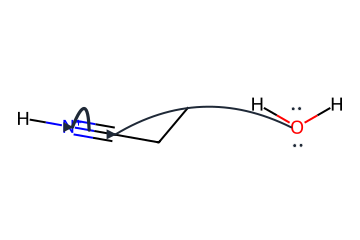
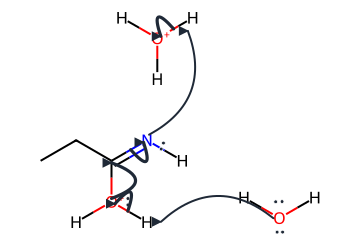
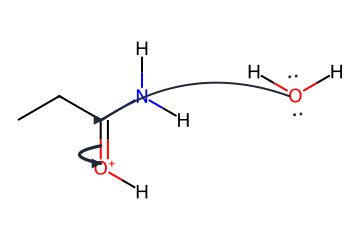
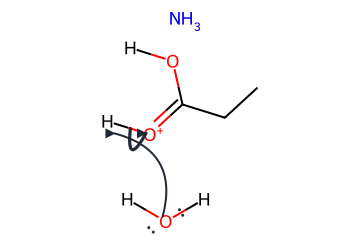
The mechanism involves two nucleophilic addition-elimination sequences. First, water adds to the protonated nitrile to form an amide. Then, water adds to the protonated amide, which collapses to give the carboxylic acid.
Mechanistic Checklist (Exam Focus)
- Protonate first. Under acidic conditions, always show protonation of the nitrile nitrogen before water attacks.
- Show the amide intermediate. The mechanism passes through an amide; recognize this as the halfway point.
- Protonate the amide. The second hydrolysis requires protonation of the amide carbonyl oxygen.
- Track nitrogen fate. NH2 becomes NH3+ (good leaving group) and departs as NH3, immediately protonated to NH4+ in acid.
- Two addition-elimination sequences. First: nitrile → amide. Second: amide → carboxylic acid.
Worked Examples
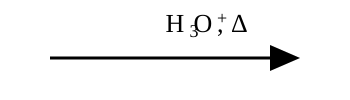
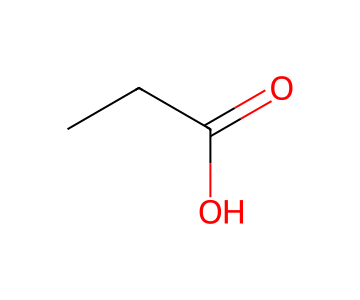
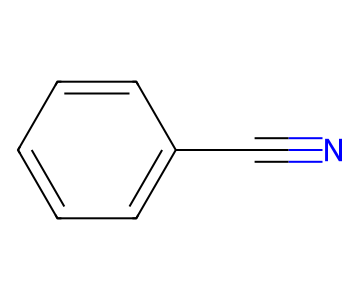
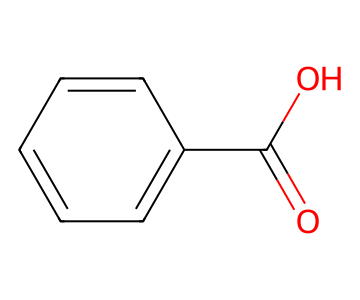
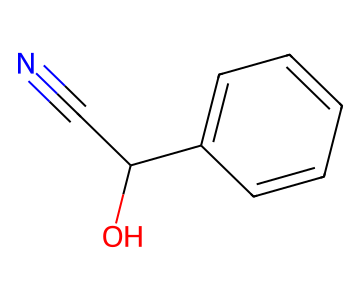
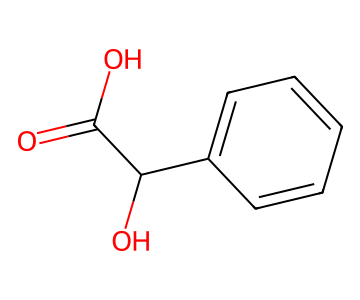
Scope & Limitations
- Works well: Simple alkyl nitriles, aryl nitriles, cyanohydrins (give alpha-hydroxy acids).
- Functional groups tolerated: Aromatic rings, ethers, halogens (unless they undergo competing hydrolysis), alcohols.
- Sensitive groups: Acetals, epoxides, and other acid-labile groups will be cleaved under these conditions.
- Stereochemistry: Chiral centers alpha to the nitrile are generally retained (no epimerization at the alpha carbon).
- Alternative: Base hydrolysis (NaOH/heat) also works and gives the carboxylate salt directly.
Edge Cases & Exam Traps
- Stopping at amide: Milder conditions (lower temperature, shorter time) can stop at the amide. Full conversion to carboxylic acid requires prolonged heating.
- Cyanohydrin trap: Cyanohydrins (alpha-hydroxy nitriles) can revert to aldehyde + HCN under certain conditions. Under acidic hydrolysis with heat, they typically give alpha-hydroxy acids.
- Base vs acid: NaOH/heat gives the carboxylate (requires acid workup for neutral carboxylic acid). H3O+/heat gives the carboxylic acid directly.
- DIBAL-H confusion: DIBAL-H at -78 C stops at aldehyde. LiAlH4 gives primary amine. Only H3O+/heat or OH-/heat gives carboxylic acid.
- Two-step synthesis: Alkyl halide + NaCN → nitrile; then H3O+/heat → carboxylic acid. This is a common one-carbon homologation sequence.
Practical Tips
- Full conversion: Reflux for several hours in dilute H2SO4 or HCl to ensure complete hydrolysis past the amide stage.
- Product isolation: The carboxylic acid can be extracted into organic solvent after neutralizing the reaction mixture.
- Monitor by TLC: The amide intermediate can be detected; continue heating until it disappears.
- Scale considerations: Large-scale reactions may require longer reflux times due to heat transfer limitations.
Exam-Style Summary
R-CN + H3O+/heat → R-COOH + NH4+. The mechanism involves two addition-elimination sequences: first converting the nitrile to an amide, then converting the amide to the carboxylic acid. Key intermediates are the protonated nitrile, imidic acid/amide, and tetrahedral intermediate. Nitrogen is expelled as ammonia (protonated to NH4+).
Interactive Toolbox
- Mechanism Solver - Enter any nitrile and see the full 7-step mechanism for acid hydrolysis to carboxylic acid.
- Reaction Solver - Provide a nitrile and predict the carboxylic acid product.
- IUPAC Namer - Name the carboxylic acid products.