Nitrile Reactions: Nitrile + Grignard to Ketone
Grignard reagents (RMgBr) react with nitriles (R-C≡N) to form ketones after aqueous workup. The highly nucleophilic carbon of the Grignard attacks the electrophilic nitrile carbon, forming an imine intermediate that hydrolyzes to a ketone.
Quick Summary
| Feature | Details |
|---|---|
| Transforms | R-C≡N + R'MgBr → R-C(=O)-R' |
| Reagents | 1) R'MgBr, ether (anhydrous) 2) H₃O⁺ workup |
| Product | Ketone (always, not aldehyde) |
| Key point | Grignard adds one R group; aqueous workup hydrolyzes the imine |
Mechanism (8 Steps)
The mechanism involves nucleophilic addition of the Grignard to the nitrile, followed by a detailed hydrolysis of the resulting imine through iminium and hemiaminal intermediates to give the ketone.
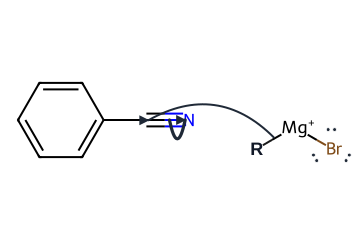
Step 1 — Nucleophilic Addition
The carbanion (R⁻) from the Grignard attacks the electrophilic nitrile carbon. The triple bond is reduced to a double bond, and negative charge develops on nitrogen (imine anion).
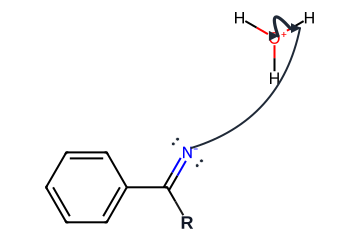
Step 2 — First Protonation (Imine Forms)
Aqueous workup (H₃O⁺) protonates the nitrogen anion to form a neutral imine.
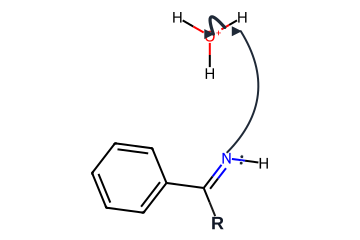
Step 3 — Second Protonation (Iminium Cation)
A second equivalent of H₃O⁺ protonates the imine nitrogen, making the carbon more electrophilic for water attack.
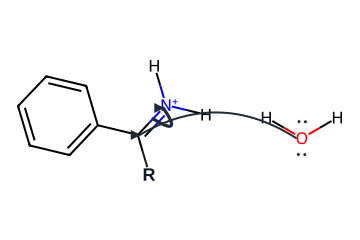
Step 4 — Water Attacks Iminium
Water attacks the electrophilic iminium carbon. The π electrons shift from C=N to nitrogen, forming a tetrahedral intermediate.
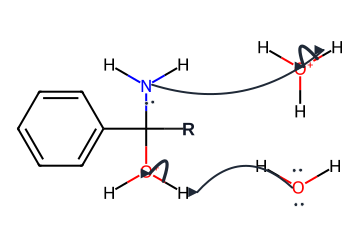
Step 5 — Proton Transfers
Two proton transfers occur simultaneously: nitrogen attacks H₃O⁺ (becoming NH₃⁺) while water deprotonates the oxonium (OH₂⁺ becomes OH).
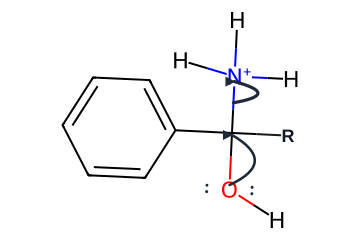
Step 6 — NH₃ Departure and Carbonyl Formation
The hemiaminal collapses: the C-N bond breaks (NH₃ leaves as a neutral leaving group), and a lone pair on oxygen forms the C=O double bond.
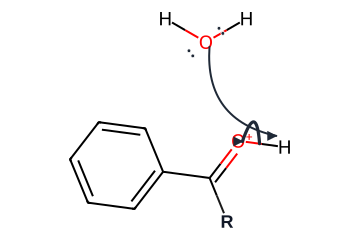
Step 7 — Final Deprotonation
Water deprotonates the protonated carbonyl (C=OH⁺), giving the neutral ketone.
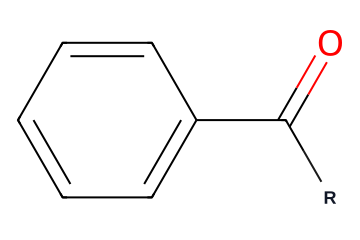
Step 8 — Ketone Product
The final product is a ketone with the R group from the nitrile and the R' group from the Grignard.
Worked Examples
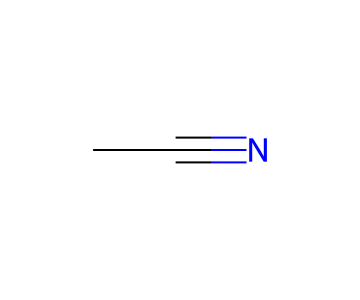
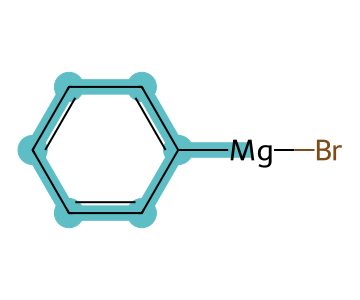
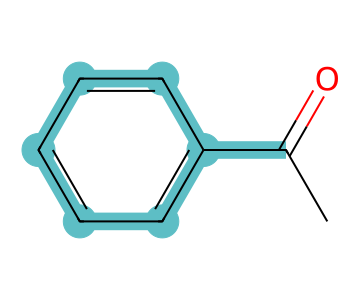
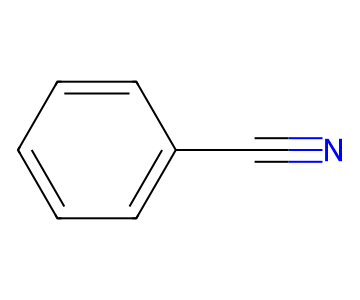
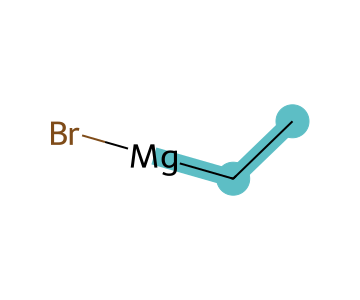
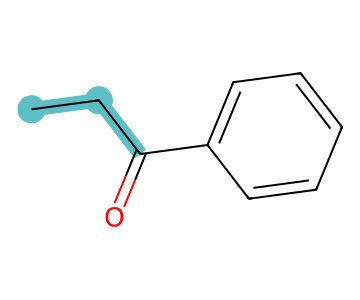
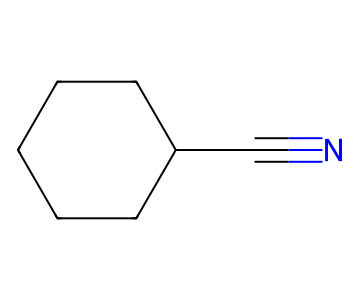
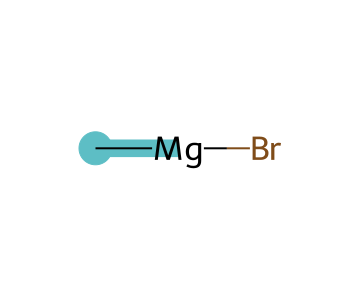
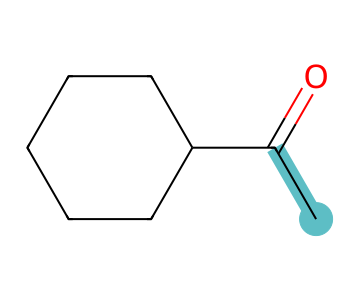
Scope and Limitations
Works Well With
- Aryl nitriles (benzonitrile, substituted benzonitriles)
- Alkyl nitriles (acetonitrile, propionitrile, etc.)
- Aryl Grignards (PhMgBr, tolylMgBr)
- Alkyl Grignards (MeMgBr, EtMgBr, iPrMgBr)
Limitations
- Aldehyde impossible: Nitrile + Grignard always gives ketone (both R groups present). To get aldehyde from nitrile, use DIBAL-H instead.
- No second addition: Unlike esters, nitriles only accept ONE Grignard equivalent (the imine intermediate is not electrophilic enough for a second attack).
- Anhydrous required: Grignard reagents are destroyed by water, so the addition must be done under anhydrous conditions before workup.
- Steric hindrance: Very bulky Grignards (tert-butyl) may have reduced yields with hindered nitriles.
Common Exam Traps
-
Confusing with ester reaction - Esters + Grignard give tertiary alcohols (2 additions). Nitriles + Grignard give ketones (1 addition). Know the difference!
-
Expecting aldehyde - Nitrile + Grignard always gives ketone. For aldehyde from nitrile, use DIBAL-H (1 equiv, −78 °C).
-
Forgetting workup - The mechanism requires aqueous (H₃O⁺) workup to hydrolyze the imine intermediate to ketone.
-
Functional group compatibility - Grignards are incompatible with protic groups (-OH, -NH₂, -COOH) and many electrophiles. If these are present, they must be protected.
-
Product prediction - The ketone has: R from the original nitrile + R' from the Grignard. Make sure you're adding them correctly.
Product Prediction Checklist
- Identify the nitrile: R-C≡N
- Identify the Grignard: R'-MgBr
- Product ketone: R-C(=O)-R'
- The nitrile carbon becomes the carbonyl carbon
- The Grignard R' group attaches to the carbonyl carbon
Comparison Table
| Nitrile Reaction | Reagent | Product |
|---|---|---|
| Grignard addition | R'MgBr, then H₃O⁺ | Ketone (R-CO-R') |
| DIBAL-H reduction | DIBAL-H (1 eq), −78 °C, then H₂O | Aldehyde (R-CHO) |
| LiAlH₄ reduction | LiAlH₄ (excess), then H₂O | Primary amine (R-CH₂-NH₂) |
| Acidic hydrolysis | H₃O⁺, heat | Carboxylic acid (R-COOH) |
| Basic hydrolysis | NaOH, heat | Carboxylate (R-COO⁻) |
Tips
- "Nitrile + Grignard = Ketone" - memorize this transformation
- Count the carbons: R from nitrile + R' from Grignard = ketone
- The imine intermediate is key - it's what gets hydrolyzed to ketone
- For ketone synthesis, this is an excellent method when you need specific R and R' groups
Related Grignard Reactions
Understanding how Grignards react with different functional groups is essential for synthesis planning:
Unlike nitriles, esters undergo two Grignard additions because the ketone intermediate is electrophilic enough for a second attack. Result: tertiary alcohol (or secondary from formate esters).
Acid chlorides also undergo two additions with Grignard (via ketone intermediate). Use Gilman reagent (R₂CuLi) instead if you want to stop at ketone.
Grignard adds once to aldehydes/ketones (1,2-addition), giving secondary or tertiary alcohols. This is the "classic" Grignard reaction.
Grignard opens epoxides at the less substituted carbon, extending the carbon chain by 2 atoms. Useful for synthesis planning.
How to make the Grignard reagent itself: alkyl/aryl halide + Mg in dry ether. Covers initiation, Schlenk equilibrium, and common failure modes.
Interactive Toolbox
- Mechanism Solver - Enter any nitrile and see the full 8-step mechanism for Grignard addition to ketone.
- Reaction Solver - Provide a nitrile and the Solver predicts the ketone product based on your Grignard reagent.
- IUPAC Namer - Use it to name the ketone products.