Lewis Structures and Formal Charge
Lewis Structures and Formal Charge
Drawing Lewis structures is a key skill for visualizing how atoms are bonded in molecules. A Lewis structure (also called a Lewis dot structure) represents atoms with their element symbols and valence electrons as dots. Covalent bonds are shown as shared electron pairs (often drawn as lines between atoms). Lewis structures help predict molecular shape, bond order, and the presence of lone pairs or formal charges. Here is the systematic approach to drawing Lewis structures and explains how to assign formal charges to atoms.
Quick Guide
Steps to Draw Lewis Structures
When creating a Lewis structure for a molecule or polyatomic ion, follow these general steps:
- Count Total Valence Electrons: Sum the valence electrons of all atoms in the species. For polyatomic ions, add an electron for each negative charge or subtract one for each positive charge.
- Draw a Skeletal Structure: Determine how the atoms are connected. Usually, the least electronegative element (excluding hydrogen) is placed at the center. Connect atoms with single bonds initially.
- Distribute Electrons as Lone Pairs: Subtract the electrons used in bonds (each single bond uses 2 electrons) from the total. Distribute the remaining electrons as lone pairs starting with outer atoms to complete their octets.
- Complete the Octet of the Central Atom: If the central atom lacks an octet after step 3, move lone pair electrons from surrounding atoms to form double or triple bonds as needed.
- Check the Total Electron Count: Ensure that the total number of electrons in the final structure equals the total valence electrons calculated in step 1. All valence electrons should be accounted for as either bonding or nonbonding electrons.
- Assign Formal Charges (if necessary): If any atoms do not have a neutral valence configuration, assign formal charges (discussed below) to reflect the electron distribution.
By following these steps, one can systematically arrive at a valid Lewis structure for most molecules. Keep in mind that some elements can have fewer or more than eight electrons (octet exceptions), which will be discussed shortly.

Example: Drawing a Lewis Structure
As an example, consider the carbonate ion, CO₃²⁻. Its Lewis structure can be drawn as follows:
- Valence Electrons: Carbon has 4 valence electrons, each oxygen has 6, and there are three oxygens. Additionally, the 2⁻ charge indicates 2 extra electrons. Total = 4 + (3 × 6) + 2 = 24 valence electrons.
- Skeleton: Place carbon in the center (least electronegative besides hydrogen) and attach three oxygens around it with single bonds. This uses 3 bonds × 2 electrons = 6 electrons.
- Lone Pairs: Distribute the remaining 18 electrons (24 total − 6 in bonds) to the oxygens. Each oxygen needs 8 electrons total. Initially give each O six more electrons as lone pairs. After this, each oxygen has 8 electrons (2 in the C–O bond and 6 as lone pairs), and all 18 extra electrons are placed (6 on each oxygen).
- Octet Check: Carbon has only 6 electrons around it (from three single bonds). To give carbon an octet, take a lone pair from one of the oxygens and form a double bond to carbon. Now carbon has 8 electrons (two in each of four bonds: one C=O double bond and two C–O single bonds).
- Final Structure: One oxygen is double-bonded to carbon (C=O) and has 2 lone pairs; the other two oxygens are single-bonded (C–O) and have 3 lone pairs each. This accounts for all 24 electrons.


The above structure for CO₃²⁻ is not unique – there are equivalent structures where a different oxygen forms the double bond. These are resonance structures, which will be addressed separately. In each resonance form, the overall arrangement of atoms is the same; only the distribution of electrons differs.
Formal Charge
After drawing a Lewis structure, it’s important to evaluate the formal charge on each atom. The formal charge is a bookkeeping tool that indicates whether an atom gains or loses electron density in the structure compared to its neutral state. The formal charge (FC) on an atom is calculated as:

In practice, this formula can be applied by counting:
- The number of valence electrons the atom has as a free, neutral atom.
- The number of electrons it owns in the Lewis structure (all nonbonding electrons on that atom + half of the bonding electrons it shares).
For a quick method: take the atom’s valence electron count, subtract the number of lone pair electrons on it, and subtract the number of bonds it has. This yields the formal charge.
Using the carbonate ion example:
- The carbon atom in CO₃²⁻ has 4 valence electrons normally. In the Lewis structure, it has 4 bonds and no lone pairs. Using the shortcut: 4 (valence) − 0 (lone electrons) − 4 (bonds) = 0. Carbon's formal charge is 0.
- The double-bonded oxygen normally has 6 valence electrons. In the structure, it has 4 lone electrons and 2 bonds. Formal charge = 6 − 4 − 2 = 0.
- Each single-bonded oxygen normally has 6 valence electrons. In the structure, one such oxygen has 6 lone electrons and 1 bond. Formal charge = 6 − 6 − 1 = −1. Thus, the two single-bonded oxygens each carry a –1 formal charge. These charges sum to –2 overall, matching the ion’s charge.
Key points about formal charge:
- The sum of all formal charges in a molecule or ion must equal the overall charge of that species.
- Small formal charges (0, ±1) are preferable to large charges. Lewis structures with minimal formal charge separation typically represent the more stable electron arrangement.
- If a negative formal charge is present, it is more favorable on a more electronegative atom (e.g., oxygen or nitrogen rather than carbon).
- Formal charges are not actual charges on atoms; they are a way to keep track of electrons. However, they help explain reactivity (sites with negative formal charge may attract electrophiles, etc.).
Octet Rule Exceptions
While the octet rule is a useful guideline, there are important exceptions in Lewis structures:
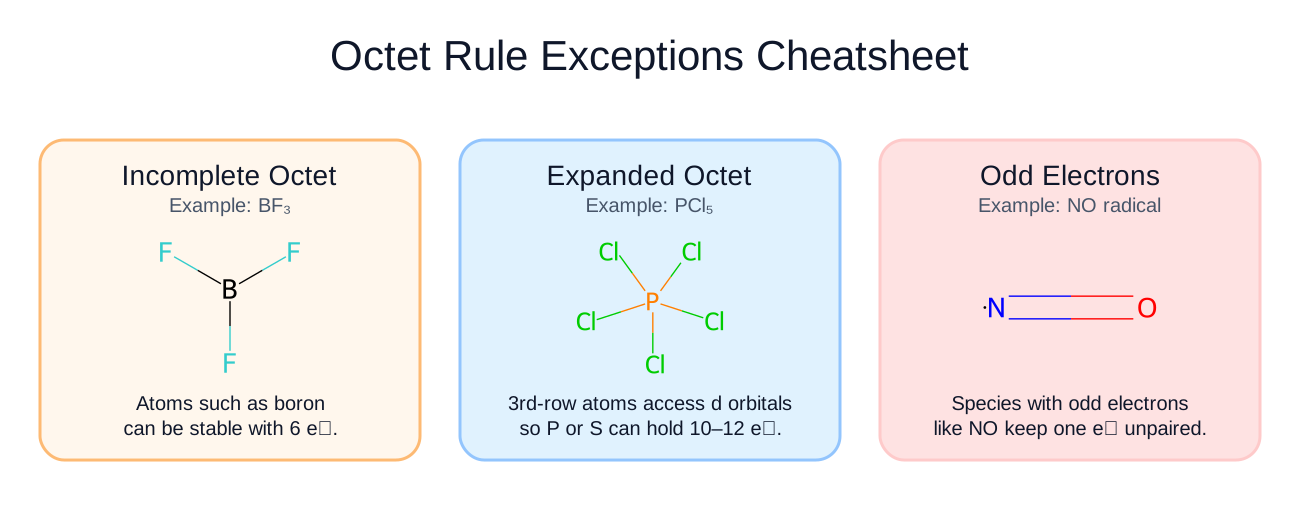
- Incomplete Octet: Some atoms are stable with fewer than eight electrons. For instance, boron often has only six valence electrons in its compounds (e.g., BF₃), and beryllium can have just four.
- Expanded Octet: Elements in the third period and beyond can sometimes have more than eight electrons by using d-orbitals. Examples include phosphorus pentachloride (PCl₅, 10 electrons around P) or sulfur hexafluoride (SF₆, 12 electrons around S). Such expanded valence is generally not encountered with second-period elements like carbon, nitrogen, or oxygen.
- Odd-Electron Species: Molecules with an odd number of total electrons cannot give every atom a pair of electrons (one atom will have a single unpaired electron). These are called free radicals. An example is nitric oxide (NO), which has 11 valence electrons; one electron remains unpaired.
Understanding these exceptions helps in drawing correct Lewis structures for all types of molecules, though in organic chemistry the focus is mostly on carbon (which obeys the octet rule strictly, except in reactive intermediates like radicals or cations).
Summary
Lewis structures provide a straightforward way to represent covalent bonds and lone pairs in molecules, following the octet rule as a guiding principle. By summing valence electrons, forming bonds, distributing lone pairs, and applying octet adjustments, one can derive valid structures for molecules and ions. Formal charge calculations are essential to assess the electron distribution: they identify any atoms that appear electron-deficient or electron-rich compared to their neutral state. The most stable Lewis structures minimize formal charge separation and place negative charges on electronegative atoms. Mastery of drawing Lewis dot structures and assigning formal charges is crucial for predicting molecule behavior, as it lays the groundwork for understanding resonance, molecular geometry, and reactivity in organic chemistry.