Alkyne Reactions: Alkyne Oxymercuration using HgSO4, H2O, H2SO4
Alkyne Reactions: Acid-Catalyzed Oxymercuration-Hydration (HgSO4, H2SO4, H2O)
Mercuric sulfate in aqueous sulfuric acid promotes the classic Kucherov hydration of alkynes. The alkyne pi bond coordinates to Hg2+, water adds to the more substituted vinylic carbon (Markovnikov orientation), and deprotonation gives an enol-Hg intermediate. Proton-assisted demetalation releases the free enol, which rapidly tautomerizes to the ketone under the acidic conditions.
- Terminal alkynes reliably furnish methyl ketones.
- Internal alkynes hydrate to ketones; unsymmetrical systems often give regioisomer mixtures.
- The Hg2+ catalyst is regenerated at the end of the cycle, but Hg waste must be handled carefully.
Quick Summary
- Reagents/conditions: catalytic HgSO4 with aqueous H2SO4/H2O, typically 25-80 deg C (often reflux).
- Outcome: Markovnikov hydration converts the alkyne π bond into an enol that tautomerizes rapidly to the ketone.
- Regioselectivity: OH installs on the more substituted vinylic carbon; terminal alkynes become methyl ketones (the terminal carbon becomes part of a CH3CO fragment).
- Stereochemistry: The transient enol rapidly tautomerizes; any E/Z information is lost in the ketone.
- Rearrangements: Vinyl cation-like manifolds do not undergo 1,2-hydride or methyl shifts.
- Catalyst: Hg2+ is returned at the end of the cycle (no mercury in the organic products).
Mechanism (7 Ionic Steps)
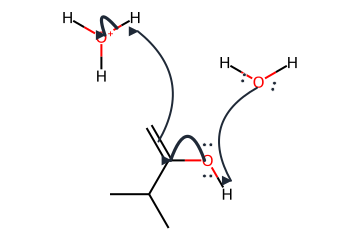
The panels below depict 3-methylbut-1-yne hydrating to 3-methylbutan-2-one.
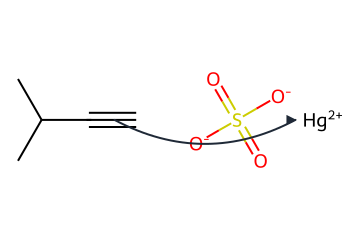
The alkyne pi system binds Hg2+ (from HgSO4 in acidic water), forming a vinyl mercurinium-like complex that activates the more substituted carbon toward nucleophilic attack.
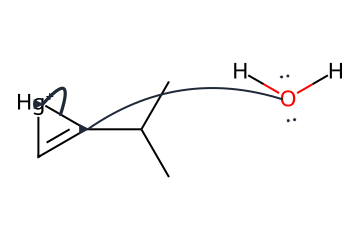
Hg2+ bridges the pi system, polarizing the Markovnikov carbon toward nucleophilic attack.
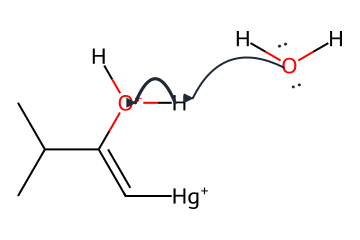
Nucleophilic addition delivers the OH2+ fragment to the Markovnikov carbon while Hg2+ remains bound to the neighboring carbon.
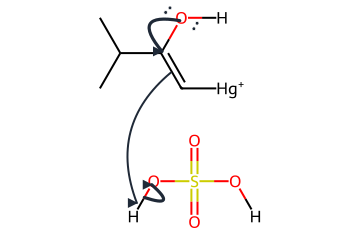
A solvent acid molecule (atom map supplied in the code comments) delivers the proton that will ultimately leave with the mercury fragment.
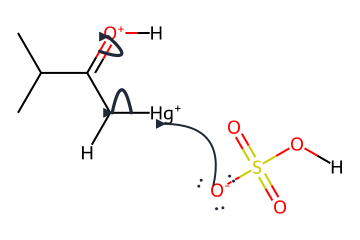
After proton transfer, the oxygen loses its positive charge and the enol-Hg intermediate is formed.
Proton delivery to the carbon bearing Hg2+ ejects the metal, returning Hg2+ to the catalytic pool.
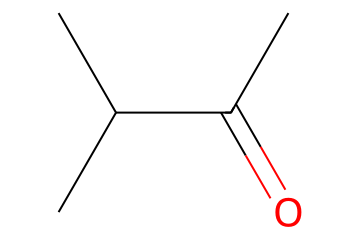
The enol protonates at oxygen, rehybridizes, and deprotonates to furnish the Markovnikov ketone.
Mechanistic Checklist
- Markovnikov orientation: OH installs on the more substituted vinylic carbon.
- Terminal alkynes hydrate to methyl ketones (the terminal carbon becomes the methyl group of the ketone).
- Unsymmetrical internal alkynes can afford mixtures of ketones when both vinylic carbons are comparably substituted.
- No 1,2-hydride or alkyl shifts occur; vinyl cation-like intermediates do not rearrange.
- Hg2+ is catalytic and absent from the organic products (manage Hg waste appropriately).
Worked Examples
Example A - Terminal alkyne hydration (prop-1-yne → propan-2-one)
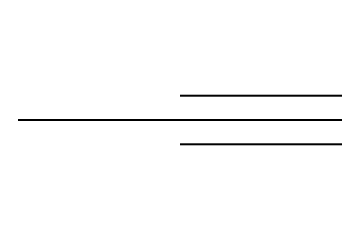
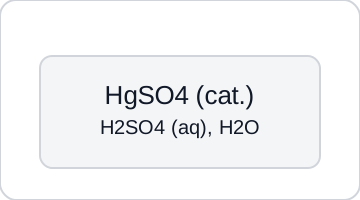
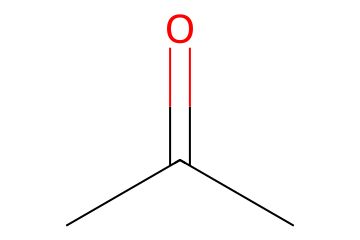
Terminal alkyne hydration delivers the methyl ketone in a single step.
Example B - Aryl-substituted alkyne (ethynylbenzene → 1-phenylethan-1-one)
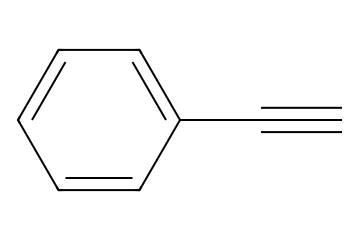
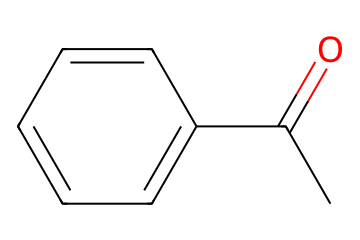
Benzylic stabilization reinforces Markovnikov capture next to the aromatic ring.
Example C - Unsymmetrical internal alkyne (hex-2-yne → regioisomeric ketones)
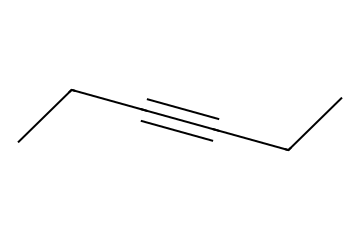
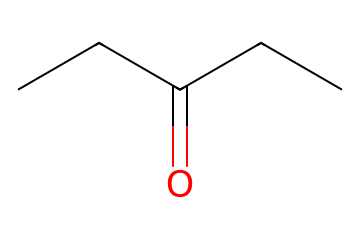
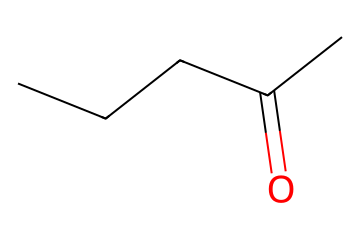
Comparable substitution on both vinylic carbons produces a regioisomeric mixture of ketones.
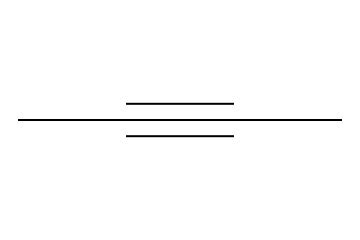
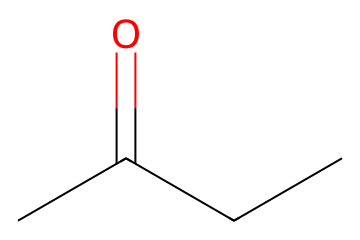
Example D - Symmetrical internal alkyne (but-2-yne → butan-2-one)
Multiple Pi Bonds & Selectivity
- Under these conditions the alkyne hydrates first; alkenes present in the same molecule usually remain unchanged or follow standard H2SO4 hydration.
- If two alkynes are present, the less hindered or more electron-rich triple bond often reacts faster, but forcing conditions hydrate both.
- Benzylic or conjugated alkynes accentuate Markovnikov capture next to the aromatic system.
Practical Tips & Pitfalls
- Medium: Use aqueous H2SO4 with catalytic HgSO4; gentle heating accelerates sluggish substrates.
- Work-up: Mercury is toxic-collect and dispose of Hg-containing waste according to institutional protocols.
- Compatibility: Strong bases or nucleophiles quench the catalyst; enol/ketone products can be acid-sensitive (watch for aldol-type side reactions if additional carbonyls are present).
- Regiochemistry alternative: For anti-Markovnikov hydration of terminal alkynes (aldehydes), choose hydroboration-oxidation instead of Hg2+ catalysis.
Exam-Style Summary
HgSO4/H2SO4/H2O hydrates alkynes through a vinyl mercurinium intermediate, giving Markovnikov enols that tautomerize to ketones. Terminal alkynes become methyl ketones; unsymmetrical internal alkynes often provide regioisomer mixtures. No rearrangements occur and Hg2+ is catalytic.
Interactive Toolbox
- Reaction Solver - highlight the Markovnikov carbon and compare regioisomers for internal alkynes.
- Mechanism Solver - animate Hg2+ activation, water attack, protodemetalation, and tautomerization.
- IUPAC Namer - confirm ketone names such as acetone, acetophenone, and hexanone regioisomers.