Alkyne Reactions: Hydration with Hg(OAc)₂ in AcOH/H₂O
Mercuric acetate in aqueous acetic acid adds electrophilically to an alkyne, forming a vinyl‑mercury intermediate that directs water to the more substituted vinylic carbon. The resulting enol is rapidly proton-shuttled to the ketone under the acidic medium. Terminal alkynes consistently furnish methyl ketones; internal alkynes hydrate toward the more substituted carbonyl (mixtures can appear when the bias is small). The pathway is polar and closed-shell—no radical initiation or carbocation rearrangements. Compare this workflow with hydroboration oxidation if you need an anti-Markovnikov aldehyde instead.
Quick Summary
- Reagents/conditions: Hg(OAc)₂ in AcOH/H₂O, 20–50 °C. Catalytic HgSO₄/H₂SO₄/H₂O variants deliver the same intermediate faster.
- Outcome: Markovnikov hydration of the C≡C bond → vinyl-mercury → enol → ketone (terminal → methyl ketone).
- Mechanism class: Electrophilic mercuration → water capture → deprotonation → acid-catalyzed tautomerization; all steps are closed-shell.
- Selectivity: Internal unsymmetrical alkynes hydrate toward the more substituted carbonyl; mixtures possible if substituent bias is weak.
- Safety: Hg(II) salts are toxic and persistent. Work in the hood, wear gloves, and collect Hg waste for licensed disposal.
Mechanism (6 Frames)
Reference substrate: 1-(but-2-yn-1-yl)cyclohexane → cyclohexane-1-carbaldehyde (Markovnikov ketone)
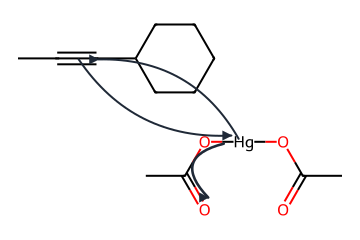
The polarized Hg(II) center accepts electron density from the alkyne, forming a bridged vinyl‑mercury adduct that activates the more substituted carbon for nucleophilic capture.
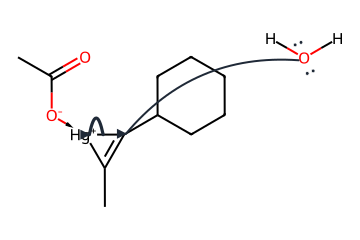
Neutral water serves as the nucleophile. Attack on the more substituted vinylic carbon (Markovnikov) collapses the bridged Hg intermediate into a syn-activated oxonium enol.
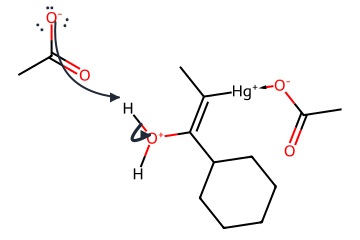
Acetate acts as the conjugate base, removing the extra proton from the oxonium. The vinyl-mercury fragment departs, leaving a neutral enol poised for tautomerization.
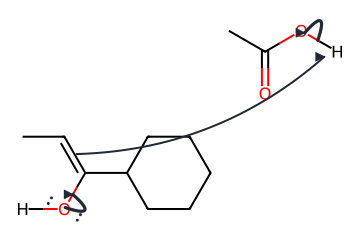
Acetic acid coordinates to the enol, allowing the enol oxygen to donate into the departing C–Hg bond while the enol π bond reaches for the acidic proton. This aligns the system for proton transfer.
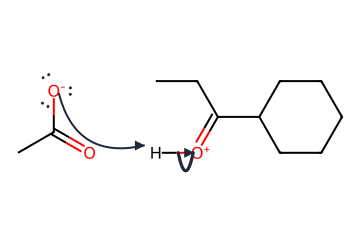
The acetate conjugate base completes the proton shuttle, stripping the oxonium proton. As the proton leaves, electrons collapse onto oxygen, installing the carbonyl and leaving a neutral ketone framework.
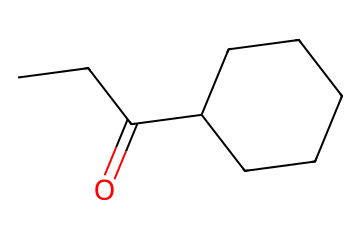
Residual proton transfers complete the tautomerization. Terminal alkynes furnish methyl ketones, whereas internal alkynes deliver the carbonyl at the more substituted carbon.
Worked Examples
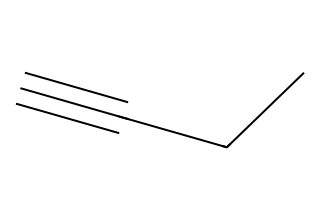
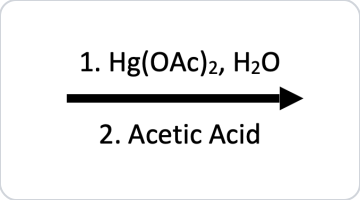
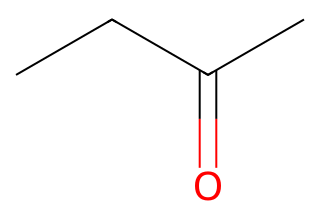
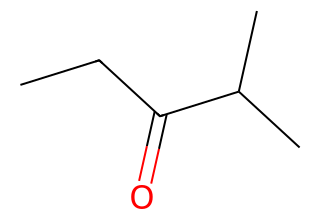
Terminal alkynes hydrate exclusively at the internal carbon, delivering methyl ketones after tautomerization.
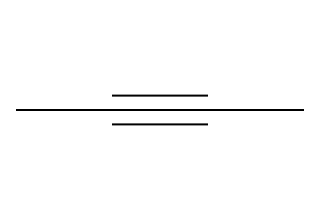
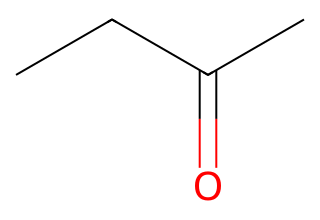
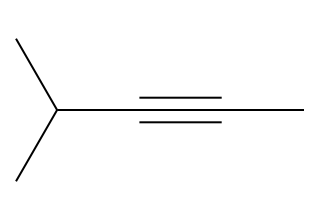
Mechanistic Checklist
- Markovnikov placement: the carbonyl carbon is the more substituted alkyne carbon; terminal alkynes furnish methyl ketones.
- Vinyl-mercury pathway avoids carbocation rearrangements—no 1,2-shifts.
- Closed-shell arrows only; no radical steps are involved.
- Tautomerization is required: the isolable product is the ketone, not the enol.
- Mercury handling is essential: vent reaction vessels, avoid skin contact, and segregate Hg waste.
Practical Tips
- AcOH/H₂O provides both the Hg(II) solvent and the proton source for tautomerization. Switching to HgSO₄/H₂SO₄ increases rate but also increases acidity—plan protecting groups accordingly.
- Acid-labile substituents (acetals, certain protecting groups) and coordinating heteroatoms (thiols, amines) can interfere—mask or remove them beforehand.
- Use hydroboration–oxidation (R₂BH then H₂O₂/NaOH) to obtain anti-Markovnikov aldehydes from terminal alkynes if that outcome is desired.
- Strip mercury from the workup with sulfide precipitation, aqueous chelators, or Hg-specific resins; never discard Hg wastes with organics.
Exam-Style Summary
Hg(OAc)₂ in AcOH/H₂O hydrates alkynes Markovnikov-selectively: electrophilic mercuration, water attack, deprotonation, and enol → ketone tautomerization yield the ketone (methyl ketone for terminal substrates). No rearrangements occur, the mechanism is closed-shell, and mercury safety is mandatory.
Related Guides
- Alkyne Hydration with HgSO₄/H₂SO₄/H₂O (Markovnikov ketones)
- Alkyne Hydroboration–Oxidation (anti-Markovnikov aldehydes)
- Alkyne Oxidation with KMnO₄ (hot) — Oxidative Cleavage
Interactive Toolbox
- Mechanism Solver — explore the six-frame Hg(OAc)₂ hydration sequence (
alkyne_oxymercuration_hgoac2). - Reaction Solver — predict ketone regiochemistry for unsymmetrical alkynes under Hg(OAc)₂ conditions.
- IUPAC Namer — verify products such as butan-2-one or 3-methylpentan-3-one.