Alcohol Acetylation with Acetic Anhydride (Ac2O / H2SO4)
Acetic anhydride under acid catalysis converts an alcohol (ROH) into an acetate ester (ROAc). Mechanistically, this is nucleophilic acyl substitution at a carbonyl (addition–elimination), not SN1/SN2 at carbon.
Quick Summary
- Reagents/conditions: Acetic anhydride (Ac₂O) + catalytic sulfuric acid (H₂SO₄).
- Outcome: ROH → ROAc (acetate ester); carbon skeleton unchanged.
- Byproduct: acetic acid (AcOH).
- Mechanism: carbonyl activation → ROH attack → collapse (acetate leaves) → deprotonation.
- Common pitfall: drawing SN1/SN2 at carbon instead of acyl substitution at the carbonyl.
Mechanism — Four Steps (Activation, Attack, Collapse, Product)
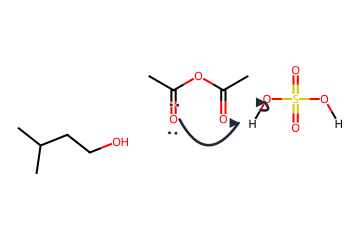
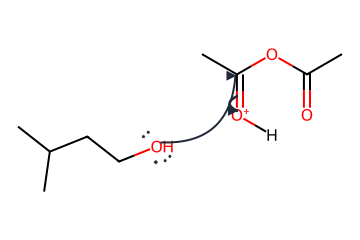
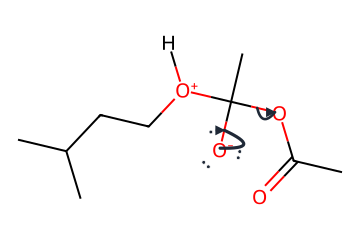
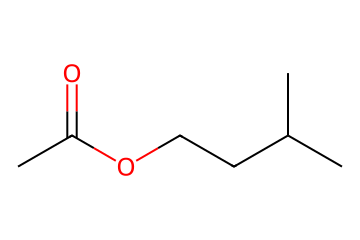
Worked Examples
Each example shows substrate → reagent → product as an acetate ester (ROAc).
Example A — Primary alcohol → acetate ester
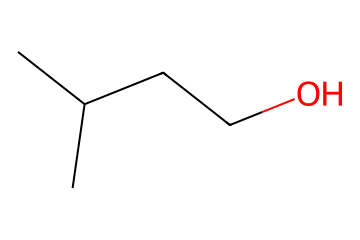
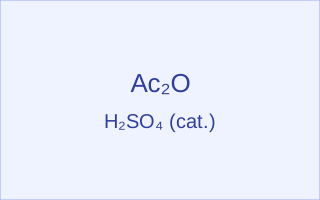
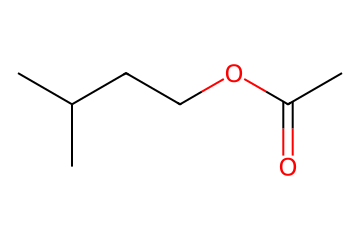
Exam cue: the O atom stays in the product (R–O–C(=O)CH₃), so this is not substitution at carbon.
Example B — Secondary alcohol → acetate ester

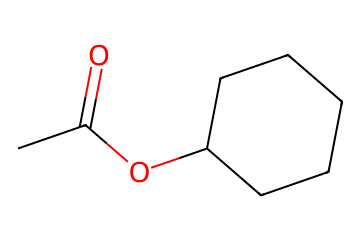
Key idea: the carbonyl is the electrophile (addition–elimination), not the alcohol carbon.
Example C — Tertiary alcohol (fringe)
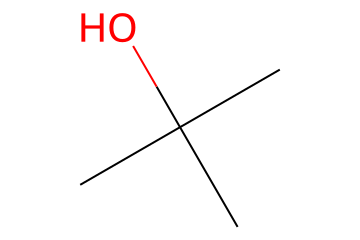
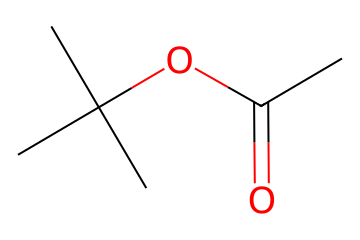
Exam trap: under strongly acidic, heated conditions, tertiary alcohols can dehydrate (E1). When Ac₂O is explicitly present, many courses still treat this as acylation to ROAc.
Scope & Limitations
- Alcohols: Primary and secondary alcohols typically acetylate cleanly; bulky substrates can be slower.
- Multiple OH groups: Polyols can acetylate more than once unless the problem specifies limited equivalents or selectivity.
- Competing nucleophiles: Amines can compete strongly (N-acetylation) if present.
- Acid sensitivity: Strongly acid-labile groups may not survive H₂SO₄ conditions.
Practical Tips & Pitfalls
- Think “carbonyl substitution” whenever you see Ac₂O (an acid derivative).
- The leaving group is acetate, and the common byproduct is acetic acid after proton transfer.
- Don’t confuse this with Fischer esterification: here the acyl donor is Ac₂O (activated), not a carboxylic acid.
Exam-Style Summary
ROH + (CH₃CO)₂O → RO–C(=O)CH₃ + CH₃CO₂H
Mechanism = activation of the anhydride carbonyl + nucleophilic addition of ROH + collapse + deprotonation.
FAQ
Is this SN1 or SN2?
Neither — it’s nucleophilic acyl substitution at a carbonyl (addition–elimination).
Where does the “acetate” piece go?
The alcohol oxygen becomes part of the ester, and the other half of the anhydride ends up as acetic acid (AcOH).
Interactive Toolbox
- Mechanism Solver — choose the Ac₂O / H₂SO₄ reagent and replay each RDKit-rendered step with curved arrows.
- Reaction Solver — test new alcohol substrates and compare against competing acid-driven transformations.
- IUPAC Namer — name the substrates and acetate ester products from the worked examples.
Related Reading
- Fischer esterification — carboxylic acid + alcohol (reversible) as the common contrast case.
- Acid chloride → ester (ROH, pyridine) — another acyl substitution route that often shows up alongside anhydrides.
- Alcohol dehydration (strong acid) — the classic competing pathway under strongly acidic, heated conditions.