Alkene Reactions: Bromohydrin Formation using Br2 and H2O
Bromohydrin formation converts alkenes into vicinal Br/OH products using Br₂ in water. The alkene polarizes Br₂, forming a three-membered bromonium ion while Br⁻ is generated. Water then attacks the more substituted carbon from the backside (anti), giving Markovnikov placement of OH (and Br on the less substituted carbon). Deprotonation yields the neutral bromohydrin. Because the mechanism does not involve free carbocations, rearrangements do not occur, and the anti relationship of Br and OH gives predictable stereochemical outcomes.
Introduction
Br₂/H₂O reacts with alkenes to produce bromohydrins through anti addition. The alkene π bond polarizes Br₂, forming a bromonium ion while releasing Br⁻. Water, the solvent nucleophile, attacks the more substituted carbon from the backside, opening the bridge. Deprotonation yields the neutral bromohydrin with OH installed at the Markovnikov position and Br on the less substituted carbon. The absence of carbocation intermediates prevents rearrangements, and the anti relationship between Br and OH provides predictable stereochemical outcomes.
Quick Summary
- Reagents: Br₂ in H₂O (or aqueous solvent mixtures). NBS in suitable aqueous media is another established route; hypobromite-based methods depend on HOBr/OBr⁻ speciation and pH.
- Outcome: Anti addition of Br and OH; OH occupies the more substituted carbon (Markovnikov), Br the less substituted carbon.
- Mechanism: Bromonium ion formation → water anti attack → deprotonation to the bromohydrin.
- Rearrangements: None (bridged bromonium prevents shifts).
- Stereochemistry: Anti describes addition from opposite faces; Br/OH are trans in the cyclic example. Achiral substrates and conditions give racemic chiral products; existing stereocenters can instead give diastereomers.
- Common pitfalls: Forgetting the bromonium intermediate, having OH add syn with Br, or using a dry nonnucleophilic solvent (which favors dibromide) or overlooking capture by another nucleophile.
Mechanism (Bromohydrin Formation)
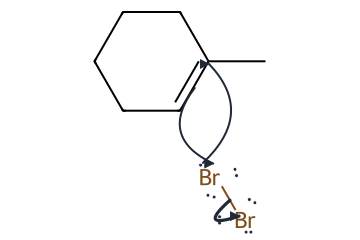
Step 1 — Bromonium formation. The alkene π bond polarizes and donates into Br₂ while the Br–Br bond heterolyzes, generating a three-membered bromonium ion and Br⁻.

Step 2 — Anti opening by water. Water approaches the bromonium from the opposite face of the bridge. Attack occurs at the more substituted carbon (greater positive character), opening the ring in an SN2-like fashion and giving an oxonium intermediate.

Step 3 — Deprotonation. Another water molecule removes the proton from oxygen, yielding the neutral bromohydrin with Br and OH anti to one another.

Step 4 — Product formation. OH is on the more substituted carbon and Br on its neighbor. This drawing shows connectivity only; anti opening predicts a trans Br/OH relationship for this cyclic substrate.
Mechanistic Checklist (Exam Focus)
- Draw the bromonium ion explicitly; no free carbocation.
- Show water attacking anti to the bridge at the more substituted carbon.
- Include the deprotonation step that yields the neutral bromohydrin.
- Highlight Markovnikov regiochemistry (OH to the more substituted carbon) and anti stereochemistry.
- In a dry nonnucleophilic solvent, Br⁻ can give dibromide; other nucleophiles can give different products.
Worked Examples
Example A — Bromohydrin Formation from 1-Methylcyclohexene
- Substrate: 1-Methylcyclohexene.
- Reagents: Br₂ (aqueous).
- Pathway: Br₂ forms a bromonium ion; water attacks the tertiary carbon anti to Br; deprotonation delivers the bromohydrin.
- Outcome: Markovnikov bromohydrin with OH at the tertiary ring carbon and Br on the adjacent, less substituted ring carbon; Br/OH anti.


When Multiple Alkenes Are Present
Electron-rich, accessible alkenes often react faster. Electronic stabilization of the bromonium and steric access for capture both matter; similar reactive sites can give mixtures.
Practical Tips & Pitfalls
- Water required: Water competes with Br⁻ for the bromonium. Dry nonnucleophilic media favor dibromide; ROH or other nucleophiles can give other products.
- Conditions: Run at 0–25 °C in subdued light to suppress radical pathways.
- Alternatives: NBS in suitable aqueous media also gives bromohydrins. Hypobromite protocols depend on pH/speciation; solvent can change the detailed pathway.
- Workup: Quench excess Br₂ with aqueous Na₂S₂O₃.
- Avoid nucleophiles: Competing nucleophiles (ROH, N₃⁻, etc.) open the bromonium and give different products.
- Stereochemistry: For a cyclic substrate, draw Br and OH trans. Check symmetry and existing chirality before assigning a racemate or diastereomeric mixture.
Exam-Style Summary
- Regiochemistry: Markovnikov — OH on the more substituted carbon, Br on the less substituted carbon.
- Mechanism: Bromonium formation → anti attack by H₂O → deprotonation.
- Intermediates: Bromonium ion; no free carbocation.
- Stereochemistry: Anti addition to the illustrated achiral cyclic substrate gives a racemic trans product; do not extend a meso/racemate rule to every substrate.
- Competing pathways: In dry nonnucleophilic media Br⁻ can give dibromides; ROH can instead give bromoethers.
Interactive Toolbox
- Practice alkene additions in Reaction Solver — practice reaction problems.
- Explore Mechanism Solver — explore reaction mechanisms.
FAQ / Exam Notes
Why is the OH Markovnikov? The more substituted carbon in the bromonium carries greater positive character, so water attacks there preferentially.
Do rearrangements occur? No. The bromonium ion prevents carbocation shifts; the carbon attacked remains fixed.
What happens without water? In a dry nonnucleophilic solvent, Br⁻ can give a vicinal dibromide. Alcohol solvents can instead give bromoethers.