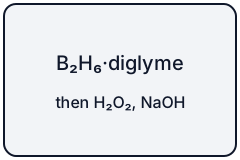
Alkene Reactions: Hydroboration using B₂H₆·diglyme, then H₂O₂/NaOH
Borane–diglyme solutions (B₂H₆·diglyme) dispense BH₃, which hydroborates an alkene syn and places boron on the less substituted carbon. Basic hydrogen peroxide (H₂O₂/NaOH) then converts the C–B bond into a C–O bond with retention at the migrating carbon, producing the anti-Markovnikov alcohol while preserving the syn relationship between H and OH. Throughout the sequence the mechanism stays closed-shell—no carbocations, no radicals, no rearrangements. For a side-by-side comparison with the classic borane–THF protocol, visit our BH₃·THF hydroboration guide.
Quick Summary
- Reagents/conditions: Step 1 B₂H₆·diglyme (0–25 °C, anhydrous ether). Step 2 H₂O₂ + NaOH(aq) (0–25 °C).
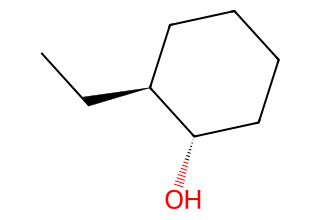
- Outcome: Anti-Markovnikov hydration; the new OH lands where B entered, preserving overall syn delivery of H/OH.
- Regioselectivity: Boron adds to the less substituted alkene carbon; oxidation maps B → OH at that same carbon.
- Stereochemistry: Hydroboration is syn and the migration is retentive, so H and OH remain on the same face.
- No rearrangements: The entire pathway is polar and closed-shell—no carbocations, radicals, or peroxide-effect inversions.
Mechanism (7 Steps)
Class: Borane–diglyme release of BH₃ followed by syn hydroboration, peroxide addition, retentive migration, collapse, and hydrolysis.
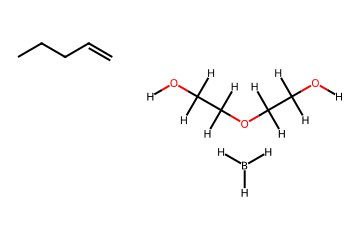
Commercial borane reagents often arrive as B₂H₆ coordinated by diglyme. The dimer dissociates to BH₃ units that remain solvated by the ether.
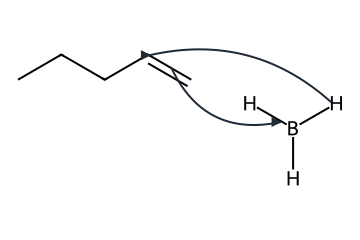
The syn addition can repeat up to three times per BH₃, furnishing a trialkylborane prior to oxidation.
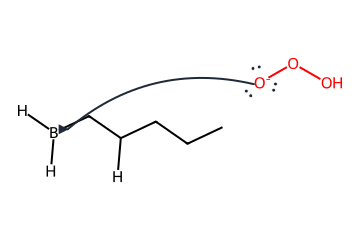
The peroxo anion is the nucleophile; base is required to generate it and to support downstream migration.
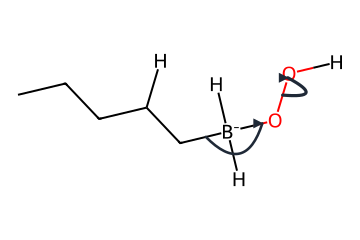
This intramolecular migration maintains configuration at carbon and sets up the C–O bond that will become the alcohol.
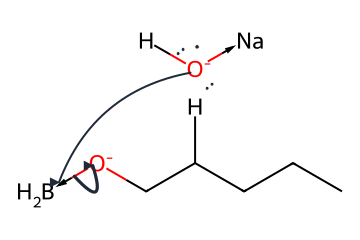
The migration triggers B–O bond reorganisation, leaving the carbon attached to oxygen and expelling boron into a borate framework.
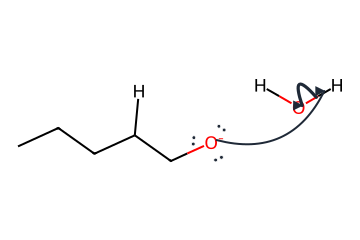
Water and peroxide supply the oxygen source and convert boron into soluble borates.
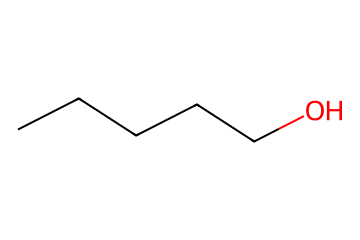
The final alcohol retains the stereochemical relationship set during hydroboration.
Mechanistic Checklist
- Hydroboration is concerted and syn; boron chooses the less substituted carbon while hydride hits the more substituted carbon.
- Oxidation is retentive at carbon: B → O migration keeps configuration, so the product preserves syn H/OH.
- No rearrangements or radicals occur; the sequence is polar throughout.
- One BH₃ unit can hydroborate up to three double bonds (B₂H₆ provides two BH₃), though stoichiometric control often ensures full conversion.
- Bulky boranes (9-BBN, disiamylborane) follow the same logic but enhance terminal selectivity if needed.
Worked Examples
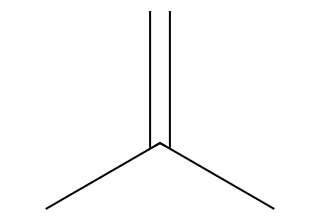
Multiple Alkenes & Selectivity
- Less hindered, electron-rich double bonds hydroborate fastest; trialkylborane formation can distribute across multiple alkenes.
- Limiting equivalents of borane or using bulky boranes curbs over-addition and favours terminal selectivity.
- Coordinating groups (allylic alcohols, amines) can modestly bias delivery, but the general regioselectivity remains anti-Markovnikov.
Practical Tips & Pitfalls
- Handling: Borane–diglyme is moisture sensitive and can fume—keep cold, under inert atmosphere, and vent carefully.
- Order of addition: Allow hydroboration to reach completion before introducing the H₂O₂/NaOH mixture; peroxide without base reacts sluggishly.
- Workup: Flush borates thoroughly; they cling to glassware. Rinse with peroxide-containing aqueous base, then water.
- Safety: H₂O₂ is an oxidizer—add slowly to control heat, especially once boranes are present.
- Clarify: The anti-Markovnikov outcome is polar, not the radical “peroxide effect” seen with HBr/ROOR.
Exam-Style Summary
- Reagents: B₂H₆·diglyme, then H₂O₂/NaOH.
- Mechanism: BH₃ release → syn hydroboration → peroxide addition → retentive alkyl migration → borate collapse → hydrolysis.
- Outcome: Anti-Markovnikov alcohols with syn H/OH; no rearrangements.
- Selectivity: Boron targets the less substituted carbon; bulky boranes can boost terminal preference when required.
Interactive Toolbox
- Compare hydroboration–oxidation to acid hydration (Markovnikov, rearrangements) in the Reaction Solver.
- Export all seven mechanism panels for study sheets via the Mechanism Explorer.
FAQ / Exam Notes
Why does boron add to the less substituted carbon? Sterics and polarisation stabilize the four-centre transition state with boron at the less hindered terminus—minimising steric clash and aligning the developing δ⁺ on boron with the more substituted carbon.
Is the overall addition syn or anti? Hydroboration is syn and the migration retains configuration, so the final OH and H are syn. Racemates form when new stereocentres arise in achiral conditions.
Can I use other boranes? Yes. 9-BBN, disiamylborane, and similar reagents follow the same oxidation sequence but give higher terminal selectivity.
Does peroxide ever trigger radical chains? Not here. Under strongly basic conditions HOO⁻ behaves as a nucleophile, not a radical initiator, so no “peroxide effect” is observed.