Alkene Reactions: Sharpless Asymmetric Epoxidation
Sharpless asymmetric epoxidation converts a primary or secondary allylic alcohol into an enantioenriched 2,3-epoxy alcohol using titanium isopropoxide, tert-butyl hydroperoxide, and a chiral tartrate ester ((+)/(–)-DET or DIPT). The free allylic OH binds titanium and organizes a chiral pocket that selects the alkene face according to the Sharpless mnemonic: orient the C=C horizontally with the OH at the lower-right corner—(+)-DET delivers oxygen to the bottom face, (–)-DET to the top face. Typical procedures employ dry CH₂Cl₂, molecular sieves, −20→0 °C, and rigorously anhydrous reagents to maintain high ee.
Want to explore variations? Predict products with the Reaction Solver, request step-by-step SVG panels from the Mechanism Solver, and double-check systematic names using the IUPAC Namer.
Quick Summary
- Reagents/conditions: Ti[Oi-Pr]₄ (5–10 mol %), (+)/(–)-DET (or DIPT), t-BuOOH (1.1–1.5 equiv), CH₂Cl₂, 3 Å or 4 Å molecular sieves, −20→0 °C.
- Outcome: Enantioenriched 2,3-epoxy alcohol (high ee when water is excluded).
- Mnemonic: Draw the allylic alcohol with OH at the lower-right. (+)-DET adds from the bottom face; (–)-DET from the top. Position flips if the OH is drawn on the lower-left.
- Scope caveat: Requires a free allylic OH; tertiary allylic alcohols and non-allylic alkenes react sluggishly.
- Alternatives: Jacobsen–Katsuki or Shi epoxidations address alkenes lacking an allylic OH.
Mechanism (5 Steps)
Class: Titanium-mediated oxygen transfer; closed-shell (no radicals or carbocations).
All mechanism frames shown below use 1-(hydroxymethyl)cyclohex-1-ene as the representative allylic alcohol; the Sharpless mnemonic applies identically to acyclic systems.
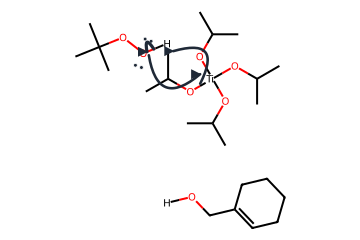
Tartrate chelates titanium, displacing isopropoxide ligands and setting the chiral environment that enforces face selectivity.
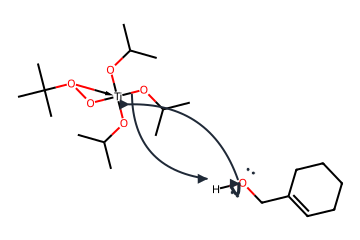
The allylic OH must be free; it binds Ti as an alkoxide and fixes the alkene geometry relative to the tartrate.
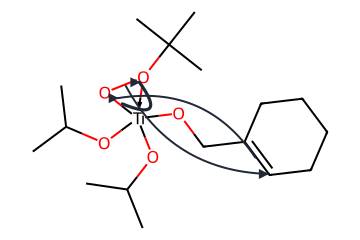
The hydroperoxide coordinates through its peroxy oxygen, positioning the reactive O–O bond for intramolecular delivery.
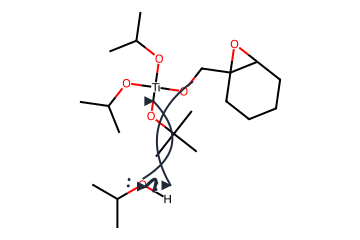
The distal peroxide oxygen inserts into the alkene as the O–O bond breaks; the alkoxide donates its proton to the tert-butyl fragment, resetting the hydroperoxide and maintaining charge balance.
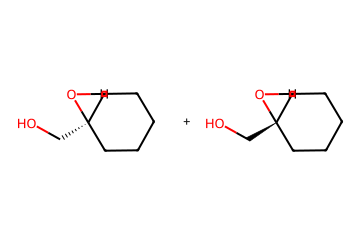
Protic workup breaks the Ti–alkoxide link, delivering isolated rel-(1S,6S)-1-(hydroxymethyl)-1,2-epoxycyclohexane.
Mechanistic Checklist
- A free allylic OH is mandatory; silyl-protected or tertiary allylic alcohols give little to no reaction.
- Catalyst trio: Ti[Oi-Pr]₄ + t-BuOOH + (+)/(–)-DET (or DIPT). Molecular sieves and cold, dry solvent preserve ee.
- Mnemonic: OH lower-right → (+)-DET attacks from below, (–)-DET from above. Drawn lower-left? Flip the assignment.
- Closed-shell pathway: No radicals, no carbocations—oxygen transfer is polar and concerted.
- Kinetic resolution is possible for secondary allylic alcohols with sub-stoichiometric t-BuOOH.
Worked Examples
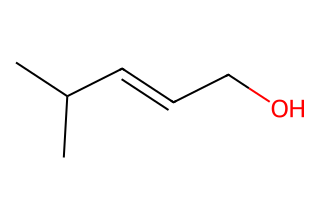
![Reagents: Ti[Oi-Pr]₄, t-BuOOH, (+)/(–)-DET](/assets/reaction-library/alkene-sharpless-epoxidation-reagent.svg)
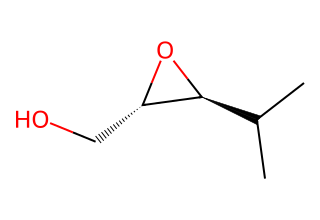
Multiple Alkenes & Selectivity
- The allylic OH dictates reactivity: distant, non-allylic alkenes are usually untouched under standard conditions.
- If multiple allylic alcohols are present, the less hindered site binds Ti fastest; ee can drop when chelation competes.
- For substrates lacking a coordinating OH, switch to Jacobsen–Katsuki or Shi epoxidation protocols instead.
Practical Tips & Pitfalls
- Keep it dry and cold: Dry CH₂Cl₂, 3 Å/4 Å sieves, and −20→0 °C are standard to maintain high ee.
- Use anhydrous t-BuOOH: Peroxide in decane works best; aqueous TBHP erodes both rate and enantioselectivity.
- DET vs DIPT: Diisopropyl tartrate (DIPT) often improves ee for hindered substrates—test both enantiomers if needed.
- Free OH required: Protecting the allylic OH abolishes the chelate and collapses selectivity.
- Avoid over-oxidation: Excess peroxide or warmer temperatures can trigger allylic oxidation instead of epoxidation.
Exam-Style Summary
- Reagents: Ti[Oi-Pr]₄, t-BuOOH, (+)/(–)-DET (or DIPT), sieves, cold CH₂Cl₂.
- Mechanism: Ti–tartrate assembly → allylic alkoxide binding → hydroperoxide activation → enantioselective oxygen transfer → hydrolysis.
- Mnemonic: OH lower-right → (+)-DET gives bottom-face epoxide, (–)-DET top-face; flip if OH drawn lower-left.
- Scope: Primary/secondary allylic alcohols excel; no reaction when OH is protected or absent.
Interactive Toolbox
- Practice the mnemonic by sketching the allylic alcohol so OH sits lower-right, then assign (+)/(–)-DET faces.
- Compare to our peracid epoxidation/workup sequence for alkene epoxidation without chiral induction.
FAQ / Exam Notes
Why must the allylic OH be free? The hydroxyl coordinates to titanium; without that chelation the chiral pocket collapses and selectivity disappears.
Can I run the reaction warm or with aqueous peroxide? Moisture and higher temperatures rapidly erode ee—use sieves, dry solvent, and anhydrous t-BuOOH.
What if my substrate lacks an allylic OH? Switch to Jacobsen–Katsuki (salen Mn) or Shi (dioxirane) epoxidations tailored for unfunctionalized alkenes.
How do I predict the product configuration? Apply the Sharpless mnemonic: orient the allylic OH at the lower-right, (+)-DET attacks from below, (–)-DET from above; flip the rule if the OH sits lower-left in your drawing.