Alkyne Reactions: Catalytic Hydrogenation with H₂ (Pd/Pt)
Molecular hydrogen over supported palladium or platinum (Pd/C, Pt/C, PtO₂), with sufficient H₂, normally reduces alkynes completely to alkanes. Each π-bond reduction consumes one H₂ through two surface H transfers: four H atoms, or two H₂ molecules, are needed per alkyne. The sequence passes through surface vinyl, alkene, and surface alkyl stages. Alkene desorption can compete, but standard unpoisoned Pd/Pt commonly continues to the alkane. Lindlar or a related partially poisoned catalyst is the standard choice for selective partial reduction; suitable internal alkynes give cis-alkenes. Dissolving-metal reduction (Na/NH₃(l), covered separately) gives the corresponding trans-alkenes.
This guide uses ethynylcyclohexane as the mechanism showcase and walks through practical shortcuts, selectivity warnings, and a worked example for applying the hydrogen stoichiometry.
Quick Summary
- Reagents/conditions: H₂ (balloon to autoclave pressures) with Pd/C, Pt/C, or PtO₂ in EtOH, EtOAc, AcOH, or hexanes; room temperature to reflux.
- Outcome (Pd/Pt): Two H₂ equivalents deliver four H atoms, reducing each C≡C to a C–C single bond (alkane).
- Partial stop: Lindlar (poisoned Pd) furnishes the cis-alkene selectively; unpoisoned Pd/Pt races to the alkane.
- Stereochemistry: Surface hydrogenation normally delivers each H pair syn. A terminal alkene intermediate has no cis/trans designation; alkene desorption competes with further reduction.
- Side chemistry: Pd/Ni catalysts can hydrogenolyze benzylic/allylic protections and reduce nitro or azide groups; adjust protecting-group strategy.
Mechanism (6 Surface Steps)
Class: Heterogeneous catalytic hydrogenation through surface vinyl and Horiuti–Polanyi alkyl intermediates. The ethynylcyclohexane illustrations are surface-site schematics: Pd symbols represent sites on a metal surface, and C–Pd bonds mark σ-bound intermediates.

The metal surface splits H₂ into adjacent hydrides. The ethynylcyclohexane remains in solution while the surface loads up with syn-deliverable hydrogen equivalents.

Ethynylcyclohexane approaches the surface. One H transfers to an alkyne carbon while the adjacent carbon forms a C–Pd bond, giving a surface vinyl intermediate rather than a free alkene.
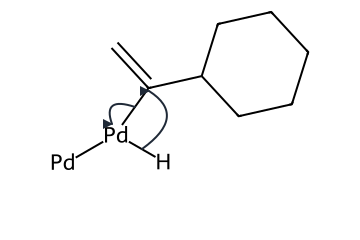
The remaining H transfers to the carbon bonded to Pd, and the C–Pd bond breaks. One H₂ has now been added overall, giving vinylcyclohexane. Its terminal CH₂=C group has no cis/trans designation.

The alkene can remain at the surface or desorb and re-adsorb. Under complete-reduction conditions, another H₂ supplies two H atoms; the next transfer begins formation of a σ-bound alkyl intermediate.
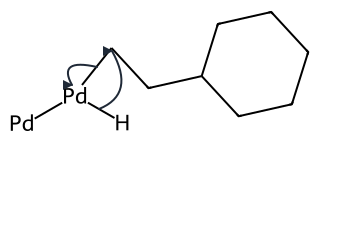
After the third H transfer, the former double bond is single and one carbon remains bonded to Pd. Transfer of the remaining surface H, with C–Pd cleavage, completes ethylcyclohexane.

The C8 skeleton is unchanged. Both π bonds have been reduced, adding four H atoms overall; the surface can load H₂ and accept another substrate.
Mechanistic Checklist
- Four surface H transfers, supplied by two H₂ molecules, drive C≡C → alkane under standard complete-reduction conditions.
- Alkene desorption competes with continued reduction; Lindlar is the standard selective partial-reduction choice.
- The carbon skeleton is retained; complete reduction does not create a regioisomer choice across the former triple bond.
- Surface hydrides deliver closed-shell electron flow (no radicals or carbocations in solution).
- Selectivity hinges on catalyst choice: Lindlar for cis-alkenes, dissolving-metal reduction (Na/NH₃(l)) for trans-alkenes.
- Beware hydrogenolysis of benzyl/allyl groups and reduction of nitro or azide moieties on Pd/Ni surfaces.
Worked Example
Example A — Internal alkyne → alkane

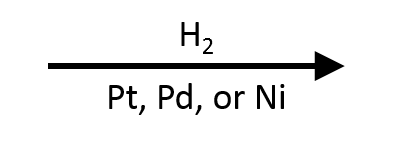

Teaching point: Hex-3-yne consumes two H₂ equivalents to form hexane. Under standard Pd/C complete-reduction conditions, the alkene intermediate normally undergoes further hydrogenation.
Multiple Unsaturations & Selectivity
- Alkynes bind the surface strongly and typically hydrogenate before isolated alkenes present in the same molecule or mixture.
- With excess H₂ and unpoisoned Pd/Pt, expect global saturation of accessible C=C and C≡C sites.
- To isolate a cis-alkene, select Lindlar (Pd/BaSO₄ or Pd/CaCO₃ with quinoline) or related partially poisoned catalysts.
- For selective trans-alkene formation from suitable internal alkynes, choose dissolving-metal reduction (Na/NH₃(l)); standard Pd/Pt complete hydrogenation is not the selective E-alkene method.
Practical Tips & Pitfalls
- Catalyst handling: Pd/C and Pt/C are pyrophoric when dry—store wet, filter carefully, and quench spent catalyst under inert or aqueous conditions.
- Gas delivery: Provide vigorous stirring and a steady H₂ source (balloon, bubbler, or pressure reactor) to avoid mass-transfer limits.
- Selectivity control: Do not rely on limiting H₂ to stop at an alkene; poisoning the surface is the reliable strategy.
- Functional groups: Watch for hydrogenolysis of benzyl/allyl protections, reduction of nitro or azide groups, and potential halide hydrogenolysis.
- Solvent choice: Alcohols (EtOH), esters (EtOAc), or acetic acid are common media; avoid unintended poisons unless partial reduction is desired.
Exam-Style Summary
H₂ over Pd or Pt normally reduces alkynes to alkanes with two H₂ equivalents through four surface H transfers. Alkene desorption is possible, but continued reduction is common under these conditions. For selective partial reduction, use Lindlar or a related catalyst; suitable internal alkynes give cis-alkenes. The carbon skeleton is retained, but sensitive protecting groups may hydrogenolyze.
Interactive Toolbox
- Mechanism Solver — explore reaction mechanisms.
- Reaction Solver — practice product prediction.
- IUPAC Namer — verify systematic names for substrates and products.
FAQ / Notes
Why is each addition syn? Both hydrogens originate from the same metal face; surface delivery enforces syn addition for each step.
Can I stop at the alkene by limiting H₂ with Pd/C? Generally no. The second syn delivery is fast on unpoisoned catalysts, so switch to Lindlar or another poisoned system for cis-alkenes.
Will aromatic rings reduce under these conditions? Mild Pd/Pt at balloon pressure leaves arenes intact, but harsh Ni or high-pressure systems can hydrogenate aromatic rings.
What about stereochemistry in the starting alkyne? Pre-existing remote stereogenic centers are generally retained. Complete hydrogenation makes the former alkyne carbons CH₂ or CH₃ groups, so it does not create new stereocenters there; a terminal alkene intermediate also has no E/Z designation.