Alkyne Reactions: Oxidation with KMnO4 (Mild vs Hot)
Potassium permanganate oxidizes alkynes through closed-shell pathways whose outcomes hinge on temperature and concentration. Cold, dilute, neutral-to-basic KMnO4 delivers syn addition across the C≡C bond, hydrolyzes to an enediol, and settles as a α-dicarbonyl (internal) or an α-keto acid (terminal). Under hot, concentrated, or prolonged permanganate, oxidation progresses toward C–C cleavage: manganese-bound fragments collapse to carbonyl species, terminal carbons over-oxidize to CO₂ or ketene, and acid workups reveal the fully oxidized products.
This guide follows 1-(but-2-yn-1-yl)cyclohexane through both regimes so you can compare frame-by-frame: syn manganate addition, enediol formation, and diketone delivery under mild settings, then additional MnO₄⁻ engagement, C–C scission, and protonation under hot, oxidative conditions. The narrated steps match the OrgoSolver Mechanism Solver output, so every frame lines up with what you will see in the app and in regression tests.
Quick Summary
- KMnO4 (cold, dilute, neutral/basic): syn manganate ester → enediol → α-dicarbonyl (internal) or α-keto acid (terminal) plus MnO₂(s).
- KMnO4 (hot, concentrated, oxidative workup): additional MnO₄⁻ induces C–C scission, giving aldehydic/carboxylate fragments; terminal carbons vent CO₂ or ketene.
- Conditions dictate outcome: ice baths and dilute permanganate cap oxidation at the diketone; heat, concentration, or extended exposure switches to cleavage.
- Solvent and pH: basic media favours enediol opening; acidic workups protonate carboxylates and liberate CO₂.
- Observation cues: purple → green → brown in solution (Mn(VII) → Mn(IV)) alongside gas evolution for terminal substrates.
Mechanism — Mild / Neutral KMnO4 (3 Frames)
Showcased substrate: 1-(but-2-yn-1-yl)cyclohexane → 4-cyclohexylbutane-2,3-dione.
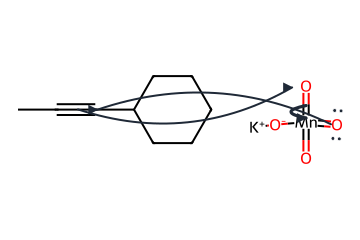
The alkyne π bond attacks an equatorial oxygen while the Mn=O bond reorganises. Both oxygens land syn, locking the substrate into a bridged manganate complex.
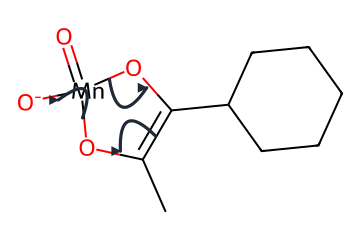
Water displaces manganese from the carbon–oxygen bonds, unveiling a vicinal diol in its enediol form. Brown MnO₂ deposits as Mn(VII) is reduced.
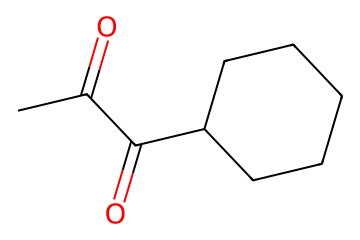
Proton transfers and Mn-mediated oxidation convert the enediol to a stable 1,2-diketone (or α-keto acid for terminal alkynes). No C–C bonds break under these conditions.
Mechanism — Hot / Concentrated KMnO4 (5 Frames)
Showcased substrate: 1-(but-2-yn-1-yl)cyclohexane under excess KMnO₄, heat, and acidic workup.
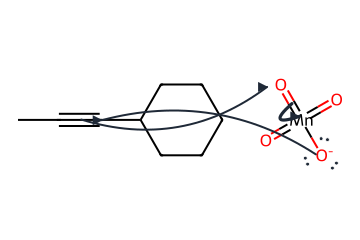
The 4-cyclohexylbutane-2,3-dione formed under mild conditions remains susceptible; hot MnO₄⁻ engages both carbonyl oxygens to re-form a chelated manganate complex.
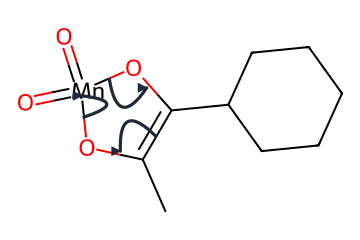
Electron density migrates from the C–C σ bond into Mn–O, priming the bond between the former alkyne carbons for oxidative cleavage.
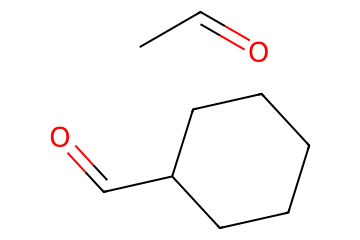
The central bond snaps, distributing electrons into the Mn–O network. Each fragment remains tethered to Mn as an acyl species, ready for further oxidation.
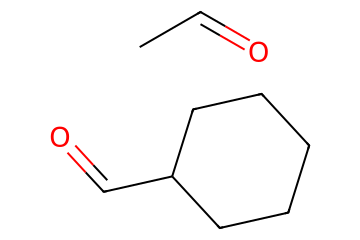
Hot permanganate strips additional electron density, producing manganese-bound carboxylates and releasing the smallest fragment as CO₂ or a ketene that hydrolyses to acetic acid.
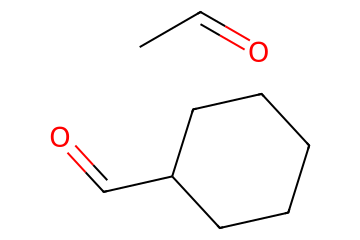
After filtering MnO₂(s), acidic conditions liberate the neutral carbonyl products. The larger fragment appears as cyclohexane-1-carbaldehyde; the smaller fragment exits as ketene/CO₂, which in aqueous media becomes acetic acid or carbonate.
Mechanistic Checklist (Exam Focus)
- Mild KMnO₄: syn addition + hydrolysis stops at α-dicarbonyls (internal) or α-keto acids (terminal).
- Hot/excess KMnO₄: sequential oxidation breaks the C≡C bond to carbonyl fragments, venting CO₂/ketene from terminal carbons.
- No radicals required — all steps proceed through closed-shell manganate intermediates.
- Mn(VII) → Mn(IV) reduction accompanies both pathways; a brown MnO₂ precipitate is a diagnostic cue.
- Explicitly note temperature, concentration, and workup in mechanisms or synthesis problems — they define which manifold appears.
Worked Examples
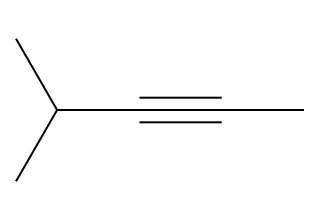
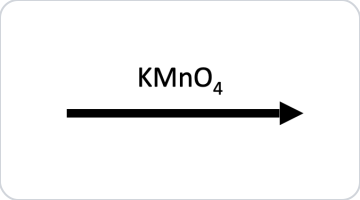
Neutral/basic workup preserves the α-dicarbonyl.
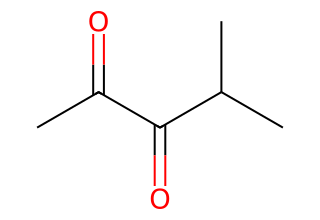
Example A highlights the textbook outcome: 4-methylpent-2-yne oxidises syn to 4-methylpentane-2,3-dione, an α-dicarbonyl verified with the OrgoSolver IUPAC Namer.

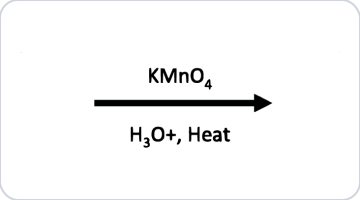
Extended oxidative exposure drives C–C cleavage.
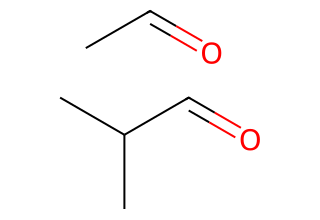
Example B shows the same alkyne under harsh conditions. KMnO₄ cleaves the C≡C bond to give 2-methylpropanal and a ketene fragment that rapidly hydrates to acetic acid — matching the OrgoSolver mechanism frames.
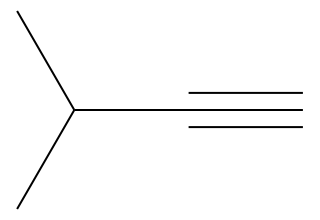
Terminal alkynes oxidise to α-keto acids here.
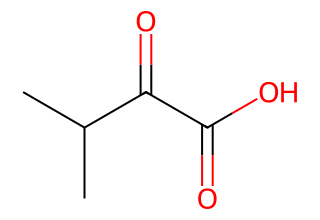
Example C illustrates the terminal case: 3-methylbut-1-yne becomes 3-methyl-2-oxobutanoic acid (α-keto isovaleric acid) under neutral permanganate conditions.
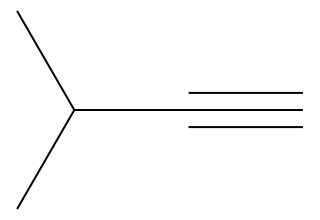
Terminal carbon expels CO₂ under these conditions.
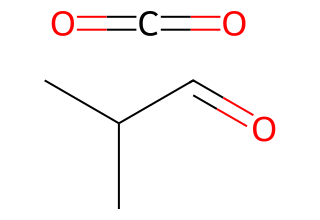
Example D combines terminal oxidation with cleavage: the internal fragment again becomes 2-methylpropanal, while the terminal carbon exits as CO₂/ketene that hydrolyses to acetic acid. Gas evolution is a hallmark of this regime.
Multiple Unsaturations & Selectivity
- Hot KMnO₄ is indiscriminate — every accessible π bond (C=C or C≡C) trends toward cleavage. Protect or remove other unsaturations if selective oxidation is required.
- Mild conditions typically oxidise the least hindered or most electron-rich alkyne first, but extended exposure will reach the remaining sites.
- Sensitive motifs (allylic alcohols, sulfides, aldehydes) over-oxidise readily; quench once the desired α-dicarbonyl forms.
Practical Tips & Pitfalls
- Maintain low temperature, dilute KMnO₄, and neutral/basic media to stop at α-dicarbonyls/α-keto acids.
- Monitor colour changes: purple → green → brown MnO₂(s). Filtering MnO₂ before acidifying prevents sludge and carries less manganese into workup.
- Introduce permanganate slowly; it is a strong oxidizer with significant exotherms. Neutralise and dispose of Mn residues responsibly.
- For hot oxidations, ventilate well — expect CO₂ (and occasionally ketene that hydrolyses downstream) when terminal carbons are present.
Exam-Style Summary
- Specify conditions: “KMnO₄ (cold, dilute, HO⁻)” implies α-dicarbonyl/α-keto acid; “KMnO₄ (hot, conc.), H₃O⁺” signals oxidative cleavage.
- Draw the syn manganate ester → enediol → diketone sequence for mild conditions.
- When hot, extend the mechanism: additional MnO₄⁻ coordination, C–C scission, and protonation to carbonyl fragments/CO₂.
- Highlight Mn(VII) → MnO₂ reduction and the absence of radical intermediates — every frame is closed-shell.
Related Guides
- Alkene Reactions: Ozonolysis with O₃ / DMS (Reductive)
- Alkene Reactions: Ozonolysis with O₃ / H₂O₂ (Oxidative)
- Alkyne Reactions: Ozonolysis to Carboxylic Acids (O₃ / H₂O)
Interactive Toolbox
- Mechanism Solver — step through the mild and hot KMnO₄ pathways (
alkyne_kmno4MechanismFunction&alkyne_kmno4_hotMechanismFunction) with OrgoSolver’s frames. - Reaction Solver — compare permanganate oxidation outcomes against ozonolysis or hydroboration for the same alkynes.
- IUPAC Namer — confirm names such as 4-methylpentane-2,3-dione, 3-methyl-2-oxobutanoic acid, and cyclohexane-1-carbaldehyde.