Hofmann elimination of quaternary ammonium salts
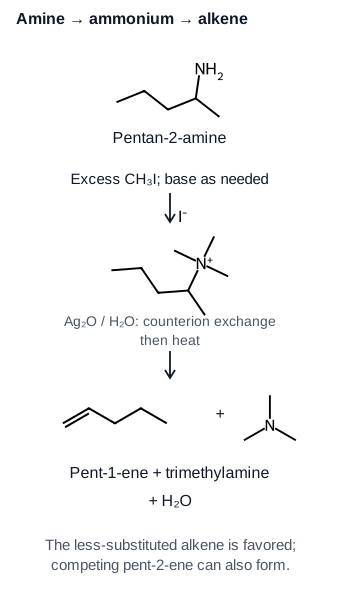
Hofmann elimination converts a quaternary ammonium salt into an alkene and a neutral tertiary amine. In the usual amine-to-alkene sequence, first methylate the amine exhaustively, then exchange the counterion for hydroxide, and finally heat. The less-substituted alkene is often favored, but that preference does not replace checking beta hydrogens and elimination geometry.
At a glance
- Reagents and conditions: 1) Excess iodomethane (CH₃I), with base as needed between N–H alkylations; 2) silver(I) oxide (Ag₂O) and water to form the ammonium hydroxide; 3) heat for elimination.
- Products: Alkene, neutral tertiary amine and water.
- Mechanism class: E2 beta elimination from the quaternary ammonium hydroxide.
- Regioselectivity: The less-substituted alkene is commonly favored.
- Stereochemistry: The illustrated E2 pathway uses an anti-periplanar arrangement; the worked pent-1-ene product has no E/Z isomerism.
- Key exam point: Positively charged quaternary nitrogen leaves as a neutral tertiary amine, not as an ammonium cation.
Mechanism
The carbon attached directly to nitrogen is alpha; the next carbon is beta. Hydroxide removes a beta hydrogen while the C–H pair forms the C=C bond and the C–N pair returns to nitrogen. These changes belong to one concerted event.
The drawing uses an anti conformer of pentan-2-yltrimethylammonium hydroxide. Blue traces the N(CH₃)₃ fragment into the trimethylamine product; red arrows show electron pairs.
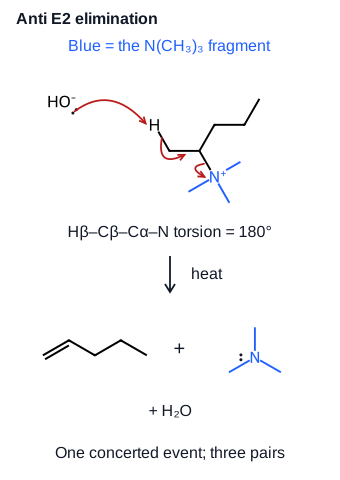
Exhaustive methylation is preparation of the leaving group, not the elimination itself. Ag₂O and water exchange iodide for hydroxide; the heated ammonium hydroxide then undergoes the E2 step shown above.
Scope, limits and traps
- Prepare the leaving group first. A free amine does not behave like the quaternary ammonium salt: NH₂⁻ would be a poor leaving group.
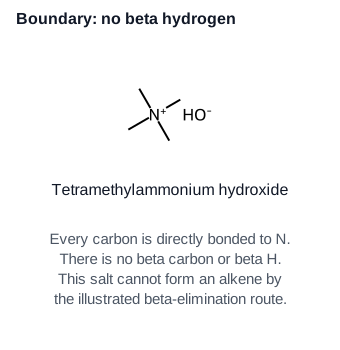
- Find a real beta H. Hydrogens on an N-methyl carbon are alpha, not beta. Those methyl arms have no next carbon; a salt with no beta H cannot give an alkene by this beta-elimination route.
- Check every eligible N-alkyl arm. Other alkyl groups can also contain beta hydrogens. Their elimination may give a different alkene and a tertiary amine other than trimethylamine.
- Treat the Hofmann preference as a trend. Access to less-hindered beta hydrogens often favors the less-substituted alkene. Conformation, especially in rings, can change the accessible products; the name alone does not specify one E/Z outcome or exclude all competing alkenes.
Worked examples
Example 1: Pentan-2-yltrimethylammonium hydroxide
Heating N,N,N-trimethylpentan-2-aminium hydroxide favors pent-1-ene, with trimethylamine and water as the other products. The starting hydroxide salt is already quaternized; no further methylation belongs in this elimination step.
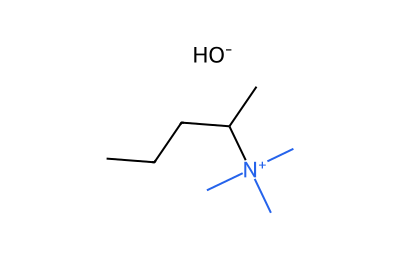
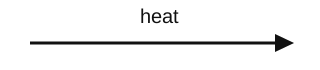
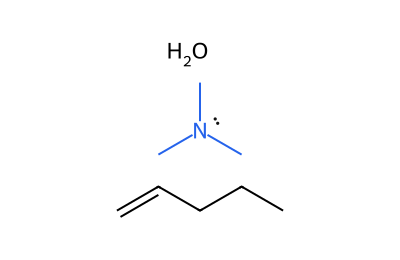
Removing a hydrogen from the terminal methyl side makes pent-1-ene. Removal from the internal methylene side would instead make the more-substituted pent-2-ene, a competing regioisomer. Count both sites before applying the preference.
Compare and contrast
| Reaction | Starting group and conditions | Main transformation |
|---|---|---|
| Ammonium Hofmann elimination | Quaternary ammonium hydroxide, heat | C–N cleavage gives an alkene and neutral tertiary amine |
| Bulky-base E2 giving a Hofmann product | Alkyl halide with a bulky base such as KOtBu | C–halogen cleavage can favor the less-substituted alkene |
| Hofmann rearrangement | Primary amide with Br₂/aqueous base | An amine forms with one fewer carbon |
Tools
- Open Reaction Solver Pro for manual input. Use the ammonium hydroxide structure and heating conditions shown above; this generic link has no example inputs preloaded.
- Open the Mechanism Solver for general arrow-pushing practice.
- Open the IUPAC Namer for naming practice.