Aromatic Reactions: Friedel–Crafts Alkylation (RCl, AlX₃)
Friedel–Crafts alkylation installs an alkyl group (–R) onto benzene and substituted arenes via electrophilic aromatic substitution (EAS). A Lewis acid such as AlCl₃ (AlBr₃ or FeCl₃ behave similarly) activates an alkyl halide (RCl) to generate a carbocation-like electrophile (R⁺). The arene attacks this electrophile, forming a σ-complex that rearomatizes after deprotonation; aqueous workup releases the alkylbenzene product. Unlike acylation, the –R product is an activating ortho/para director, so polyalkylation can occur. Additionally, primary and secondary alkyl halides may undergo carbocation rearrangements to more stable carbocations before ring attack—a key pitfall that distinguishes alkylation from acylation.
Key Emphasis (Teaching Pivots)
- Electrophile identity: Carbocation (R⁺) or carbocation-like species generated from RCl plus AlCl₃/AlBr₃/FeCl₃. The Lewis acid polarizes the C–X bond, making carbon electrophilic.
- Carbocation rearrangements: Primary carbocations rearrange to secondary; secondary can rearrange to tertiary. Methyl and tertiary alkyl halides do not rearrange. This is the major pitfall of FC alkylation.
- Canonical EAS pattern: π-attack → σ-complex (Wheland) → deprotonation → aromaticity restored.
- Polyalkylation risk: –R is activating and ortho/para-directing, so multiple alkyl groups can add unless stoichiometry is controlled.
- Acylation–reduction workaround: To avoid rearrangements, use FC acylation followed by Clemmensen or Wolff–Kishner reduction to obtain un-rearranged alkylbenzenes.
Quick Summary
- Reagents/conditions: RCl with AlCl₃/AlBr₃/FeCl₃ in dry CH₂Cl₂ or other aprotic solvent.
- Electrophile: Carbocation (R⁺) or carbocation-like species generated by Lewis acid coordination to the halide.
- Outcome: Ar–H → Ar–R; product alkyl group is activating and ortho/para-directing.
- Selectivity: Ortho/para directors lead to o/p alkylation (para often favored sterically); meta directors yield meta if the substrate is reactive enough.
- Rearrangement warning: Primary → secondary → tertiary carbocation rearrangements are common. n-Propyl chloride may give isopropylbenzene; n-butyl chloride may give tert-butylbenzene or sec-butylbenzene.
- Limitations: Strong EDG (–NH₂, –OH) bind the Lewis acid and must be protected; strong EWGs (–NO₂, –CF₃, –SO₃H) prevent alkylation entirely.
Mechanism — Friedel–Crafts Alkylation (5 Frames; arrows A–E)
Each frame below uses benzene and methyl chloride as the reference substrate.
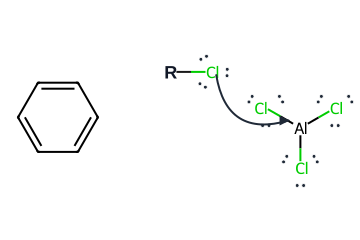
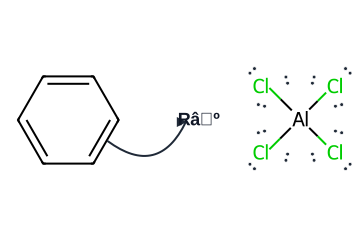
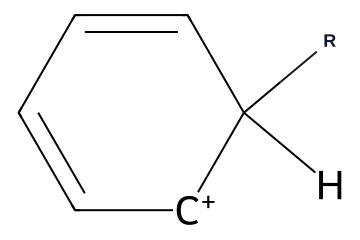
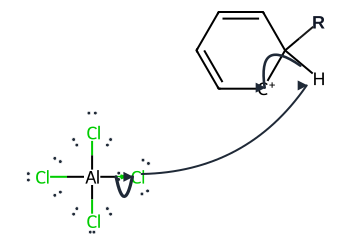
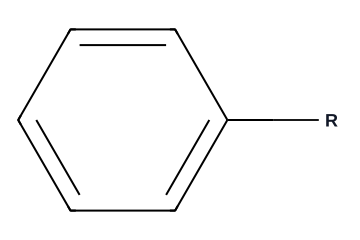
Orientation is handled by the global EDG/EWG map: activators (alkyl, alkoxy, amide) → ortho/para (para favored when sterically open); deactivators (carbonyls, –NO₂, –CF₃) push toward meta. The newly installed –R behaves as an ortho/para director for any subsequent EAS.
Mechanistic Checklist (Exam Focus)
- Always show Lewis acid coordination to the halide first; the electrophile is R⁺ (or a polarized R–Cl–AlCl₃ complex), not the alkyl halide attacking directly.
- Watch for rearrangements: Primary carbocations (1°) rearrange to secondary (2°); 2° can rearrange to tertiary (3°). Draw the rearranged product when applicable.
- The σ-complex formation (π attack) is rate-determining; depict the Wheland intermediate with the benzylic H explicit.
- Product –R groups are activating and direct ortho/para, so polyalkylation is common unless controlled.
- Strong donors (–NH₂, –OH) bind or protonate AlCl₃; protect them (acetanilide, silyl ethers) or expect failure.
- For un-rearranged products, prefer FC acylation followed by reduction (Clemmensen or Wolff–Kishner).
Worked Examples
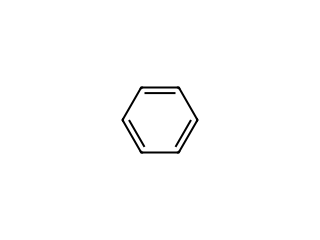
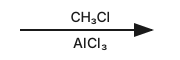
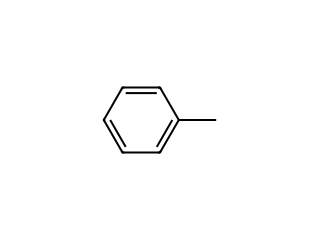
Methyl chloride cannot rearrange (no β-hydrogens). Clean formation of toluene. Excess can lead to xylenes.
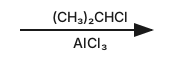
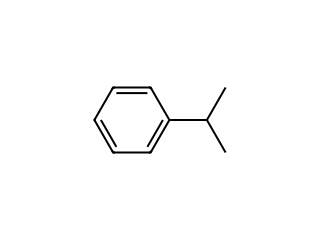
Secondary isopropyl cation is stable enough; no rearrangement occurs. Product is cumene (isopropylbenzene).
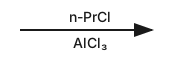
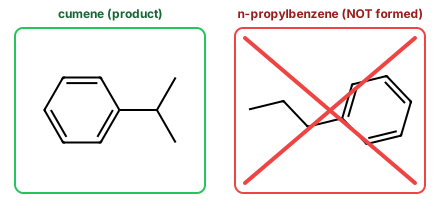
Rearrangement trap: The primary n-propyl cation rearranges via 1,2-hydride shift to the more stable secondary isopropyl cation before ring attack. The product is cumene, not n-propylbenzene!
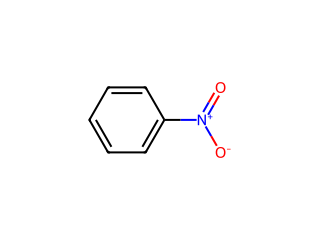
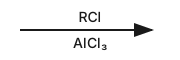
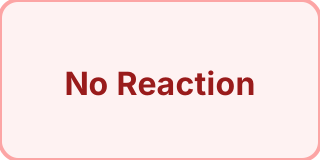
Strong meta directors like –NO₂ deactivate the ring; Friedel–Crafts alkylation fails under standard conditions.
Scope & Limitations
- Works well: Benzene, alkylbenzenes, mildly activated rings with methyl, tert-butyl, or stable secondary alkyl halides.
- Rearrangement-prone: Primary alkyl halides (except methyl) often rearrange. n-Propyl → isopropyl, n-butyl → sec-butyl or tert-butyl.
- Challenging: Strong EDG (–OH, –NH₂) unless protected; strong EWGs (–NO₂, –CF₃, –SO₃H) halt the reaction.
- Polyalkylation: Because –R is activating, controlling stoichiometry is essential to avoid over-alkylation.
- Workaround: Use FC acylation + reduction (Clemmensen/Wolff–Kishner) for un-rearranged linear alkylbenzenes.
Practical Tips
- Keep everything dry—AlCl₃/AlBr₃/FeCl₃ hydrolyze instantly.
- Use slight excess of Lewis acid for efficient activation.
- For tertiary and benzylic alkyl halides, the carbocation is stable and no rearrangement occurs.
- Control stoichiometry carefully to minimize polyalkylation.
- Plan protection for amines/phenols (e.g., acetanilide) before attempting ring alkylation.
- When linear alkyl products are needed, prefer acylation–reduction over direct alkylation.
Exam-Style Summary
RCl with AlCl₃/AlBr₃/FeCl₃ generates a carbocation (or carbocation-like) electrophile. Benzene attacks to give the σ-complex, AlX₄⁻ removes the proton to restore aromaticity, and the alkylbenzene is released. The product alkyl group is activating and directs ortho/para, so polyalkylation can occur. Primary alkyl halides rearrange to more stable carbocations before ring attack—this is the key trap. For un-rearranged products, use acylation followed by reduction.
Interactive Toolbox
- Mechanism Solver — Animate Lewis acid activation → σ-complex → deprotonation while toggling alkyl group (methyl, ethyl, isopropyl, tert-butyl, benzyl) and Lewis acid (AlCl₃/AlBr₃/FeCl₃).
- Reaction Solver — Predict ortho/meta/para outcomes for substituted arenes under Friedel–Crafts alkylation and flag incompatibilities (e.g., unprotected –NH₂/–OH, strongly deactivated rings).
- IUPAC Namer — Practice naming alkylbenzene products such as toluene, cumene, tert-butylbenzene, and xylenes.