Cyclic hemiacetals and sugar anomers
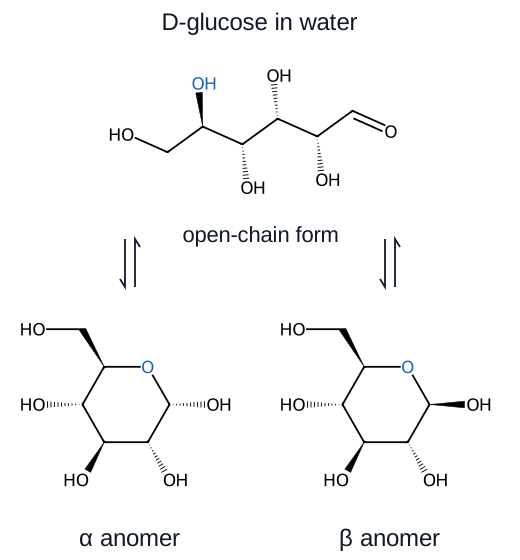
A hydroxyl group can add to a carbonyl within the same molecule, forming a cyclic hemiacetal. In aqueous D-glucose, the C5 hydroxyl closes onto the C1 aldehyde to make a six-membered ring. Closure creates the α and β anomers; opening and reclosure allow them to interconvert.
At a glance
- Conditions: Water; equilibration also occurs without added acid or base. Acid or base can accelerate mutarotation.
- Product: A cyclic hemiacetal, with OH and OR attached to the former carbonyl carbon.
- Mechanism class: Reversible intramolecular nucleophilic addition, with proton transfers.
- Stereochemistry: The new anomeric center can have either configuration; pre-existing stereocenters retain their configurations.
- Key exam point: Hemiacetal ring closure does not eliminate a molecule of water.
Mechanism
These original panels choose an acid-catalyzed pathway: carbonyl protonation, intramolecular alcohol addition, then deprotonation. Neutral water and base-catalyzed routes also permit equilibration, but they have different proton-transfer steps. Red arrows show electron-pair movement; blue tracks the original C5 hydroxyl oxygen into the ring.
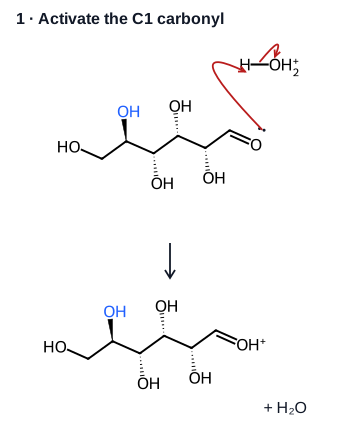
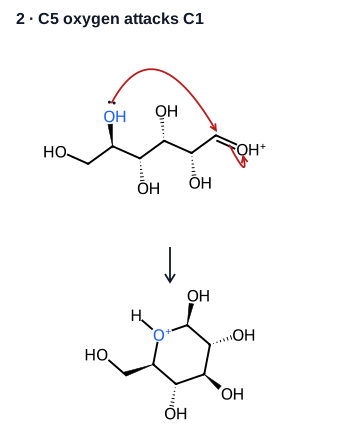
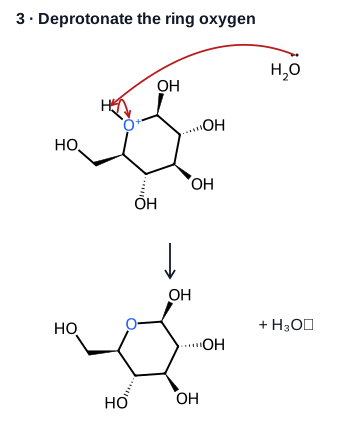
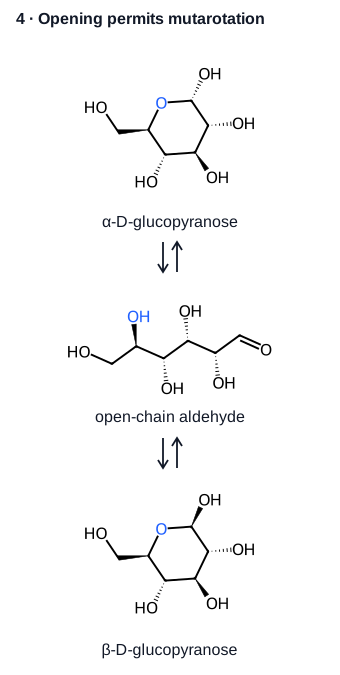
The attacking C5 oxygen becomes the ring ether oxygen, while the original carbonyl oxygen becomes the anomeric OH. C2–C5 retain their configurations, and the new C1 center can have either configuration. Ring closure has no net addition or loss of water.
Ring opening reverses hemiacetal formation and restores the aldehyde. Reclosure permits α/β interconversion. The changing optical rotation as dissolved sugar approaches equilibrium is mutarotation; the anomeric OH does not simply flip while every ring bond remains intact.
Scope, limits and traps
- Five- and six-membered cyclic hemiacetals are often favored. Ring size counts the ring oxygen as well as the carbon atoms; D-glucopyranose has five carbons and one oxygen in its ring.
- In a conventional Haworth drawing of D-glucopyranose with CH₂OH above the ring, α has the anomeric OH trans to CH₂OH; β has it cis. These two forms are diastereomers, not enantiomers.
- D/L and α/β answer different stereochemical questions. Neither designation by itself gives the sign of optical rotation.
- The drawings use skeletal stereobonds. A pyranose ring is not physically planar; its favored conformations are chairlike.
- Aqueous glucose contains predominantly cyclic forms, with a small open-chain population and other minor forms. The overview identifies the principal pyranose anomers without claiming that they are the only species or occur in equal amounts.
- Replacing the anomeric OH with OR produces a glycoside, an acetal. An ordinary glycoside does not undergo mutarotation in neutral water without cleavage of its glycosidic bond.
Worked examples
Example 1: D-glucose closes at C1
Open-chain D-glucose, (2R,3S,4R,5R)-2,3,4,5,6-pentahydroxyhexanal, gives α-D-glucopyranose and β-D-glucopyranose in water.
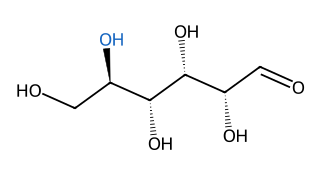
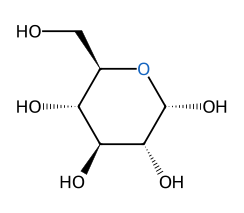
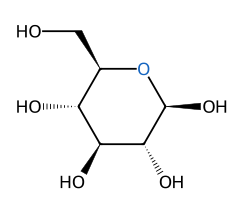
C1 is the anomeric carbon because it was the aldehyde carbonyl carbon. The C5 oxygen becomes part of the ring; the terminal C6 carbon remains outside it as CH₂OH. Do not close the chain by connecting C1 directly to C5: that would replace the required C–O bond with an incorrect C–C bond.
Tools
- Aqueous sugar example: Open Reaction Solver Pro. Enter the specified open-chain D-glucose manually, then select water and aqueous conditions.
- Explore reaction mechanisms with the Mechanism Solver.
- Explore names with the IUPAC Namer.