Glycoside formation and hydrolysis
An ordinary O-glycoside is an acetal at a sugar's anomeric carbon. Acid-catalyzed reaction of a free sugar hemiacetal with an alcohol replaces its anomeric OH with OR. Aqueous acid reverses the reaction, releasing the free sugar and alcohol.
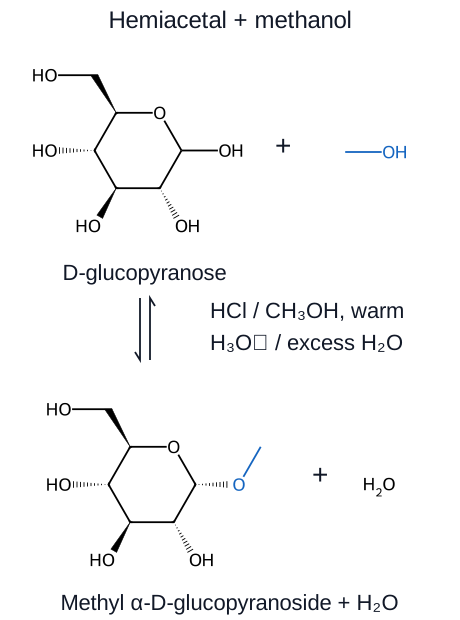
At a glance
- Formation: An alcohol such as methanol, an acid catalyst such as HCl, and commonly warming; excess alcohol favors glycoside formation.
- Hydrolysis: Excess water with acid, often with warming, restores the free sugar hemiacetal and alcohol.
- Product class: An O-glycoside, with two C–O–C connections at the anomeric carbon.
- Stereochemistry: Direct acidic glycosidation can give both α and β products; a single starting anomer does not ensure a single product anomer.
- Key exam point: Blocking the anomeric OH as an acetal prevents ordinary neutral-water mutarotation at that center.
Mechanism
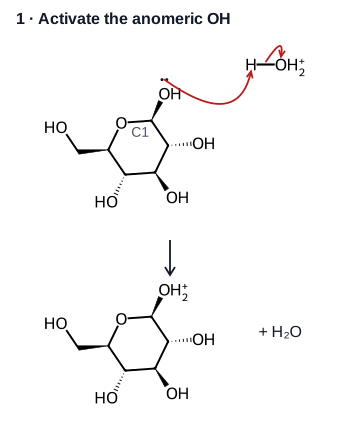
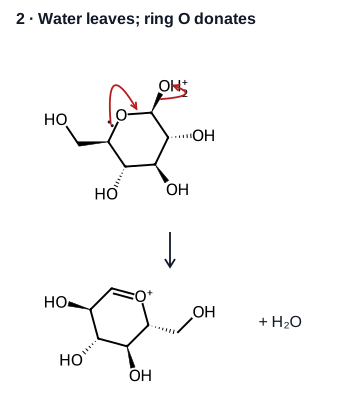
These original panels show a formal acid-catalyzed pathway for D-glucopyranose and methanol. Protonation, water loss, alcohol capture and deprotonation produce an acetal. The two oxocarbenium drawings are resonance contributors, not two species in equilibrium; they do not establish a long-lived free ion. Red arrows show electron-pair movement. Blue tracks the methanol oxygen and methyl carbon. Solvent water represents proton shuttling; methanol can also serve as a solvent base.
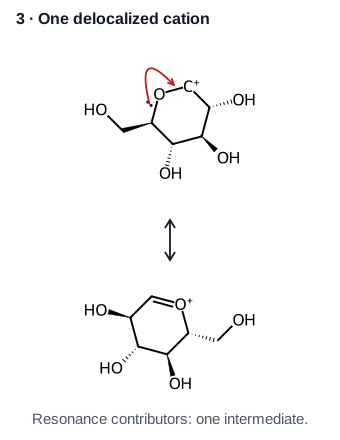
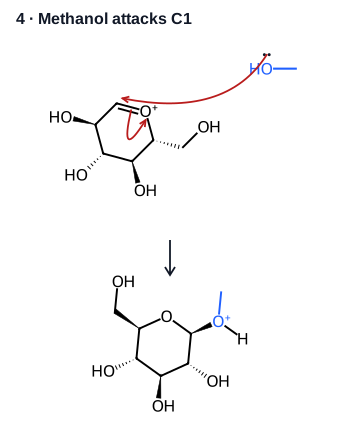
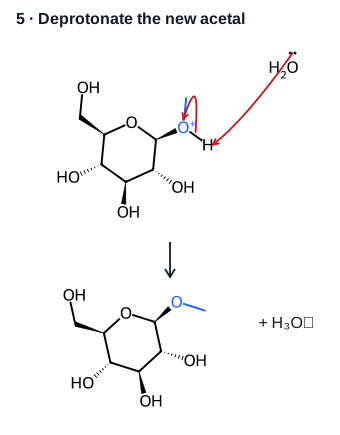
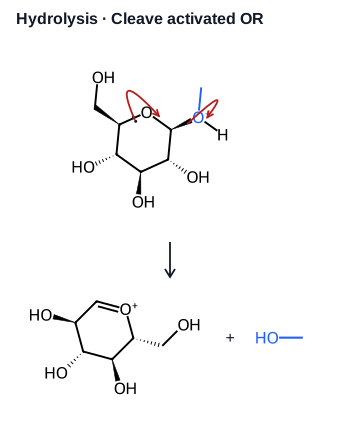
Acid hydrolysis is shown separately below. An aqueous medium favors replacement of OR by OH, consuming water overall.
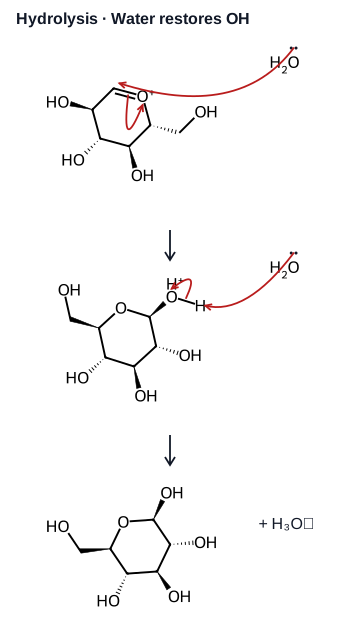
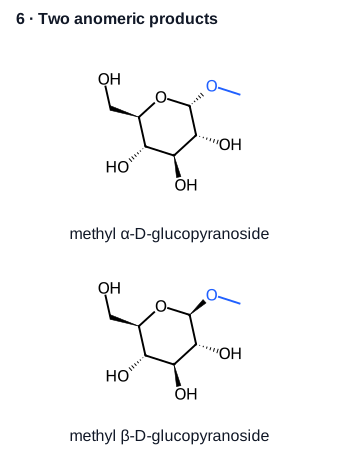
Both α and β methyl glucopyranosides can form, with C2–C5 configurations retained. Their intact acetal centers do not undergo ordinary neutral-water mutarotation. After hydrolysis, the restored free hemiacetal can open and reclose, allowing the sugar to mutarotate.
Scope, limits and traps
- These examples concern ordinary O-linked aldopyranosides. Their behavior does not establish a universal rule for C-glycosides, N-glycosides or every carbohydrate linkage.
- In methyl D-glucopyranosides, α and β differ at C1. They retain the sugar's other stereocenters. Product ratios and possible pyranose/furanose distributions depend on the reaction conditions; the drawings are not an exhaustive product inventory.
- A methyl glucopyranoside has several free OH groups, but no free anomeric OH. Those remaining OH groups do not restore ordinary mutarotation or reducing behavior at its blocked C1.
- A disaccharide can still have a different free anomeric center and be reducing. Do not conclude that every molecule containing a glycosidic bond is nonreducing.
- Ordinary acetals resist neutral water and ordinary aqueous base. Acidic water promotes cleavage; an alcohol-rich acidic medium instead supports glycosidation or exchange.
- Opening a free sugar hemiacetal ring is not the same transformation as hydrolyzing a glycosidic bond. The former needs no net addition or loss of water; the latter consumes water.
Worked examples
Example 1: Methyl D-glucopyranosides and their hydrolysis
D-Glucopyranose reacts with methanol under HCl catalysis to give methyl α-D-glucopyranoside and methyl β-D-glucopyranoside. The starting drawing leaves C1 unspecified while retaining the known D-glucose stereochemistry.
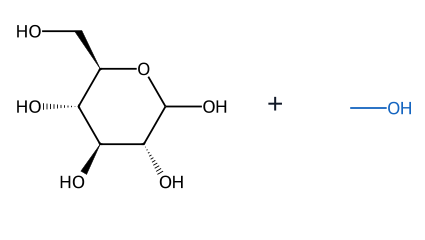
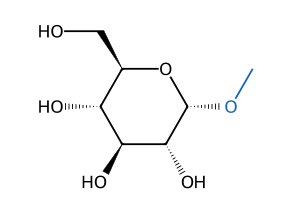
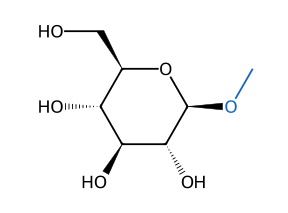
The anomeric OH is replaced by OCH₃; the ring oxygen remains part of the ring. Formation of either pyranoside changes C₆H₁₂O₆ + CH₄O into C₇H₁₄O₆ + H₂O. Treating either methyl glucopyranoside with aqueous acid reverses that balance, giving D-glucose and methanol. The glucose can mutarotate after hydrolysis, even though the intact methyl glycoside does not do so in neutral water.
Tools
- Alcohol and sugar inputs: Open Reaction Solver Pro. Enter the specified D-glucopyranose manually and select methanol and hydrochloric acid as separate reagents.
- Explore reaction mechanisms with the Mechanism Solver.
- Explore names with the IUPAC Namer.