Carboxylic Acid to Amide (DCC Coupling)
Exam Answer
- Reagents
- DCC plus amine (often with additive like DMAP)
- Major outcome
- RCO2H plus amine to amide
- Selectivity
- Mild coupling avoids acid chloride route
Common traps
- Acid plus amine alone gives ammonium salt (not amide)
- Urea byproduct is expected
- Additives can change rate/selectivity depending on substrate
Dicyclohexylcarbodiimide (DCC) activates a carboxylic acid toward nucleophilic attack by an amine, forging an amide and precipitating dicyclohexylurea (DCU). The key intermediate is the O-acylisourea; without additives it can rearrange to an unreactive N-acylurea, so reactions are usually run at 0–25 °C in dichloromethane or DMF with optional HOBt/HOAt or catalytic DMAP. DCU typically crystallizes, simplifying workup.
Quick Summary
| Reagents / conditions | RCO₂H (1.0 eq) + R′NH₂ / NH₃ / R′₂NH (1.1–2.0 eq) + DCC (1.0–1.3 eq); optional HOBt/HOAt (0.5–1.0 eq) or DMAP (5–10 mol %); dry CH₂Cl₂ or DMF, 0 °C → rt. |
|---|---|
| Outcome | Secondary amides from RNH₂, primary amides from NH₃, tertiary amides from R₂NH, plus DCU (precipitates in CH₂Cl₂). |
| Mechanism | Carboxylate adds to DCC → O-acylisourea; the amine attacks the acyl carbon → tetrahedral intermediate; collapse expels DCU to give the amide. Additives detour through active esters (HOBt/HOAt) or acyl-DMAP. |
| Pitfalls | N-acylurea (O→N migration) and α-racemization via oxazolone pathways—mitigated by low temperature, prompt aminolysis, and HOBt/HOAt or DMAP. |
| Amines that work | RNH₂ (standard), NH₃ (primary amides), R₂NH (tertiary amides). Tertiary amines (R₃N) lack N–H and only serve as bases/catalysts. |
Mechanism — Five RDKit Frames


Mechanistic Checklist (Exam Focus)
- Always show the O-acylisourea before the amine attacks—this is not an acid chloride route.
- Include a tetrahedral intermediate for the aminolysis step; collapse generates the amide plus DCU.
- Mention N-acylurea formation (O→N migration) and how HOBt/HOAt or DMAP suppress it.
- For α-stereogenic acids, note the racemization risk via oxazolone and the need for low-T / rapid coupling.
- Primary and secondary amines (and NH₃) form amides; tertiary amines do not because they lack N–H.
- DCU precipitation is diagnostic and simplifies workup (filter, wash, extract).
Worked Examples
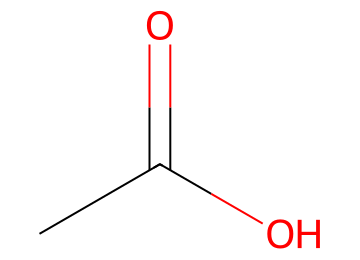
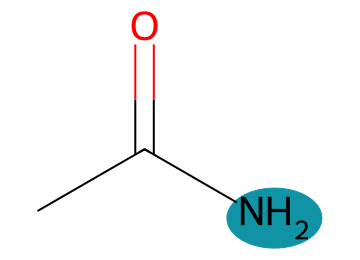
NH₃ → Primary amide (highlighted NH₂)
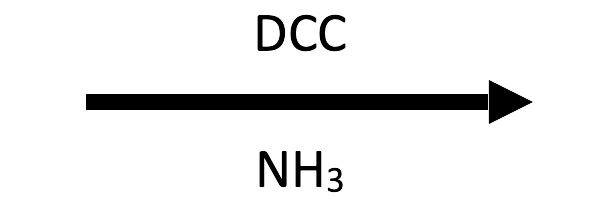
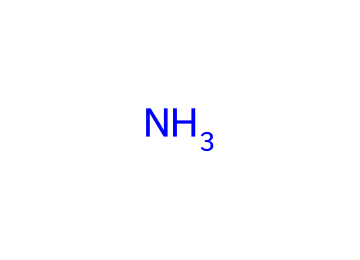
Acetic acid + NH₃ + DCC; teal highlight tracks the –NH₂ fragment delivered by ammonia.
Dry conditions prevent hydrolysis of the O-acylisourea.
Cyclohexylmethylamine (RNH₂) → Secondary amide
Benzoic acid + aminomethylcyclohexane; the teal highlight shows the portion of the amine that ends up on the product.
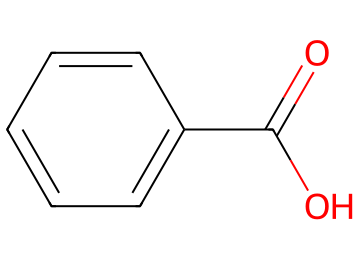

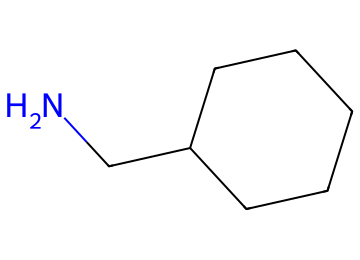
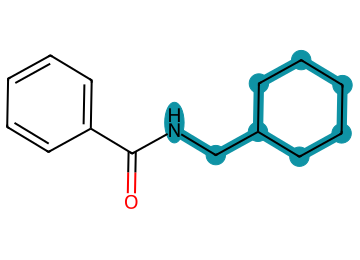
Cyclohexylmethylamine delivers a bulky secondary amide in excellent yield.
Dimethylaminoethane (R₂NH) → Tertiary amide
p-Anisic acid + dimethylaminoethane; the product highlight shows the tertiary amine fragment that becomes part of the amide.
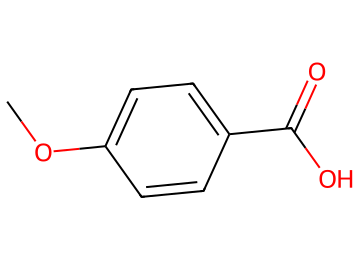
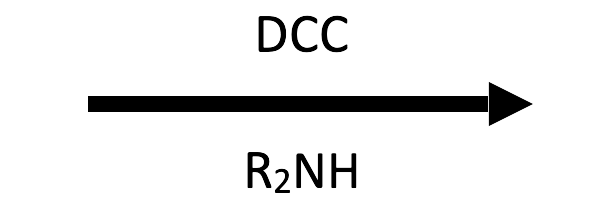
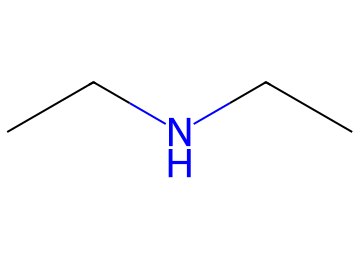
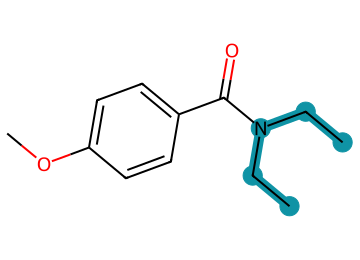
HOBt/HOAt or DMAP keeps the O-acylisourea from rearranging before aminolysis.
Trialkylamine (R₃N) → No amide product
DCC cannot form amides with tertiary amines; no N–H is available to transfer.
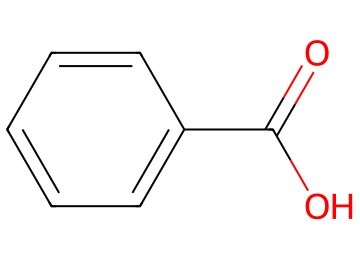
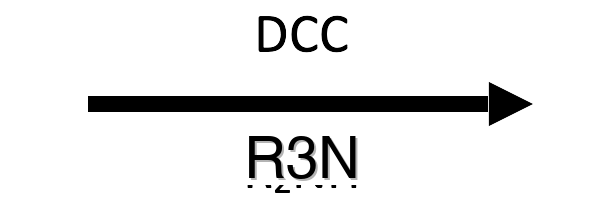
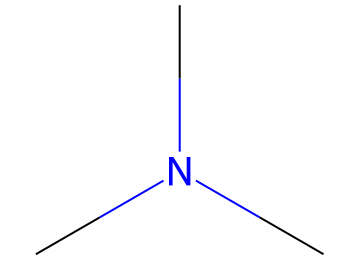
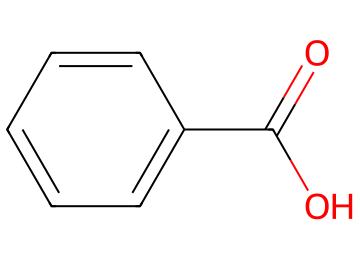
Trialkylamines serve only as bases/catalysts; draw an “✗ No amide” note.
Scope & Limitations
- Amines: RNH₂ and R₂NH couple efficiently; NH₃ is viable with dry conditions. Tertiary amines do not form amides (no N–H).
- Acids: Aliphatic, benzylic, and aromatic acids work; sterically hindered acids may require DMAP or alternate carbodiimides (DIC, EDC).
- Additives: HOBt/HOAt form active esters that suppress N-acylurea and racemization; DMAP accelerates aminolysis, especially for hindered R₂NH.
- Stereochemistry: α-Chiral acids risk racemization through oxazolone formation—keep cold, react quickly, add HOBt/HOAt.
- Functional groups: Free alcohols/thiols may compete; protect sensitive sites. Water hydrolyzes O-acylisourea.
- Operational: DCU is insoluble in CH₂Cl₂ (filter), but more soluble in DMF; cooling can force precipitation.
Practical Tips & Pitfalls
- Order of addition: Either pre-activate acid + DCC at 0 °C for ~10 min then add amine, or add DCC to a premixed acid/amine. Pick one method and stick with it.
- Temperature: Start cold (0–5 °C) to limit N-acylurea and racemization; warm to rt only after aminolysis is underway.
- Additives: Use HOBt/HOAt (0.5–1.0 eq) or DMAP (5–10 mol %) whenever the amine is hindered or the acid is α-chiral.
- Workup: Filter DCU through celite, rinse with solvent, then proceed to usual aqueous workup. Residual DCU on silica can be minimized by pre-filtration.
- Safety: DCC is a potent skin sensitizer—gloves and dedicated spatulas only. Dispose of DCU-containing waste appropriately.
- Moisture: Keep everything dry; water hydrolyzes the O-acylisourea and wastes DCC.
Exam-Style Summary
RCO₂H + DCC → O-acylisourea → amine attack → tetrahedral intermediate → amide + DCU (ppt).
RNH₂ → secondary amide, NH₃ → primary amide, R₂NH → tertiary amide.
Use HOBt/HOAt or DMAP to minimize N-acylurea and racemization; tertiary amines (R₃N) do not couple.
Interactive Toolbox
- Mechanism Solver — Choose the DCC reagent buttons (NH₃ / RNH₂ / R₂NH) to watch each mechanism variant rendered frame-by-frame.
- Reaction Solver — Load the same NH₃ / RNH₂ / R₂NH presets to preview the amide outcomes and warnings just like the mechanism view, but in quiz form.
- IUPAC Namer — Confirm names like “cyclohexyl benzamide” or “N,N-dimethyl p-anisamide” after running the solver.