Malonic and acetoacetic ester alkylation
Malonic and acetoacetic esters have an acidic carbon between two carbonyl groups. Base forms a stabilized enolate, which can add an alkyl group by displacing a leaving group from an alkyl halide. This guide stops at that C-alkylation product, with the ester groups still present.
At a glance
- Reagents and conditions: Sodium ethoxide in ethanol for the ethyl esters shown, followed by a suitable alkyl halide, warming or reflux as required by the procedure, and workup.
- Product: An alkyl-substituted malonate diester or acetoacetate beta-keto ester.
- Mechanism class: Enolate formation followed by SN2 C-alkylation.
- Regioselectivity: Alkylation at the acidic carbon between the carbonyl groups in these examples.
- Stereochemistry: The malonate example is achiral; the acetoacetate example is shown without assigning one enantiomer.
- Key exam point: Alkylation alone does not hydrolyze the ester or remove CO₂.
Mechanism
Ethoxide removes a proton from the carbon between the two carbonyl groups. The resulting enolate is resonance stabilized, so an alkoxide base can be used here without requiring the stronger bases commonly used for ordinary ketone enolates. Matching ethoxide to an ethyl ester also avoids introducing an unwanted alkoxy-group exchange.
The carbon-centered contributor below shows where the new bond forms. That carbon attacks the primary carbon bearing bromine, while the C-Br bond electrons leave with bromide. The oxygen-centered resonance contributors describe the same enolate; they are not different carbon skeletons.
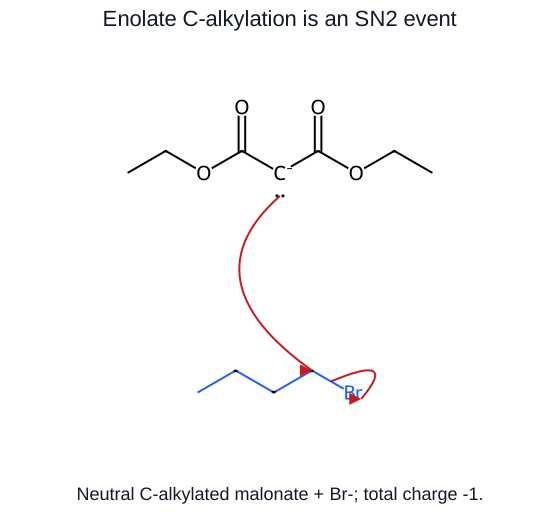
The C-alkylated organic product is neutral and bromide carries the negative charge. The proton removed during enolate formation is accepted by ethoxide, producing ethanol. No carbonyl is consumed in this SN2 step.
Scope, limits and traps
- Methyl and unhindered primary alkyl halides are usual SN2 partners. Secondary partners can compete through elimination; tertiary halides do not undergo the ordinary SN2 route shown here. Aryl and vinyl halides are not interchangeable with primary alkyl halides.
- Enolates can react through carbon or oxygen. These examples teach the established C-alkylation products; do not assume every electrophile, counterion and solvent gives exclusive C-alkylation.
- The monoalkylated product can still have a central proton. Additional base and electrophile can permit a second alkylation, so reagent amounts and reaction stages matter.
- Is this the complete malonic or acetoacetic ester synthesis? No. Ester hydrolysis and heated decarboxylation are additional reactions. The products drawn here retain their ester groups.
Worked examples
Example 1: Malonate gains a straight butyl group
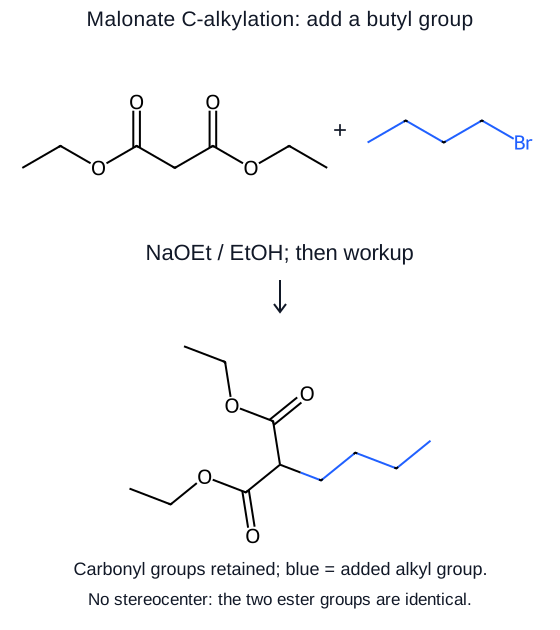
Diethyl propanedioate (diethyl malonate), C₇H₁₂O₄, and 1-bromobutane give diethyl 2-butylpropanedioate, C₁₁H₂₀O₄, shown in the overview. The new C-C bond joins the central malonate carbon to the carbon that originally bore bromine. All four carbons of the butyl chain are retained.
Sodium ethoxide in ethanol gives this alkylated diester after workup. The name “diethyl n-butylmalonate” refers to the same connectivity; it does not mean the ester groups have become butyl esters. The two CO₂Et groups are identical, so the central carbon is not a stereocenter.
Example 2: Acetoacetate retains its ketone and ester
Ethyl 3-oxobutanoate (ethyl acetoacetate), C₆H₁₀O₃, and iodoethane, with NaOEt in ethanol, give ethyl 2-ethyl-3-oxobutanoate, C₈H₁₄O₃. Reflux followed by aqueous workup gives this alkylated beta-keto ester, before its subsequent chemistry.
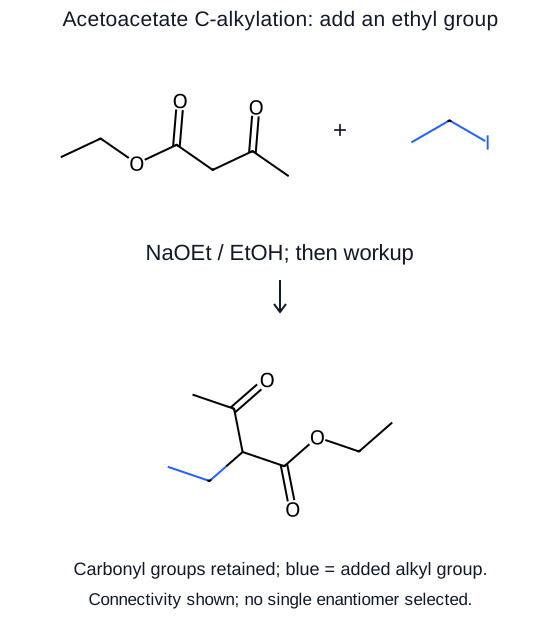
The new ethyl group attaches between the ketone and ester. This carbon has four different substituents, but the ordinary achiral conditions do not select one enantiomer; its configuration is left unassigned in the drawing. It remains able to enolize. Do not replace this product with pentan-2-one unless separate hydrolysis and decarboxylation conditions are supplied.
Tools
- For manual-entry practice, open Reaction Solver Pro and enter diethyl malonate and 1-bromobutane with ethoxide. Keep the endpoint at the alkylated diester.
- Explore the Mechanism Solver.
- Practice naming with the IUPAC Namer.