Thioester formation and hydrolysis
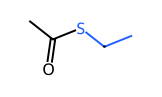
A thioester has the linkage R–C(=O)–S–R′. An acid chloride can acylate a thiol to form this bond; hydrolysis breaks the bond between the acyl carbon and sulfur. The net products retain a carbonyl C=O group.
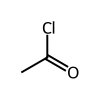
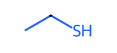
pyridine
At a glance
- Formation: Acid chloride + thiol, with a base such as pyridine.
- Hydrolysis: Aqueous hydroxide gives a carboxylate; acid workup gives the carboxylic acid.
- Mechanism class: Nucleophilic acyl substitution.
- Key exam point: Track the acyl C–S bond separately from the sulfur–alkyl bond.
Mechanism
Formation: addition, elimination and proton removal
In the direct thiol-attack pathway shown here, ethanethiol sulfur attacks the acid chloride's carbonyl carbon. Collapse of the tetrahedral intermediate restores C=O and releases chloride. Pyridine then removes the sulfur-bound proton, giving the neutral thioester and pyridinium chloride. The panels separate the electron-pair movements; blue tracks the intact S–ethyl fragment.
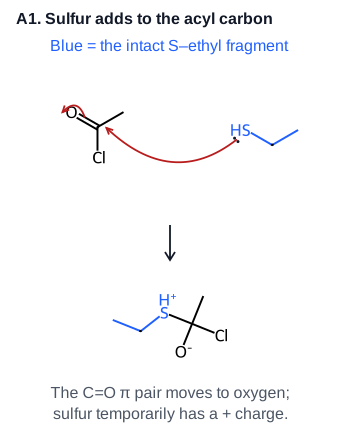
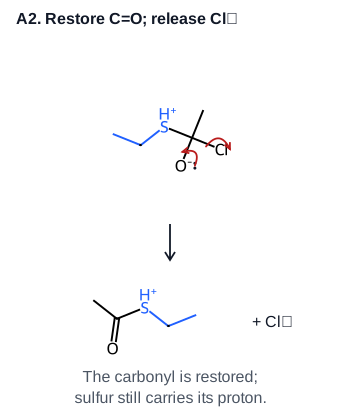
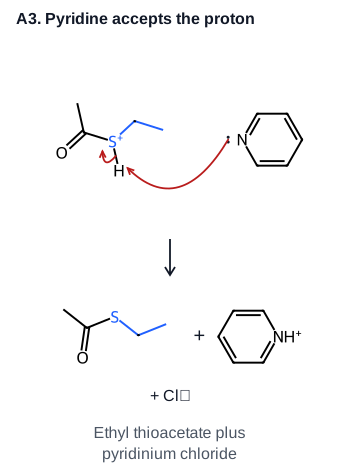
Pyridine is drawn as the proton acceptor in this teaching pathway; acyl-pyridinium participation is not shown.
Hydrolysis: cleave the acyl C–S bond
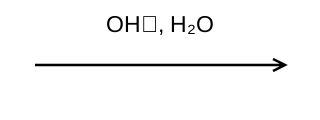
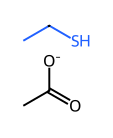
Hydroxide attacks the carbonyl carbon. In the addition–elimination representation below, the tetrahedral intermediate collapses and releases ethanethiolate. Proton transfer then gives acetate and ethanethiol overall for one equivalent of hydroxide. The sulfur–ethyl bond stays intact throughout.
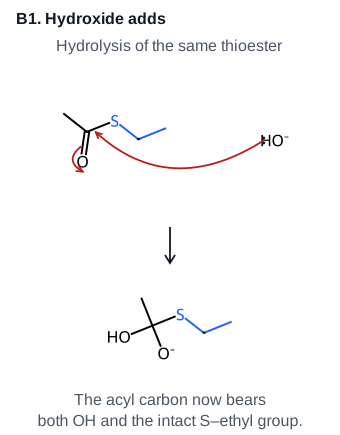
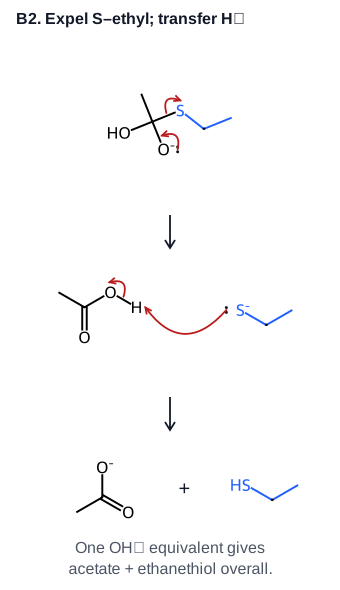
Excess strong base can leave more of the sulfur fragment as ethanethiolate. Acid workup gives acetic acid and protonates the sulfur fragment; it does not convert that fragment into ethanol.
Scope, limits and traps
- Keep C=O: a thioester contains sulfur beside the carbonyl carbon, not in place of the carbonyl oxygen.
- Before acid workup, draw the carboxylate rather than the neutral carboxylic acid for base hydrolysis.
- The sulfur fragment's protonation depends on conditions. The one-equivalent hydroxide net equation can be written with RSH; excess strong base can give RS⁻. Acid workup protonates the sulfur fragment.
- Do not split the sulfur–ethyl bond when predicting hydrolysis. The ethyl group leaves together with sulfur, not as ethanol.
Worked examples
Example 1: Acetyl chloride + ethanethiol → ethyl thioacetate
The product is S-ethyl ethanethioate, commonly called ethyl thioacetate, CH₃C(=O)SCH₂CH₃. Its two acetyl-fragment carbons come from acetyl chloride, and its two ethyl carbons come from ethanethiol. Pyridinium chloride accounts for the proton and chloride removed during formation.
Example 2: Ethyl thioacetate → acetate and ethanethiol
Aqueous hydroxide hydrolyzes the thioester. The following shows the net products for one hydroxide equivalent; the RSH/RS⁻ balance changes with excess base. After acidic workup, the acyl product is acetic acid.
Tools
- For Example 1, open Reaction Solver Pro and manually enter acetyl chloride and ethanethiol, with pyridine and a standard workup. This generic link does not preload the example.
- Open the IUPAC Namer for naming practice.