Nitrile Reactions: Nitrile to Primary Amine with LiAlH4
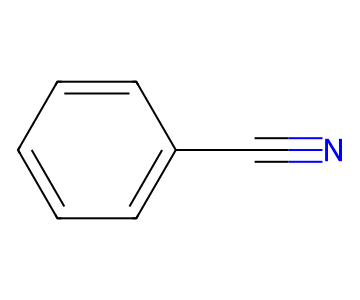
LiAlH₄ (lithium aluminum hydride) reduces nitriles (R-C≡N) to primary amines (R-CH₂-NH₂) after aqueous workup. Unlike DIBAL-H which delivers only one hydride and stops at the aldehyde, LiAlH₄ delivers two hydrides to fully reduce the nitrile to an amine.
Quick Summary
| Feature | Details |
|---|---|
| Transforms | R-C≡N → R-CH₂-NH₂ |
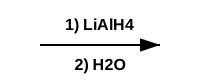
| Reagents | 1) LiAlH₄, ether 2) H₂O |
| Product | Primary amine |
| Key difference | LiAlH₄ gives amine (2 H⁻); DIBAL-H gives aldehyde (1 H⁻) |
Mechanism (6 Steps)
The mechanism involves two sequential hydride transfers from LiAlH₄ to the nitrile carbon, followed by aqueous workup to release the free amine.
Step 1 - Lewis Acid Coordination
The nitrile nitrogen lone pair coordinates to the electrophilic aluminum of LiAlH₄, forming a Lewis acid-base complex.
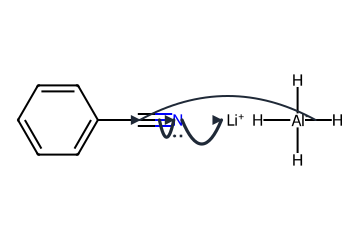
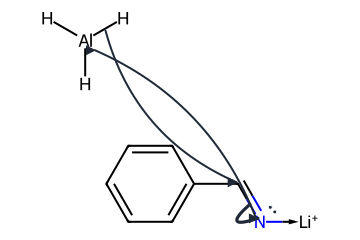
Step 2 - First Hydride Transfer
A hydride from AlH₄⁻ attacks the nitrile carbon. The triple bond is reduced to a double bond (C=N), forming an imine-aluminum intermediate.
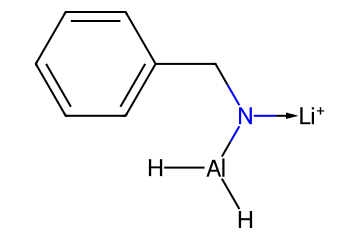
Step 3 - Second Hydride Transfer
A second hydride attacks the imine carbon. The double bond is reduced to a single bond (C-N), forming an amine-aluminum complex.
Step 4 - Amine-Aluminum Complex
After two hydride additions, the carbon now has two new hydrogens and nitrogen remains bound to aluminum in an anionic complex.
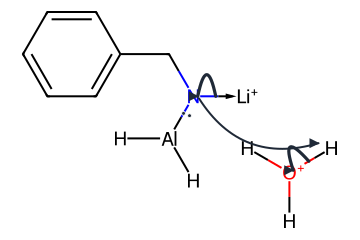
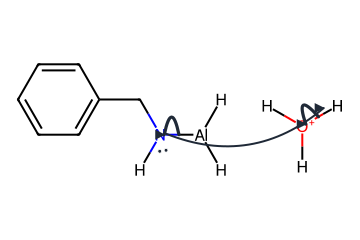
Step 5 - Aqueous Workup
Water protonates the nitrogen and breaks the Al-N bond, releasing the amine.
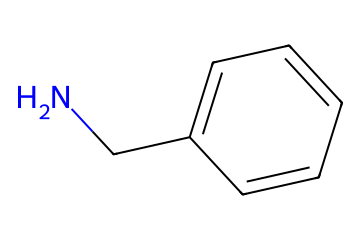
Step 6 - Primary Amine Product
The final product is a primary amine (R-CH₂-NH₂).
Worked Examples
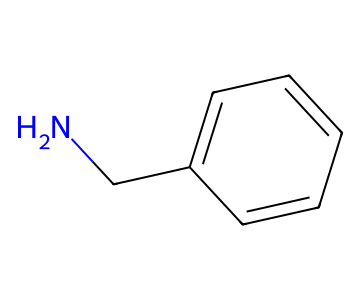
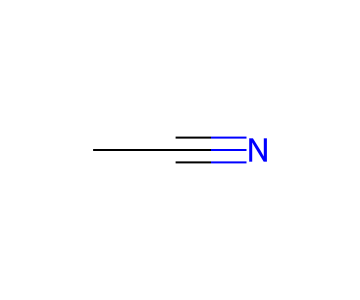
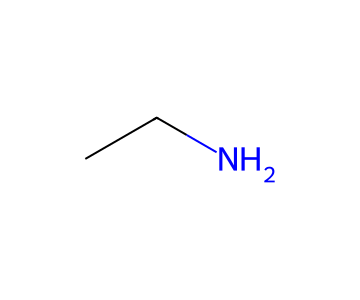
LiAlH₄ vs DIBAL-H: Key Comparison
| LiAlH₄ | DIBAL-H | |
|---|---|---|
| Hydrides delivered | 2 | 1 (controlled by stoichiometry + cold temp) |
| Product from nitrile | Primary amine (R-CH₂-NH₂) | Aldehyde (R-CHO) |
| Conditions | Room temp or reflux, ether | 1 equiv, −78 °C, then H₂O workup |
| Selectivity | Full reduction | Partial reduction (stops at imine) |
Why DIBAL-H stops at aldehyde: At −78 °C with 1 equivalent, the bulky isobutyl groups and low temperature prevent a second hydride transfer. Warming or excess reagent → over-reduction to amine.
Exam tip: If the question asks for an aldehyde from a nitrile, use DIBAL-H (1 equiv, −78 °C). If it asks for an amine, use LiAlH₄.
Common Exam Traps
-
Wrong reagent selection - LiAlH₄ gives amine, not aldehyde. DIBAL-H gives aldehyde.
-
Forgetting workup - The mechanism requires aqueous workup to release the free amine.
-
Chemoselectivity - LiAlH₄ reduces many functional groups. If other reducible groups are present, they will also be reduced:
- Reduced: aldehydes → alcohols, ketones → alcohols, esters → alcohols, carboxylic acids → alcohols, amides → amines, epoxides → alcohols, acid chlorides → alcohols
- Not reduced: alkenes, alkynes, aromatic rings, ethers, simple halides
-
Protic solvent destruction - LiAlH₄ reacts violently with water/alcohols. Must use anhydrous ether solvents.
Product Prediction Checklist
- Identify the nitrile: R-C≡N
- Convert to amine: R-CH₂-NH₂
- The nitrile carbon becomes a CH₂ group
- Check for other LiAlH₄-reducible groups
Tips
- "Nitrile carbon becomes CH₂" - quick way to predict connectivity
- Count the hydrides: 2 H⁻ from LiAlH₄ = amine; 1 H⁻ from DIBAL-H = aldehyde
- LiAlH₄ is not selective - it reduces almost everything
Interactive Toolbox
- Mechanism Solver - Enter any nitrile and see the full 6-step mechanism for LiAlH₄ reduction to primary amine.
- Reaction Solver - Provide a nitrile and the Solver predicts aldehyde vs amine outcomes based on your reagent inputs.
- IUPAC Namer - Use it to name the amine products.