Sulfide oxidation to sulfoxides and sulfones
Oxidation adds oxygen at the sulfur atom of a sulfide, R–S–R′. One transferred oxygen gives a sulfoxide, R–S(=O)–R′; a second gives a sulfone, R–S(=O)2–R′. The carbon–sulfur framework stays intact in these transformations. Oxidant loading helps set the target, but loading alone does not guarantee selectivity.
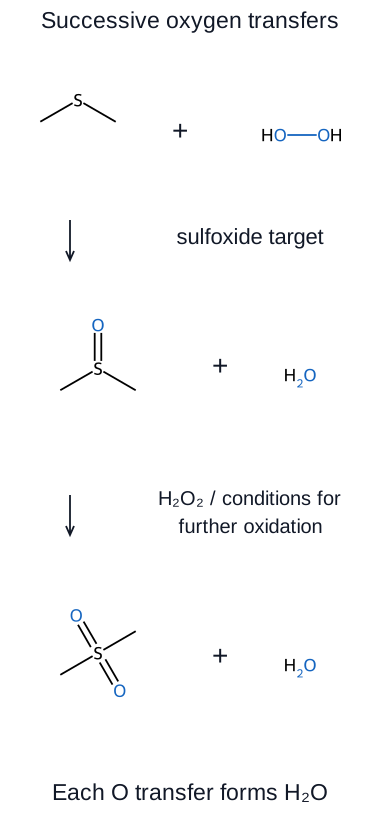
At a glance
- Starting class: A sulfide, R–S–R′, also called a thioether.
- Sulfoxide conditions: Aqueous hydrogen peroxide commonly oxidizes dialkyl sulfides near room temperature; limited oxidant targets one oxygen transfer.
- Sulfone conditions: Further oxidation requires another oxygen transfer. Peroxide systems chosen for this stage may use a catalyst, such as a tungstate system, and adjusted reaction conditions.
- Stoichiometry: One H₂O₂ per transferred oxygen in the formal balances below; each transfer also forms H₂O.
- Key exam point: R₂S, R₂SO and R₂SO₂ are different oxidation levels, not different carbon skeletons.
Mechanism
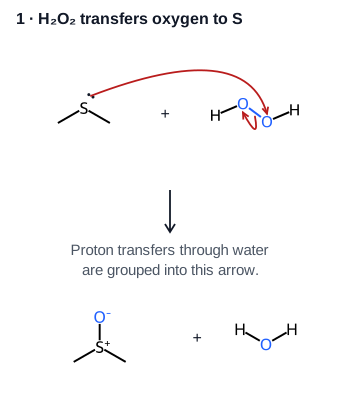
These original panels use hydrogen peroxide for the illustrated oxygen transfer. The sulfur lone pair participates in S–O bond formation while the peroxide O–O bond breaks. Water molecules assist proton transfers; their microscopic order depends on the medium. The first panel deliberately groups those proton transfers rather than assigning a free hydroxide intermediate or a universal one-step mechanism. Red arrows show the core electron-pair movements, and blue tracks peroxide oxygen atoms.
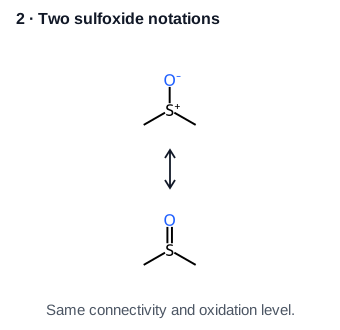
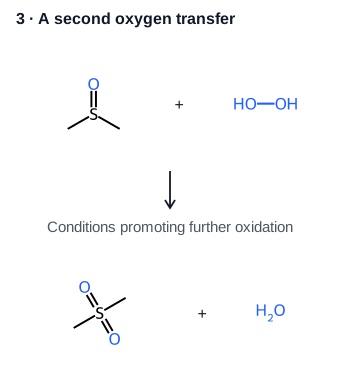
The conventional S=O and charge-separated S⁺–O⁻ drawings have the same atom connectivity. Further oxidation adds a second oxygen at sulfur, giving a sulfone. The second-transfer panel is a net equation, not a claim that every peroxide or catalyst system follows the same elementary steps.
Scope, limits and traps
- Approximately one equivalent is a useful limited-oxidant target for sulfoxide formation, but incomplete conversion and further oxidation can still occur. Excess peroxide does not universally force pure sulfone: substrate, catalyst, solvent, temperature and time also matter.
- Keep the C–S bonds. Moving O onto a methyl carbon would give an alcohol or carbonyl compound with different connectivity.
- A sulfide has one sulfur linking two carbon groups. A disulfide has an S–S bond; it is not the product of adding one oxygen to a sulfide.
- Sulfoxides with different carbon substituents can be stereogenic at sulfur. Dimethyl sulfoxide has two identical methyl groups and is achiral; do not invent an R/S product pair for DMSO.
- Oxidizing sulfur to make DMSO is different from using activated DMSO in a Swern oxidation of an alcohol. The reagents and the atom undergoing oxidation are different.
Worked examples
Example 1: Dimethyl sulfide to dimethyl sulfoxide
Dimethyl sulfide gives dimethyl sulfoxide (DMSO) after one net oxygen transfer from hydrogen peroxide.
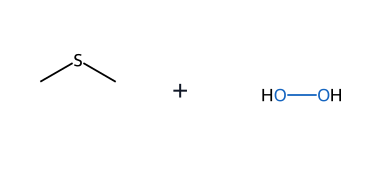
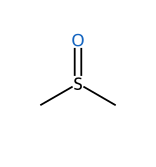
The product gains one oxygen and keeps formula C₂H₆ for its carbon/hydrogen framework. Sulfur remains between the two methyl groups.
Example 2: The dimethyl sulfone target
Conditions that promote further oxidation give dimethyl sulfone. Starting from the sulfide, two net oxygen transfers are needed.
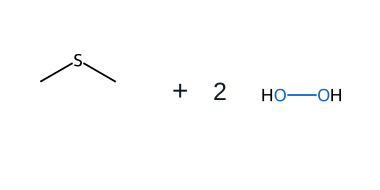
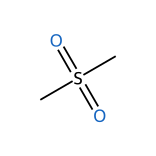
The sulfone contains two oxygens on sulfur. Simply changing the written peroxide amount does not specify the rate or selectivity of that second oxidation.
Tools
- Limited-peroxide example: Open Reaction Solver Pro. Enter dimethyl sulfide manually and select hydrogen peroxide at one equivalent with the standard workup setting.
- Explore reaction mechanisms with the Mechanism Solver.
- Explore names with the IUPAC Namer.