Thiol oxidation and disulfide reduction
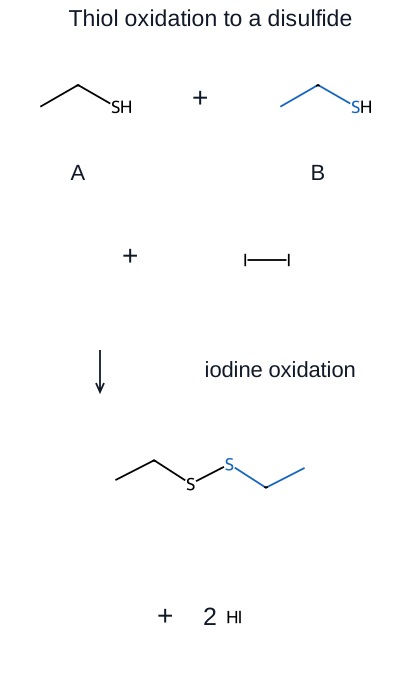
Oxidation joins two thiol groups, R–SH, to form a disulfide, R–S–S–R. Reduction cleaves that S–S bond and restores two thiols. Iodine is a common oxidant for this pair; zinc in acidic medium provides a reductive route back. The carbon–sulfur bonds remain intact in both directions.
At a glance
- Oxidation: Two thiols plus I₂ give one disulfide and two equivalents of acid/iodide.
- Reduction: Zinc in acidic protic medium can cleave a disulfide to two thiols; aqueous acid with an alcohol-containing medium is a supported formulation.
- Bond changed: S–S forms or breaks; the C–S framework is retained.
- Stoichiometry: Two RSH molecules correspond to one RSSR molecule.
- Key exam point: Zinc is consumed as a reductant, becoming Zn²⁺; it is not a catalyst in the balanced reduction below.
Mechanism
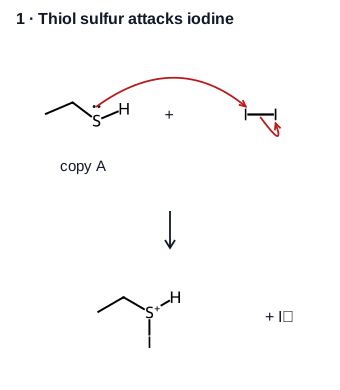
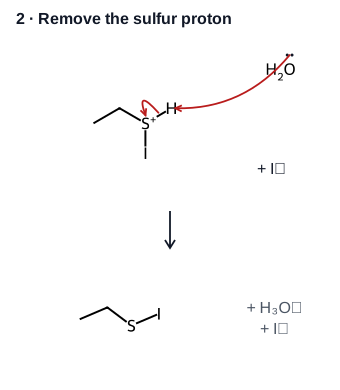
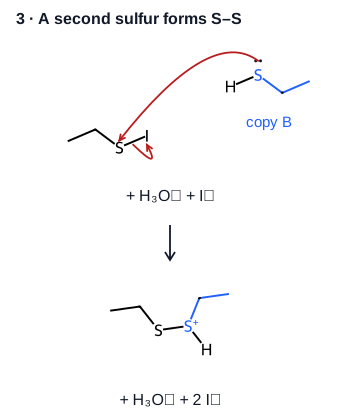
The oxidation panels show a selected iodine pathway through a sulfenyl iodide, R–S–I. Thiol sulfur reacts with iodine; solvent proton transfer gives the sulfenyl iodide. A second thiol then forms the S–S bond, and another proton transfer gives the neutral disulfide. These formal charged drawings explain the electron flow; they do not imply that the intermediates are isolated or that every thiol oxidation uses this route. Red arrows show electron-pair movement. Blue tracks the heavy atoms of thiol copy B, and the new S–S bond is black.
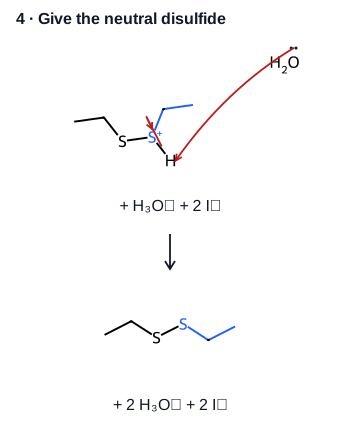
Zinc/acid reduction is a different, reagent-driven process. The final panel keeps the net electron and proton balance without inventing an elementary mechanism at the metal surface.
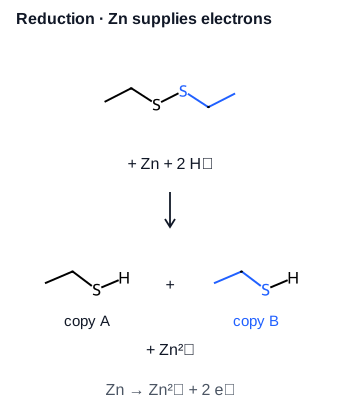
Oxidation removes two protons and two electrons overall: 2 RSH → RSSR + 2 H⁺ + 2 e⁻. Iodine accepts the electrons: I₂ + 2 e⁻ → 2 I⁻. The explicit solvent drawings use H₃O⁺; the equivalent formal balance is 2 RSH + I₂ → RSSR + 2 H⁺ + 2 I⁻, often written with 2 HI.
For reduction, Zn → Zn²⁺ + 2 e⁻ combines with RSSR + 2 H⁺ + 2 e⁻ → 2 RSH. Thus RSSR + Zn + 2 H⁺ → 2 RSH + Zn²⁺. Chloride from HCl is an unchanged spectator.
Scope, limits and traps
- Do not draw only one thiol molecule as the balanced reduction product of one disulfide. Each sulfur retains its carbon group and gains H, giving two RSH molecules.
- A disulfide contains two sulfur atoms joined together. A sulfide, R–S–R′, contains one sulfur between two carbon groups and is a different functional group.
- Iodine oxidation does not add oxygen. A sulfoxide or sulfone is not the disulfide product in this scheme.
- Mixing two different thiols can produce symmetrical and mixed disulfides. Selective R–S–S–R′ formation is not guaranteed merely by mixing RSH and R′SH.
- Zinc/acid compatibility depends on the rest of the substrate. Cleaving a disulfide selectively is not a promise that every other reducible or acid-sensitive group survives.
Worked examples
Example 1: Ethanethiol to diethyl disulfide
Two molecules of ethanethiol, CH₃CH₂SH, react with iodine to give diethyl disulfide, CH₃CH₂–S–S–CH₂CH₃.
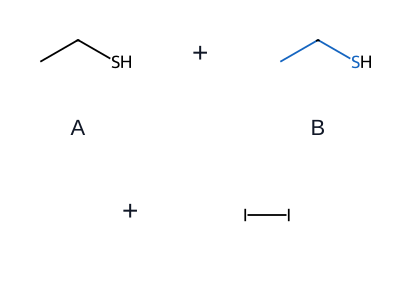
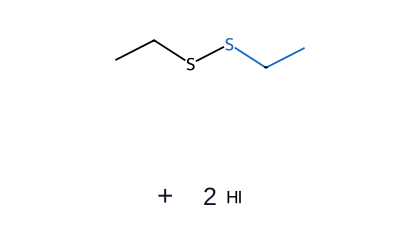
The organic product has one fewer pair of hydrogen atoms than the two starting thiols combined. Neither ethyl group is removed or transferred to iodine.
Example 2: Reduce diethyl disulfide back to ethanethiol
Diethyl disulfide gives two ethanethiol molecules with zinc and acid. The ionic equation makes the electron donor and charge balance explicit.
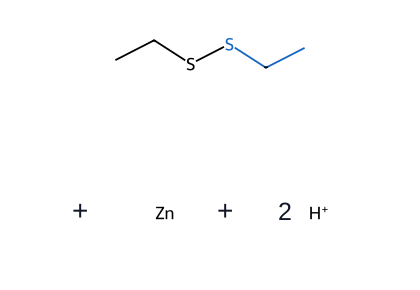
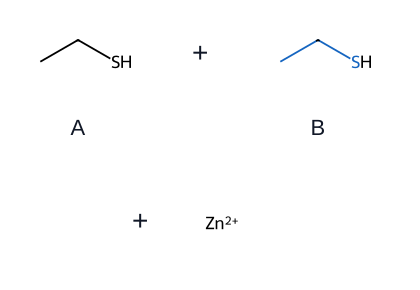
The S–S bond breaks, while both C–S bonds remain. The two product structures are chemically identical ethanethiol molecules; A/B labels distinguish their atom origins rather than different products.
Tools
- Oxidation partners: Open Reaction Solver Pro. Enter ethanethiol and iodine manually as separate participants, with the standard workup setting. Use the balanced equation to track two thiols per disulfide.
- Explore reaction mechanisms with the Mechanism Solver.
- Explore names with the IUPAC Namer.