Aldol Reactions: Addition vs. Condensation (Base-Catalyzed)
Aldol reactions are base-catalyzed carbonyl reactions that form a new C–C bond via an enolate. For most college organic chemistry problems, the key is conditions: cold/dilute base stops at the β-hydroxy carbonyl (aldol addition), while heat (Δ) drives dehydration to the α,β-unsaturated carbonyl (aldol condensation, E1cb).
Quick Summary
- NaOH, cold/dilute → aldol addition → β-hydroxy carbonyl
- NaOH, heat (Δ) → aldol condensation → α,β-unsaturated carbonyl (dehydration via E1cb)
Conditions at a Glance
| Conditions | Product |
|---|---|
| NaOH (dilute), cold | β-Hydroxy carbonyl (aldol addition) |
| NaOH, Δ (heat) | α,β-Unsaturated carbonyl (aldol condensation) |
Mechanism
Mechanism overview
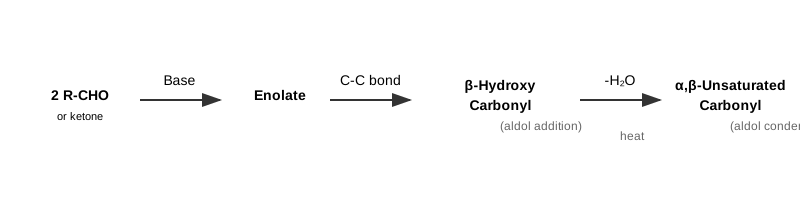
Aldol Addition (Steps 1–3)
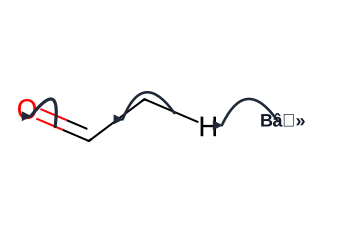
Step 1: Form the enolate
Base removes an α‑H to give an enolate (the nucleophile).
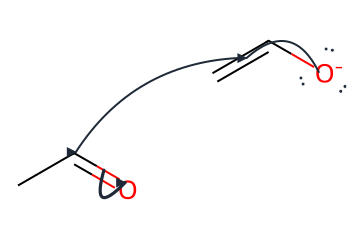
Step 2: Make the C–C bond
The enolate attacks a carbonyl to give an alkoxide (new C–C bond).
Step 3: Protonate
Protonation gives the β-hydroxy carbonyl (aldol addition product).
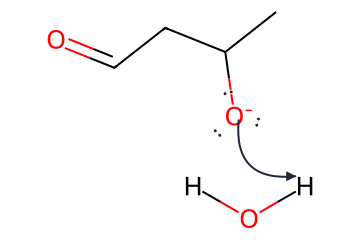
If the problem says cold/dilute base, stop after Step 3 (aldol addition).
Aldol Condensation (Steps 4–5)
If the problem shows heat (Δ), dehydration continues to the condensation product:
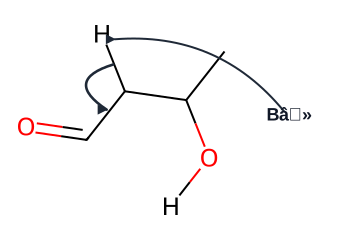
Step 4: Deprotonate (E1cb)
Base removes an α‑H again to set up elimination.
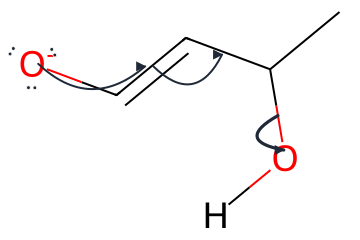
Step 5: Eliminate (dehydration)
Elimination gives the α,β-unsaturated carbonyl (conjugated product).
Worked Examples
Example A: Self-Aldol Condensation
2 eq
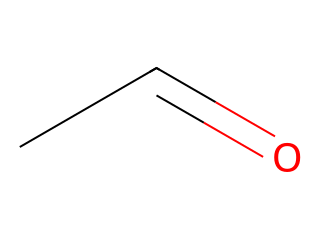
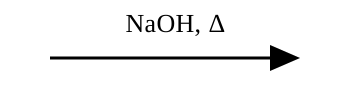
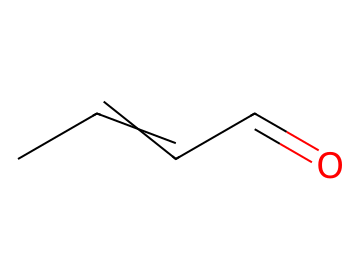
Acetaldehyde self-condensation → crotonaldehyde
Example B: Crossed Aldol (Claisen–Schmidt)
- Benzaldehyde has no α‑hydrogens, so it can’t form an enolate (electrophile only).
Enolate
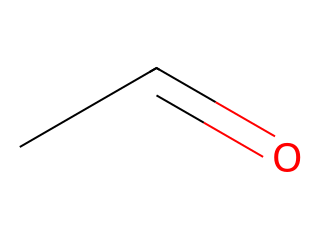
Electrophile
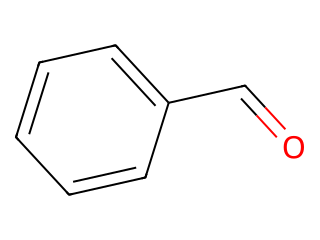
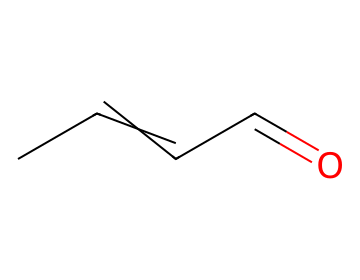
Acetaldehyde + Benzaldehyde → cinnamaldehyde
Example C: Intramolecular Aldol (Ring Formation)
- Intramolecular aldol cyclizations usually favor 5‑ and 6‑membered rings.
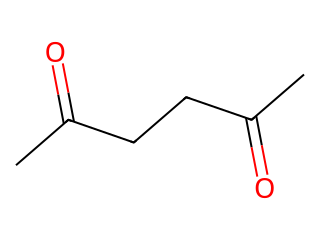
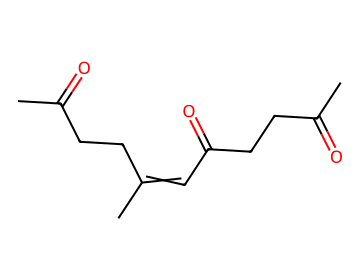
2,5-hexanedione → 3-methylcyclopent-2-enone (5-membered ring)
Exam Quick Reference
| Clue in Problem | Product |
|---|---|
| "NaOH, cold" or "dilute" | β-Hydroxy carbonyl (addition) |
| "NaOH, Δ" or "heat" | α,β-Unsaturated carbonyl (condensation) |
| Benzaldehyde + ketone | Crossed aldol (benzaldehyde = electrophile only) |
| Dicarbonyl + base | Intramolecular → ring |
Key points:
- Heat drives dehydration (E1cb elimination)
- Conjugated product is usually (E) (trans)
- Self-condensation doubles carbons minus H₂O
Interactive Toolbox
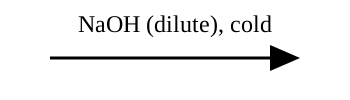
Use NaOH (cold/dilute) to stop at the β-hydroxy carbonyl (aldol addition).
Add heat (Δ) to drive dehydration to the α,β-unsaturated carbonyl (aldol condensation).
- Mechanism Solver — step through aldol addition/condensation with electron-pushing arrows.
- Reaction Solver — draw a carbonyl and predict the aldol product under cold vs heat conditions.
- IUPAC Namer — name the β-hydroxy carbonyl or α,β-unsaturated carbonyl product.
Related Reading
- Directed Aldol with LDA — Kinetic enolate control for crossed aldols
- Claisen Condensation — Ester equivalent