Carbonyl + Amine Condensation → Imine or Enamine (RNH₂ vs R₂NH)
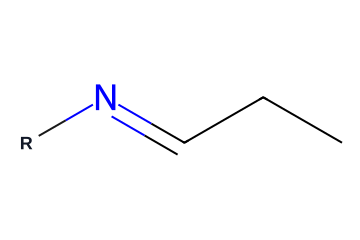
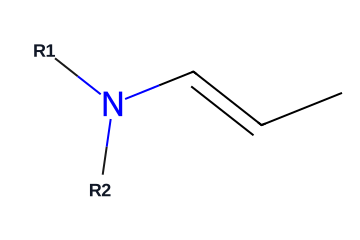
Aldehydes and ketones condense with amines by one shared mechanistic spine: carbonyl activation → nucleophilic addition (carbinolamine) → dehydration to an iminium ion. The branch occurs after the iminium. Primary amines (RNH₂) still possess an N–H, so deprotonation at nitrogen yields an imine (C=N–R). Secondary amines (R₂NH) cannot lose N–H; instead an alpha proton on the carbonyl fragment is removed to form an enamine (C=C–NR₂). Both outcomes demand mild acid (pH 4–6) and removal of water (Dean–Stark, sieves, molecular distillation) to push the equilibrium forward.
Quick Summary
- Reagents/conditions: Carbonyl partner (aldehyde or ketone), RNH₂ for imines or R₂NH for enamines, trace acid (AcOH, p-TsOH) adjusted to pH ~4–6, and an active method to remove water (Dean–Stark, azeotropes, 3 Å sieves).
- Outcome rules: Aldehydes react faster than ketones; imine formation requires an N–H; enamine formation requires both a secondary amine and at least one alpha hydrogen on the carbonyl substrate.
- Reversibility: Both products hydrolyze in aqueous acid, so these condensations double as protecting-group tactics for carbonyls.
- Driving forces: Keep the amine partially unprotonated (mild acid only) and continuously remove water; otherwise the carbinolamine or iminium plateaus.
Mechanism — Steps 1–6 With Dual Branching
The first four steps are identical regardless of the amine class. Steps 5 and 6 diverge; the article shows them side by side so learners can compare the proton sources, arrow logic, and products.
Step 1 — Protonate the carbonyl oxygen (activation)
Trace acid converts the carbonyl into a better electrophile. The C=O oxygen grabs H₃O⁺, and the newly formed water/acid pair balances charge. Mild activation lets the amine remain nucleophilic.

Step 2 — Amine attack and carbinolamine formation
The amine lone pair attacks the activated carbonyl carbon, collapsing the π bond and yielding a tetrahedral carbinolamine (a hemiaminal). Proton transfers within the adduct restore a neutral nitrogen.

Step 3 — Proton shuttles prepare the leaving group
The hydroxyl group on the carbinolamine is protonated, giving HOH⁺, while the nitrogen is adjusted so that dehydration can proceed. Internal shuttles or the conjugate base perform this role.

Step 4 — Dehydrate to the iminium intermediate
Loss of water and re-formation of the C=N π bond generate an iminium ion (positively charged nitrogen). This common intermediate is the fork in the road for both outcomes.
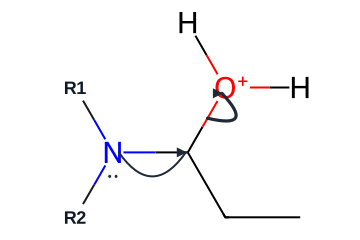
Step 5 — Divergence: choose the proton to remove


Step 6 — Product frame
Mechanistic Checklist
- Confirm the carbonyl actually contains an aldehyde or ketone; acid chlorides and carboxylic acids follow different playbooks.
- Ensure the amine class matches the target: RNH₂ → imine, R₂NH → enamine. Tertiary amines fail because they have no N–H and cannot form enamines either.
- Count alpha hydrogens on the carbonyl partner before promising an enamine outcome.
- Maintain mild acidity so nucleophilicity and dehydration are balanced.
- Remove water continuously; Dean–Stark traps, azeotropes, or sieves are mandatory for sluggish ketones.
Worked Examples
Scope & Limitations
- Works well: Aliphatic aldehydes, unhindered ketones, cyclic secondary amines (pyrrolidine, morpholine), and primary aliphatic amines.
- Slower: Aromatic amines, sterically hindered ketones, and conjugated carbonyls. Increase heat time and reinforce water removal.
- Fails: Tertiary amines (no N–H) and carbonyls lacking alpha hydrogens (no enamine branch).
- Functional-group sensitivity: Strong acid-labile substituents can be damaged by p-TsOH; use AcOH or buffered acetate instead.
Edge Cases & Exam Traps
- No α-H, no enamine: Benzophenone + R₂NH stops at the iminium salt. Show the stalled intermediate instead of a nonexistent enamine.
- Too much acid: Fully protonates the amine; no attack occurs even though the carbonyl is activated.
- Water not removed: The equilibrium rests at starting materials; exam questions often hide the Dean–Stark trap on purpose.
- Naming confusion: “Schiff base” = imine; “enamine” is nucleophilic at carbon, not nitrogen.
Practical Tips
- Use 0.1–0.2 equiv of acid; more simply neutralizes the amine.
- Track progress by IR (C=O disappearance, C=N appearance) or ¹H NMR (imine CH at 8–9 ppm, enamine vinyl H around 5–6 ppm).
- Keep reaction media dry during workup; even small water leaks hydrolyze enamines rapidly.
- For Stork enamine syntheses, distill off solvent under reduced pressure immediately after formation to avoid back-hydrolysis.
Exam-Style Summary
Carbonyl + amine + mild acid → carbinolamine → iminium → branch. Primary amines deprotonate at nitrogen (imine). Secondary amines deprotonate at the α-carbon (enamine) provided an α-H exists. Both products hydrolyze under aqueous acid, so the reaction is reversible and driven only by water removal and the stability of the product.
Interactive Toolbox
- Mechanism Solver — Tap the RNH₂ or R₂NH buttons to watch the full RDKit-rendered mechanism with overlays.
- Reaction Solver — Input your carbonyl class, amine type, and conditions to forecast imine vs enamine outcomes.
- IUPAC Namer — Confirm systematic names for the products featured above.
Related Reading
- Acid Chloride → Amide using Amines
- Carboxylic Acid → Acid Chloride via SOCl₂
- Oxime/Beckmann Rearrangement Guide