Ketone α-Halogenation under Base (NaOH → X₂)
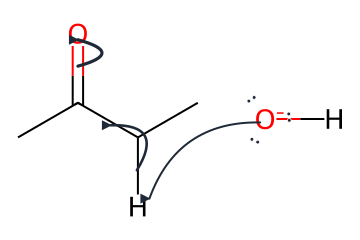
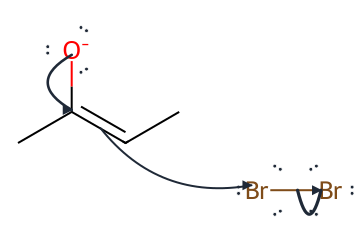
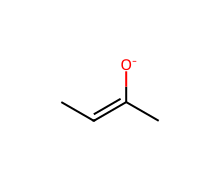
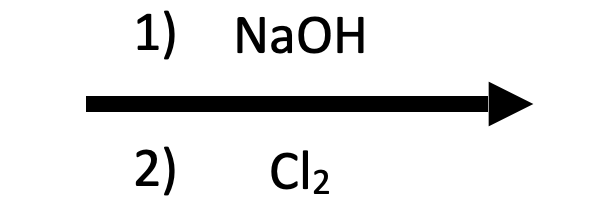
Hydroxide removes an α-proton to generate the enolate, which then attacks molecular halogen (X₂ = Cl₂ or Br₂) to form the α‑halo ketone. Each substitution increases the acidity of the remaining α‑hydrogens, so base-promoted halogenation readily repeats (polyhalogenation). When a methyl ketone is driven with excess base/halogen, the cycle continues to the haloform reaction, fragmenting to a carboxylate plus CHX₃. Use this guide alongside the acid-catalyzed companion (mono-halogenation via enols) to highlight the contrasting behavior.
Quick Summary
- Reagents/conditions: NaOH(aq) to generate the enolate, followed by X₂ (Cl₂ or Br₂) at 0–25 °C in water or aqueous alcohol.
- Outcome: Mono α‑halogenation with limited reagents; di-/tri‑halogenation under excess X₂/base.
- Trends: Br₂ ≈ Cl₂ for rate; excess halogen/base pushes successive substitutions and haloform for methyl ketones.
- Regioselectivity: Kinetic α-site (less hindered) dominates with NaOH; stronger, non-equilibrating bases exaggerate this bias.
- Stereochemistry: α‑Centers racemize via the planar enolate; newly formed stereocenters are racemic.
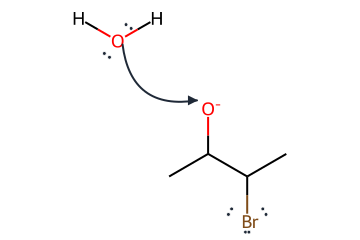
Mechanism — Base Path via Enolate (Steps A–J)
Haloform Branch (Methyl Ketones; Steps K–N)
- After three successive halogenations at a methyl ketone, OH⁻ adds to the carbonyl (Step K) to give a tetrahedral intermediate.
- Collapse of that intermediate expels CX₃⁻ (Step L), leaving a carboxylate (base form of the acid).
- CX₃⁻ deprotonates solvent water (Step M/N), generating haloform (CHX₃) and regenerating hydroxide. Acidic workup converts the carboxylate to the free acid.
Mechanistic Checklist (Exam Focus)
- Base pathway = enolate chemistry (contrast with the acid enol route).
- Polyhalogenation is expected if reagents are not limited.
- Methyl ketones proceed to haloform (CHX₃) when excess base/halogen is present.
- α‑Racemization is unavoidable; do not promise retention/inversion.
- Enolate formation sets the regiochemistry; subsequent halogenations stay on the same α-carbon.
- Strong base/heat can trigger E2 of α‑halo ketones to give enones (flag as a side reaction).
Worked Examples
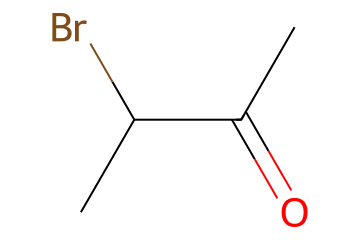
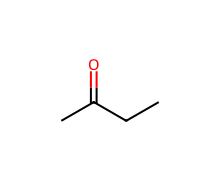
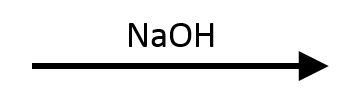
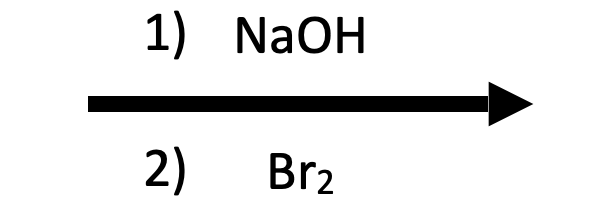
2-Butanone → 3-Bromo-2-butanone
 +
+
 →
→
 +
+
 →
→
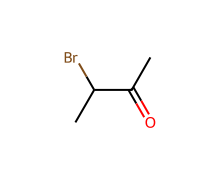
Limiting Br₂ (≈1 equiv) at low temperature delivers mostly the mono-brominated product, showcasing the kinetic preference for the less hindered α-site of 2-butanone.
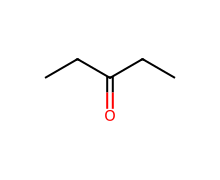
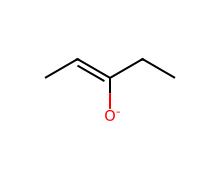
2-Pentanone → Poly-α-chloro Products
 +
→
+
→
 +
+
 →
→
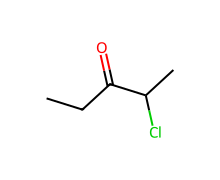
Supplying 2–3 equivalents of Cl₂ under basic conditions autocatalyzes further α-chlorination, yielding α,α-dichloro and α,α,α-trichloro products unless the reaction is quenched early.
Acetone → Haloform (CHX₃) + Acetate
 +
→
+
→
 +
→
+
→
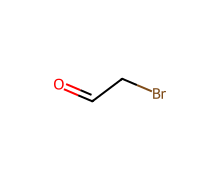
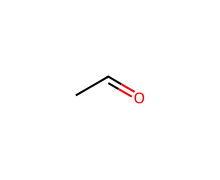
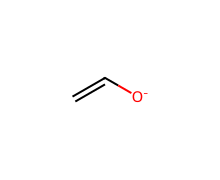
Excess Br₂ with NaOH drives exhaustive α-halogenation of acetone; hydroxide then cleaves the C–C bond to give bromoform (CHBr₃) and acetate (haloform reaction).
Scope & Limitations
- Good: Ketones with α‑hydrogens, especially benzylic or allylic sites.
- Poly-prone: Methyl ketones or substrates with a single α-site accumulate CX₃ rapidly.
- Sluggish: Heavily hindered α-sites; insufficient base or halogen slows successive substitutions.
- No reaction: α‑Free ketones (e.g., benzophenone) cannot form the enolate.
- Compare: Acid pathway delivers mono-halogenation at the thermodynamic enol site.
Practical Tips
- Limit mono: Meter X₂ (≤1 equiv), keep the mixture cool, and quench promptly.
- Drive poly: Provide excess X₂/OH⁻ and allow time; monitor for haloform when methyl ketones are present.
- Workup: Quench residual halogen with Na₂S₂O₃, then acidify if a neutral α‑halo ketone or carboxylic acid is desired.
- Safety: Handle halogens and CHX₃ cautiously; provide ventilation and appropriate waste disposal.
Exam-Style Summary
NaOH forms the enolate (arrows A–C); X₂ traps it (D–F); water reprotonates (G). Excess halogen/base repeats the loop on the same α-carbon, and methyl ketones advance to the haloform branch (K–N) to give carboxylate + CHX₃. Contrast with the acid route, which mono-halogenates via the thermodynamic enol.
Related Reading
- Ketone enol halogenation (acid)
- Haloform reaction of methyl ketones
- Keto–enol tautomerization (H₃O⁺)
Interactive Toolbox
- Mechanism Solver — animate enolate formation, X₂ capture, the polyhalogenation loop, and haloform toggle (Cl₂/Br₂, equivalents, methyl-ketone flag).
- Reaction Solver — predict mono vs. poly outcomes, flag haloform conditions automatically, and surface competing E2 warnings for α‑halo ketones.
- IUPAC Namer — confirm α‑halo ketone names and haloform/carboxylate outputs without exposing SMILES strings.