Ketone α-Halogenation via Enols (Cl₂/Br₂/I₂, acid)
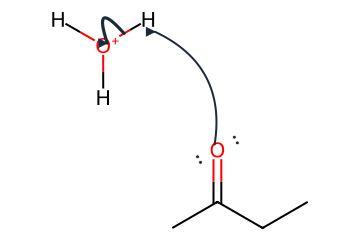
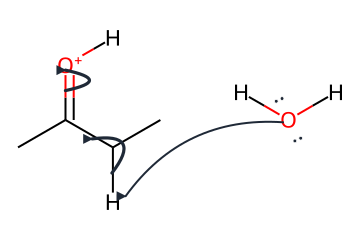
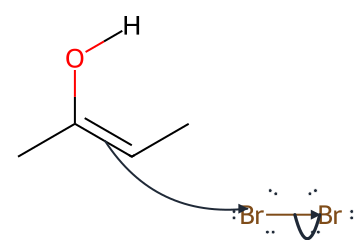
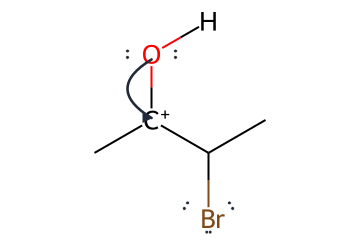
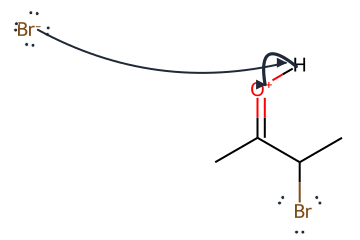
Under acidic conditions, ketones monohalogenate at the α-position via their enol. Protonation primes the carbonyl for keto–enol tautomerism, the enol π bond attacks X₂ (Cl₂, Br₂, or I₂), and the carbonyl reforms while the oxonium is deprotonated to give the α-halo ketone. Acid favors the thermodynamic enol, so halogenation appears at the more substituted or resonance-stabilized α-site, and the reaction normally stops after one substitution (contrast with basic poly-halogenation).
Quick Summary
- Reagents/conditions: Cl₂, Br₂, or I₂ with catalytic acid (H₃O⁺, AcOH/HCl, TFA). Solvents: AcOH, MeOH, or CH₂Cl₂ containing trace acid at 0–25 °C.
- Outcome: Ketone → α-halo ketone (mono-halogenation). HX is the co-product.
- Mechanism: Acid-catalyzed keto–enol tautomerization followed by electrophilic halogenation of the enol (closed-shell; no radicals).
- Regioselectivity: Acid selects the thermodynamic enol; halogenation occurs at that α-carbon.
- Stereochemistry: New α-stereocenters form racemically; existing α-stereocenters can racemize through enolization.
- Reactivity trend: Cl₂ ≳ Br₂ » I₂ (iodination is sluggish/reversible; often aided by an oxidant that consumes I⁻).
Mechanism (6 Frames)
Worked Examples
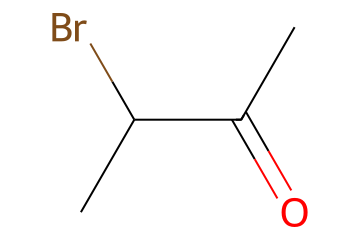
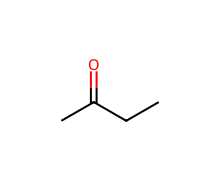
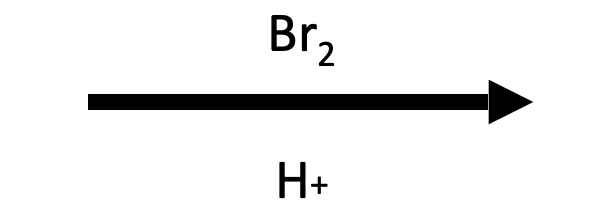
2-Butanone → 2-Bromo-2-butanone (Br₂/H⁺)
 +
+
 →
→
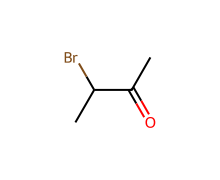
2-Butanone showcases the two different α positions (methyl vs. methylene); under Br₂/H⁺ the more substituted enol wins, giving racemic 2-bromo-2-butanone.
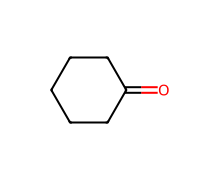
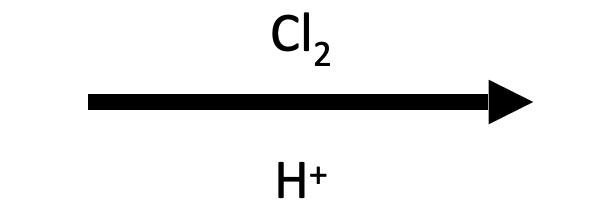
Cyclohexanone → 2-Chlorocyclohexanone (Cl₂/H⁺)
 +
+
 →
→
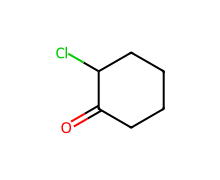
Planar enolization erases the α-stereocenter; chlorination yields 2-chlorocyclohexanone (cis/trans mix on workup).
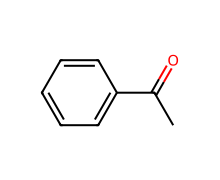
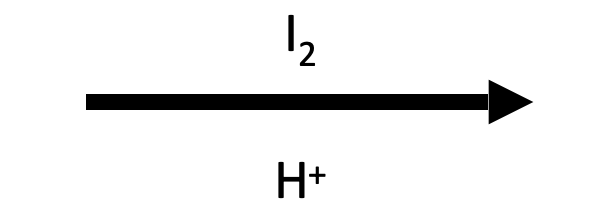
Acetophenone → 2-Iodoacetophenone (I₂/H⁺)
 +
+
 →
→
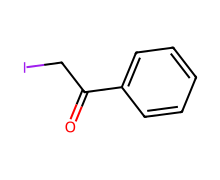
Benzylic enolization is fast; iodination often needs an oxidant (HIO₃/HNO₃) to consume I⁻ and push conversion.
Scope & Limitations
- Requires α-H: Without an α-hydrogen (e.g., benzophenone) no enol forms, so no halogenation occurs.
- Thermodynamic control: Acid chooses the more substituted/benzylic/allylic enol; dicarbonyls halogenate at the most acidic site.
- Halogen choice: Cl₂ and Br₂ react readily. I₂ is sluggish/reversible; plan for an oxidant or accept partial conversion.
- Functional group tolerance: Acid-labile protecting groups (acetals) can hydrolyze; mild AcOH/HCl conditions are common.
- Poly-halogenation: Suppressed under acid. For exhaustive halogenation or haloform, use basic conditions instead.
Practical Tips
- Shield from bright light to avoid radical halogenation pathways.
- Use acetic acid or aqueous mineral acid to manage enolization and solubility.
- For iodination, include an oxidant (HIO₃, HNO₃) or stronger acid to consume I⁻.
- Quench with NaHCO₃ then Na₂S₂O₃ to remove residual acid/halogen.
- Expect racemization at pre-existing α-stereocenters through enolization.
Exam-Style Summary
Ketone + X₂/H⁺ → α-halo ketone via the enol. Sequence: (1) protonate the carbonyl → (2) remove the α-H to make the thermodynamic enol → (3) enol π bond attacks X₂ → (4) the carbonyl reforms, retaining the oxonium proton → (5) halide/base removes that proton → (6) product + HX remain while acid is regenerated. Acidic conditions favor mono-halogenation at the thermodynamic enol site; basic media are required for poly-halogenation/haloform. Watch for sluggish iodination and α-racemization.
Related Reading
Interactive Toolbox
- Mechanism Solver: Use Mechanism Solver to see each step of the α-halogenation via enols mechanism along with descriptions of each step!
- Reaction Solver: Quickly find the product of any ketone reacted with X₂/H⁺!
- IUPAC Namer: Learn the naming ins and outs of ketones and α-halo ketones.