Alkene Reactions: Oxymercuration of Alkenes using Hg(OAc)2, alcohol, and NaBH4
Alkoxymercuration–demercuration converts an alkene into a Markovnikov ether in two discrete steps. Step 1 uses Hg(OAc)2 dissolved in an alcohol (EtOH is illustrated; MeOH is another established choice for this mercury salt) to generate a bridged mercurinium ion that favors alcohol attack at the more substituted alkene carbon. Step 2 replaces the C–Hg bond with hydrogen using aqueous NaBH4, releasing elemental mercury and leaving the ether. Because the pathway proceeds through a bridged intermediate instead of a discrete carbocation, rearrangements are suppressed. Compare this ether-forming route with acid-catalyzed addition of alcohols. For alcohol products, aqueous oxymercuration gives Markovnikov hydration, whereas hydroboration–oxidation gives anti-Markovnikov hydration.
Introduction
Treating an alkene with Hg(OAc)2 in an alcohol creates a three-membered mercurinium ion in which the HgOAc bridge spans the alkene carbons. Positive character concentrates on the more substituted carbon (Cβ), so the alcohol oxygen attacks there from the face opposite Hg (anti opening). Loss of a proton (often to acetate) delivers the alkoxymercury intermediate. In a separate step, NaBH4 (usually in basic aqueous solution) reduces the C–Hg bond to C–H, releasing Hg(0) and affording the Markovnikov ether. Throughout this guide we distinguish the substituent that originated on the alkene as R(alkene) and the alkoxy fragment as R(alcohol) to avoid ambiguity.
Quick Summary
- Sequence: Step 1 Hg(OAc)2 in ROH (no NaBH4 present); Step 2 NaBH4/NaOH (aq) demercuration.
- Intermediate: Bridged mercurinium ion followed by an alkoxymercury species.
- Regiochemistry: Alcohol adds Markovnikov at Cβ; hydrogen installs at Cα during demercuration.
- Stereochemistry: ROH opens the bridge anti to Hg; NaBH4 reduction is not generally stereospecific. Check whether a chiral product forms before describing it as racemic.
- Rearrangements: Disallowed—no free carbocation forms.
- Intramolecular variant: Tethered OH can cyclize (5-exo-trig favored; 6-endo possible depending on geometry).
- Scope: Hg(OAc)2 is established with MeOH and EtOH. More hindered alcohols can require a different mercury salt, such as Hg(O2CCF3)2.
Mechanism (Alkoxymercuration–Demercuration)
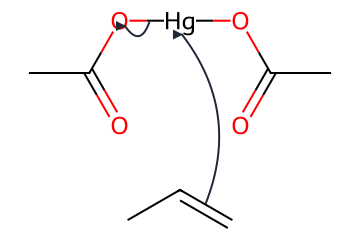
The alkene π bond donates to the Hg(II) center, forming a three-membered mercurinium bridge. Simultaneously, one acetate ligand departs as AcO⁻. Positive charge resides primarily on the more substituted carbon (Cβ), priming it for nucleophilic attack. NaBH4 must be excluded at this stage or the mercuric acetate will be quenched prematurely.

The ethanol oxygen (representing ROH in general) approaches from the face opposite Hg and bonds to Cβ. The Cβ–Hg bond breaks and the electrons return to Hg, leaving a single Cα–Hg bond. Because the mercurinium constrains the approach, the addition is anti relative to Hg.

The displaced acetate (or solvent ROH/H₂O) acts as base, removing the proton from the oxonium oxygen. The result is a neutral alkoxymercury species featuring Cβ–O–R(alcohol) and Cα–HgOAc.
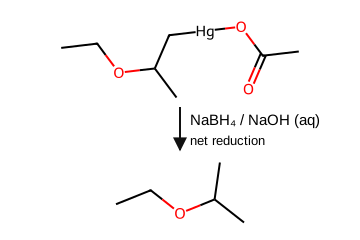
NaBH4 replaces Cα–Hg with Cα–H overall. Demercuration involves radical intermediates; the scheme shows the net reduction rather than a single paired-electron elementary step. Configuration at a stereogenic carbon formerly bonded to Hg is not generally preserved, but this does not imply that every ether is chiral or racemic.

The final ether retains the original alkene carbon skeleton, places the OR(alcohol) group on the more substituted carbon, and carries a hydrogen on the less substituted carbon. The relative stereochemistry that existed across the alkene is often lost because the NaBH4 step is not stereospecific.
Mechanistic Checklist
- Identify Cα (less substituted) and Cβ (more substituted). ROH attack opens the Hg bridge; one Cα–Hg bond remains until reduction.
- ROH must attack from the face opposite Hg (anti opening); syn attack is disfavored.
- Keep acetate around—AcO⁻ is a convenient base for deprotonation, though ROH or H2O can serve.
- Note the change in labels: R(alkene) stays on carbon, R(alcohol) rides with oxygen. Do not use a single “R” for both.
- Show demercuration as the net replacement of C–Hg by C–H. Do not depict it as an SN2 attack at carbon or invent a single two-electron collapse.
- After NaBH4 the configuration at Cα is not guaranteed; check whether a stereocenter remains before assigning a racemate or diastereomeric mixture.
Worked Examples
Example A — 2-Methylpropene → tert-Butyl Ethyl Ether
- Substrate: 2-methylpropene (isobutylene).
- Reagents: Step 1 Hg(OAc)2, EtOH; Step 2 NaBH4, NaOH (aq).
- Outcome: EtO installs at the tertiary carbon (Markovnikov); H replaces Hg at the carbon that was terminal in the alkene.

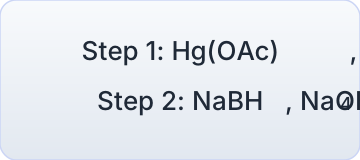

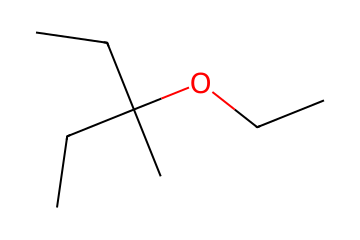
Example B — 3-Methyl-2-pentene → 3-Ethoxy-3-methylpentane
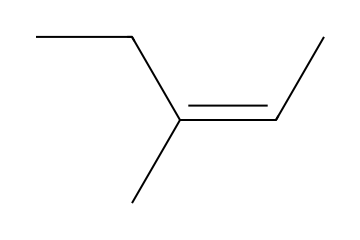
- Substrate: 3-methyl-2-pentene (either E or Z gives this Markovnikov connectivity).
- Reagents: Step 1 Hg(OAc)2, EtOH; Step 2 NaBH4, NaOH (aq).
- Outcome: EtO adds to C3; NaBH4 replaces Hg with H at C2. The product is achiral because C3 has two equivalent ethyl groups.
When Multiple Alkenes Are Present
Hg(OAc)2 responds fastest to the most electron-rich, least hindered alkene. If several double bonds are available, the one that best stabilizes a bridged cation (often the more substituted or benzylic site) reacts first. Tethered alcohols can compete intramolecularly: a pendant OH that can reach Cβ typically closes a 5-exo-trig ring to give a cyclic ether after NaBH4. Longer tethers may allow 6-endo capture, depending on the tether and substrate geometry. Map out possible bridges before predicting the major product.
Practical Tips & Pitfalls
- Run it in two steps. Add Hg(OAc)2 to the alcohol solvent (with or without a cosolvent such as THF). After mercuration is complete, work up and then treat the organomercury intermediate with aqueous NaBH4. Mixing NaBH4 into the mercuration step wastes reagent and stops the reaction.
- Control light and temperature. Keep reactions at 0–25 °C and in subdued light; photolyzed mercury salts or elevated temperatures can erode selectivity.
- Bases for deprotonation. Acetate or solvent ROH can remove the oxonium proton. Added water also competes as a nucleophile, so it is not a universal remedy for a hindered alcohol.
- Waste handling. Collect all mercury-containing aqueous and organic layers for hazardous waste disposal; neutralize NaBH4 carefully to avoid vigorous hydrogen release.
- Label your substituents. Use R(alkene) for the carbon substituent and R(alcohol) for the incoming alkoxy group to avoid confusing stereochemical discussions.
Exam-Style Summary
- Hg(OAc)2 + ROH → mercurinium ion; AcO⁻ leaves.
- ROH attacks anti at Cβ (Markovnikov), giving an oxonium.
- AcO⁻ (or ROH/H₂O) removes the proton → alkoxymercury intermediate.
- NaBH4 reduces C–Hg to C–H; Hg leaves as Hg(0); ether forms.
- No carbocation rearrangements; stereochemistry after NaBH4 is typically not retained.
Interactive Toolbox
- Compare with aqueous oxymercuration to see how changing the nucleophile alters the outcome.
- Explore the Mechanism Solver to practice drawing reaction mechanisms.
- Practice ether syntheses in the Reaction Solver alongside acid-catalyzed and Williamson routes.
FAQ / Exam Notes
- Why doesn’t rearrangement occur? The mercurinium bridge prevents the formation of a true carbocation, so 1,2-shifts are disfavored.
- Is the final product stereospecific? No. While ROH opens anti to Hg, the NaBH4 reduction often scrambles the configuration at the carbon formerly bonded to Hg.
- Can I use other alcohols? MeOH and EtOH are established with Hg(OAc)2. Primary studies found Hg(O2CCF3)2 more effective for i-PrOH and t-BuOH; do not assume any alcohol or phenol works with the acetate salt.
- What if the substrate contains an internal OH? Intramolecular attack can compete and usually delivers 5-membered cyclic ethers after demercuration.
- How do I stop at the alkoxymercury stage? Omit the NaBH4 step to represent the alkoxymercury intermediate. Isolation requires a substrate-specific procedure and mercury-waste controls; a generic quench does not establish its stability.