Dieckmann condensation
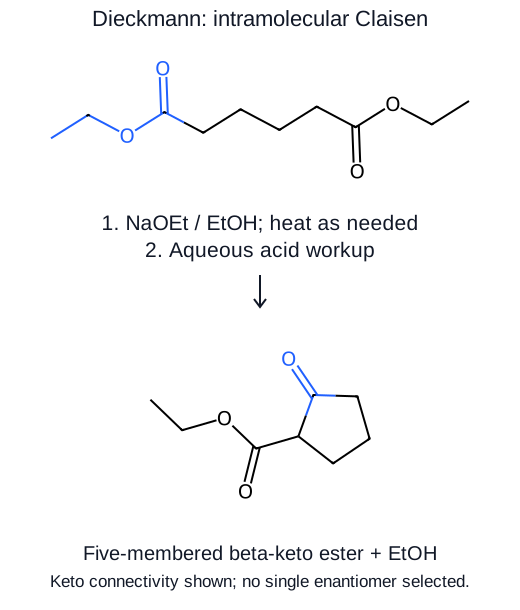
The Dieckmann condensation closes a diester into a cyclic beta-keto ester. An ester enolate attacks the other ester group in the same molecule: count the atoms in the new ring, then retain the ester attached to the attacking carbon.
At a glance
- Reagents and conditions: For the ethyl esters shown, sodium ethoxide in ethanol, with heating as needed, followed by a separate aqueous acid workup.
- Product: A cyclic beta-keto ester, rather than a simple cyclic ketone.
- Mechanism class: Intramolecular Claisen condensation; nucleophilic acyl substitution by an ester enolate.
- Regioselectivity: The tether determines which atoms can close a favorable ring. The symmetric substrates below avoid competing constitutional products.
- Stereochemistry: Keto connectivity is shown without assigning a single enantiomer; the alpha center can enolize.
- Key exam point: Include the attacked carbonyl carbon in the ring count. The other carbonyl remains in the exocyclic ester.
Mechanism
Ethoxide first removes an alpha proton from one ester. The carbon-centered enolate contributor below shows the carbon that forms the new bond; an oxygen-centered resonance contributor represents the same enolate, not a different reacting molecule.
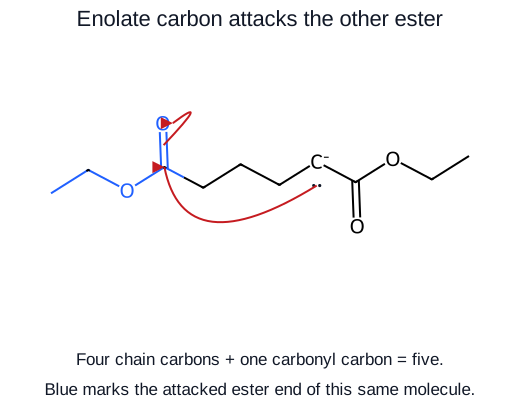
Attack converts the other ester carbonyl into a tetrahedral alkoxide. Re-forming that carbonyl ejects ethoxide. The new ring contains the attacking alpha carbon, the intervening chain and the attacked carbonyl carbon.
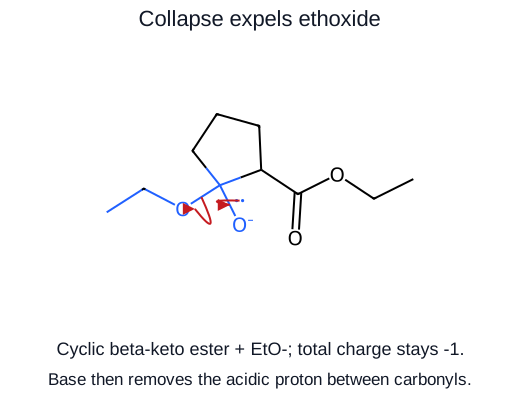
The cyclic beta-keto ester still has a proton between its two carbonyl groups. Removal of this more acidic proton traps the product as an enolate and helps drive the ordinary alkoxide-mediated condensation. Base is therefore consumed in this product-trapping stage; do not treat the usual reaction as requiring only a catalytic trace of alkoxide.
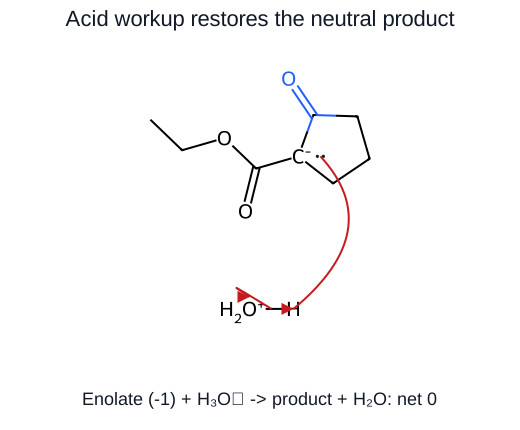
The drawings use blue for the attacked ester end within the same starting molecule. No second carbon partner is added. Acid workup restores the neutral product; it does not by itself mean the ester has been hydrolyzed and decarboxylated.
Scope, limits and traps
- Five- and six-membered closures are the usual favorable cases. A diester does not guarantee cyclization: tether length, substitution and competing intermolecular reactions matter.
- The ordinary product-deprotonation driving force requires a surviving proton between the carbonyls. Check the donor's alpha hydrogens before applying the standard mechanism to a substituted diester.
- Matching the alkoxide to the ester alkoxy group avoids introducing an unwanted ester-exchange change: NaOEt/EtOH is the usual matched choice for ethyl esters.
- Do not draw an aldol alcohol. The attacked group is an ester with an alkoxide leaving group, so acyl substitution restores a carbonyl.
- Stop at the cyclic beta-keto ester after acid workup. Heated hydrolysis and decarboxylation would be additional reactions with a different endpoint.
Worked examples
Example 1: Diethyl adipate closes a five-membered ring
Diethyl hexanedioate (diethyl adipate), C₁₀H₁₈O₄, gives ethyl 2-oxocyclopentane-1-carboxylate, C₈H₁₂O₃, shown in the overview. Four chain carbons and the attacked ester carbonyl carbon form the five-membered ring. The donor ester remains attached to the attacking alpha carbon; the displaced ethoxy group becomes ethanol in the neutral net balance.
The atom check is C₁₀H₁₈O₄ → C₈H₁₂O₃ + C₂H₆O. No carbonyl carbon disappears. Both sodium in toluene and sodium ethoxide routes can give this product. The teaching scheme above uses matched ethoxide/ethanol conditions; temperatures, times and yields from the sodium/toluene procedure do not automatically apply.
Example 2: Diethyl pimelate closes a six-membered ring
Diethyl heptanedioate (diethyl pimelate), C₁₁H₂₀O₄, has one more chain carbon. It gives ethyl 2-oxocyclohexane-1-carboxylate, C₉H₁₄O₃, plus ethanol after acid workup.
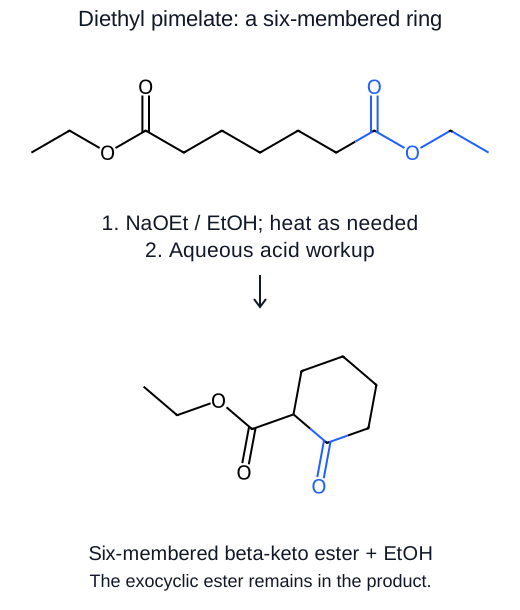
The extra carbon is in the ring, not in a longer ester alkyl group. Both examples retain an exocyclic ethyl ester and are drawn as keto connectivity without a single-enantiomer assignment.
Tools
- For manual-entry practice, open Reaction Solver Pro and enter diethyl adipate with ethoxide and an acid-workup stage.
- Explore the Mechanism Solver.
- Check names with the IUPAC Namer.