Azo coupling of diazonium salts
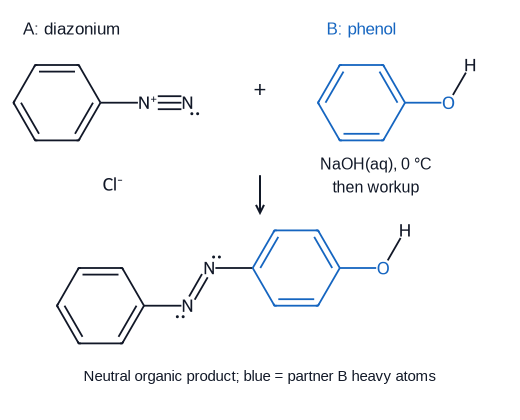
Azo coupling joins an arenediazonium salt to an electron-rich aromatic ring, forming an Ar–N=N–Ar′ bridge. The phenol or arylamine ring supplies the attacking carbon; both nitrogen atoms of the diazonium group remain in the product. This guide follows coupling with phenol and N,N-dimethylaniline.
At a glance
- Reagents and conditions: A freshly prepared cold aqueous arenediazonium salt; phenol in aqueous sodium hydroxide (NaOH), or N,N-dimethylaniline with acidity controlled to avoid excessive amine protonation.
- Product: An aromatic azo compound, Ar–N=N–Ar′.
- Mechanism class: Electrophilic aromatic substitution on the activated coupling ring.
- Regioselectivity: Para coupling is usual when that position is free in these examples.
- Stereochemistry: The drawings show an E azo arrangement; coupling is not a promise of a single geometric isomer under every condition.
- Key exam point: Keep both diazonium nitrogens in the product; do not release N₂ as in a Sandmeyer substitution.
Mechanism
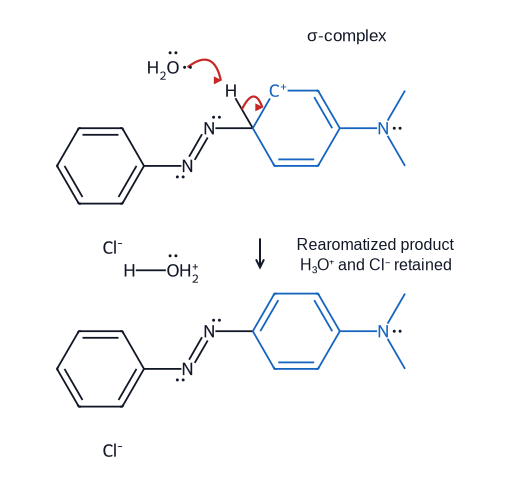
N,N-Dimethylaniline illustrates the two substitution steps. Its dimethylamino group activates the ring, and the para carbon attacks the terminal nitrogen of benzenediazonium. Blue continues to mark the coupling partner's ring and substituent atoms; red arrows show electron-pair movement.
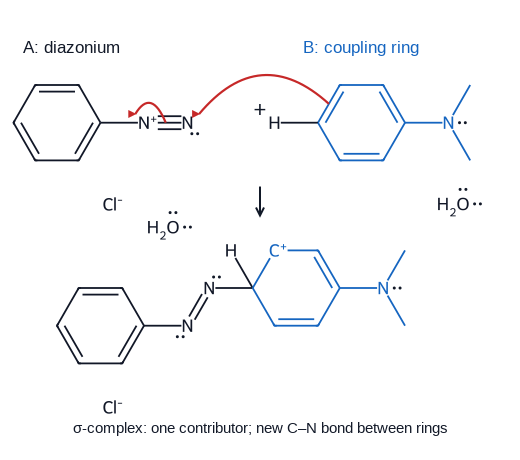
The attacked carbon temporarily bears both H and the new azo substituent. The ring has lost aromaticity, and its positive charge is delocalized; the drawing shows one resonance contributor.
Scope, limits and traps
- Use an activated coupling ring. Phenol/phenoxide and N,N-dimethylaniline are suitable partners; ordinary benzene should not be substituted into these examples as though it had the same reactivity.
- Control acidity for an arylamine partner. Protonating the dimethylamino nitrogen reduces its ability to donate into the ring, so strongly acidic conditions can slow coupling. For phenol, aqueous base increases the phenoxide population and activates the ring.
- Para is a preference, not a universal guarantee. Check whether the para position is available before copying either worked product.
- Keep the two nitrogen roles separate. N,N-Dimethylaniline is the ring coupling partner; it is not a primary arylamine that can be converted to the same diazonium salt by ordinary diazotization.
- Distinguish coupling from replacement. Azo coupling retains N=N between two rings; Sandmeyer substitution replaces the diazonium group and expels N₂.
- Use the diazonium solution cold and freshly prepared. Competing decomposition can reduce the useful coupling reaction; the worked phenol preparation uses 0 °C.
Worked examples
Example 1: Phenol gives a para hydroxyazo compound
Benzenediazonium chloride couples with phenol in cold aqueous NaOH to give 4-(phenyldiazenyl)phenol, also called 4-hydroxyazobenzene. The figure shows the neutral organic product after workup.
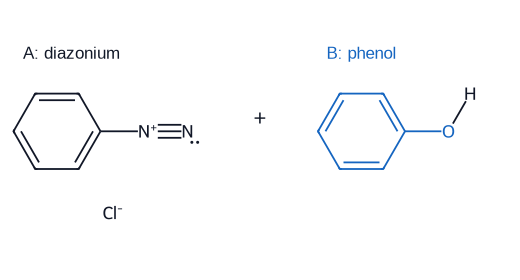
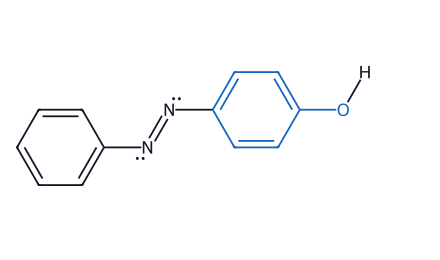
The oxygen remains on its original ring. Do not replace OH with the azo group or draw an O–N bond as the final ring-coupling product.
Example 2: N,N-Dimethylaniline retains its amino substituent
Benzenediazonium chloride couples with N,N-dimethylaniline to form N,N-dimethyl-4-(phenyldiazenyl)aniline, commonly called 4-(dimethylamino)azobenzene. Use cold aqueous conditions with controlled acidity so that enough unprotonated coupling partner remains available.
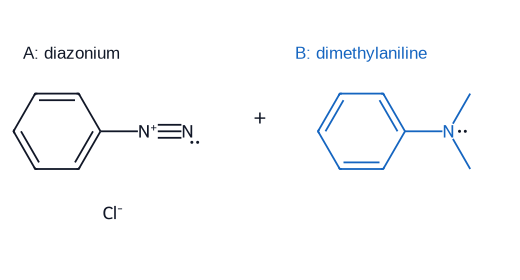
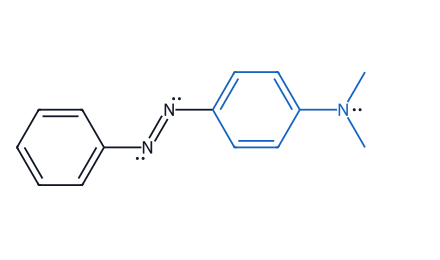
Count three product nitrogens: two in the azo bridge and one in N(CH₃)₂. The carbon–nitrogen bond forms at the ring, not at the donor amine nitrogen.
Tools
Use manual input for the separately specified coupling partners.
- Advanced example: Open Reaction Solver Pro for manually entering the diazonium salt and phenol or N,N-dimethylaniline as separate participants.
- Open the Mechanism Solver.
- Open the IUPAC Namer.