Wolff-Kishner Reduction: Hydrazone Formation and Base/Heat Deoxygenation
The Wolff-Kishner reduction converts aldehydes and ketones into the matching alkanes. Stage 1 can be carried out as an acid-catalyzed condensation: hydrazine (NH2NH2) adds to the protonated carbonyl to give the hydrazone. Stage 2 heats that hydrazone with strong base (KOH or NaOH) so that deprotonation/protonation steps collapse the C=N-NH2 unit, expelling nitrogen gas and replacing C=O with CH2. Compared with the Clemmensen reduction, Wolff-Kishner uses strongly basic, high-temperature conditions that can suit acid-sensitive substrates, provided the condensation and base/heat stages are compatible.
Quick Summary
- Overall reaction: Aldehyde or ketone + NH2NH2 (cat. acid) forms a hydrazone. Strong base and heat then replace C=O with CH2 while releasing N2.
- Stage 1 (hydrazone formation): NH2NH2, catalytic AcOH or TsOH, solvent (EtOH, toluene with Dean-Stark, or THF/water) with water removal to drive condensation.
- Stage 2 (base/heat detail): KOH or NaOH, high-boiling solvent (diethylene glycol, triethylene glycol), 150-220 deg C. Huang-Minlon variant distills off water/hydrazine before the high-temperature step in the NH2NH2/NaOH sequence.
- Selectivity vs Clemmensen: Choose Wolff-Kishner when the substrate tolerates base and heat but cannot survive strong acid.
- Hydrazone stereochemistry: Hydrazones may appear as E or Z isomers; both are viable for Stage 2.
Mechanism (Stage 1) - Hydrazone Formation in Five Steps


Mechanism (Stage 2) - Base/Heat Drives N2 Extrusion
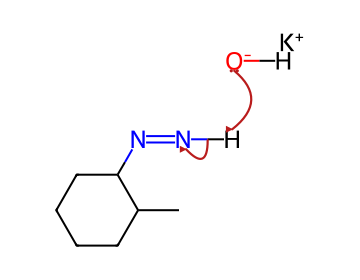
Stage 2 starts from the hydrazone. Strong base removes one terminal N-H proton. Resonance places negative charge at the former carbonyl carbon, which is protonated by solvent to give a diazene (R2CH-N=NH). Deprotonation of its remaining terminal N-H permits N2 loss, leaving a carbanion that is protonated to give the alkane. Heating in a high-boiling solvent (diethylene glycol or triethylene glycol) drives the reduction. The Huang-Minlon modification combines the carbonyl compound, hydrazine and hydroxide in one pot, then distills off water and excess hydrazine before the high-temperature stage.




Worked Examples
The examples pair each reactant with NH2NH2/NaOH and the expected product outcome.
Cyclohexanone → Cyclohexane


NH2NH2/AcOH followed by hot NaOH in diethylene glycol delivers cyclohexane while venting N2.
Acetophenone → Ethylbenzene


Dean-Stark water removal plus Huang-Minlon heating (excess hydrazine, NaOH, 190–200 °C) collapses the aromatic ketone to ethylbenzene.
Benzaldehyde → Toluene


Aldehydes condense rapidly with hydrazine; the base/heat stage completes the reduction to toluene with minimal byproducts.
Scope & Limitations
- Reliable substrates: Aryl and aliphatic aldehydes, moderately hindered ketones, cyclic ketones.
- Tolerant groups: Some acid-sensitive functions can tolerate the basic reduction stage, but check compatibility with any acid-assisted condensation and with the hot base. Silyl ethers in particular vary in stability.
- Caution zones: Base- or heat-labile groups (alkyl halides, sulfonates, some heteroaryl substituents) can eliminate or rearrange during Stage 2. Very hindered ketones condense slowly; plan longer reaction times and aggressive water removal.
- Not ideal: No alpha hydrogen is required. Nitro groups and other reducible or heat-sensitive functions may undergo side reactions under the hot, basic conditions.
Practical Tips
- Use mild acid (AcOH or catalytic TsOH) in Stage 1. Strong mineral acid protonates hydrazine too much and stalls addition.
- Remove water continuously (Dean-Stark, azeotropic distillation, or molecular sieves) to push the condensation toward hydrazone, especially for ketones.
- For Huang-Minlon conditions, combine the carbonyl compound, hydrazine and hydroxide in the glycol first; distill off water and excess hydrazine, then raise the temperature to complete reduction.
- Hydrazine is toxic and corrosive; handle it in a hood with proper PPE. Expect vigorous N2 evolution in Stage 2, so vent apparatus safely.
- Compare against the Clemmensen reduction (Zn(Hg)/HCl). Pick Wolff-Kishner when the substrate tolerates base and heat better than strong acid.
Exam-Style Summary
Wolff-Kishner is a two-stage carbonyl deoxygenation. Form the hydrazone under NH2NH2 and mild acid, remove water to lock it in, then heat strongly with base so deprotonation/protonation steps expel N2 and reveal the alkane (C=O -> CH2). Remember why it complements Clemmensen: Wolff-Kishner can suit acid-sensitive substrates but requires compatibility with the condensation conditions, strong base and high temperatures.
Related Reading
Interactive Toolbox
- Mechanism Solver - Open mechanism practice.
- Reaction Solver - Open reaction practice; check substrate compatibility with base and heat using the scope notes above.
- IUPAC Namer - Confirm hydrazone names before moving into the base/heat stage or reporting the final alkane.