Boc and Fmoc amine protecting groups
Boc and Fmoc protect an amine as a carbamate, reducing the nitrogen’s nucleophilicity during later reactions. Their main planning difference is how they come off: Boc is commonly removed with acid, while Fmoc is removed with base. Check the rest of the molecule before choosing either strategy.
Read the protecting-group shorthand
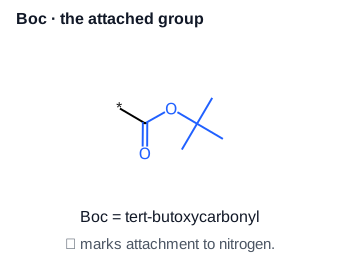
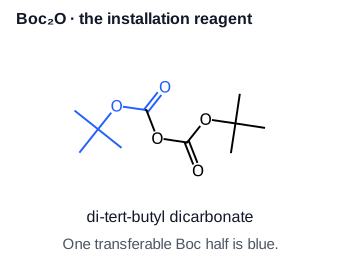
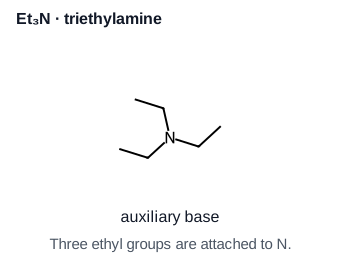
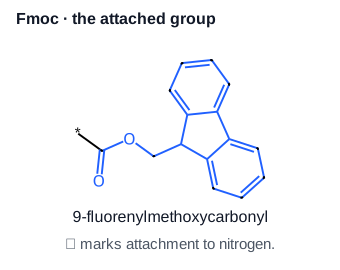
Boc and Fmoc name the groups attached to nitrogen; Boc₂O is a reagent and Et₃N is a separate base. In the attachment fragments, ∗ marks the bond to nitrogen. Blue marks protecting-group atoms.
At a glance
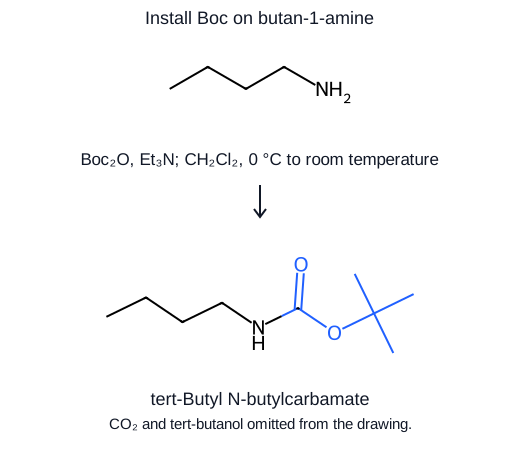
- Install Boc: Di-tert-butyl dicarbonate (Boc₂O) with a suitable base such as triethylamine; CH₂Cl₂ and 0 °C to room temperature are representative conditions.
- Remove Boc: TFA in CH₂Cl₂ commonly gives an ammonium salt. A later basifying workup gives the free amine.
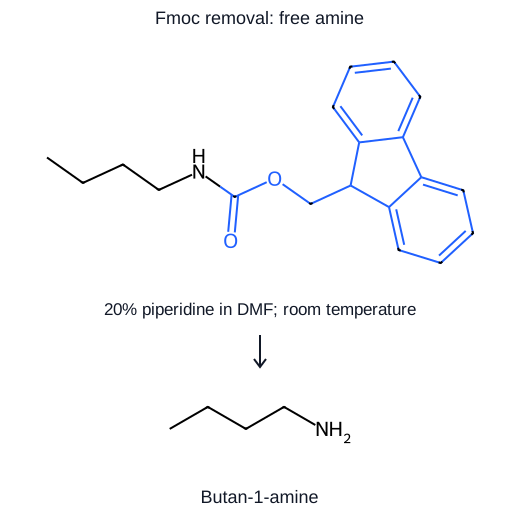
- Remove Fmoc: Piperidine in DMF, often 20% v/v at room temperature; use the substrate-specific exposure time.
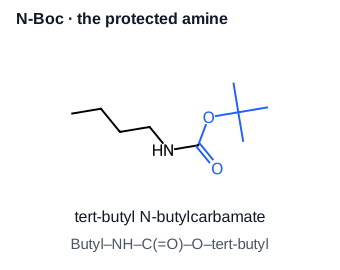
- Product class: A protected amine is a carbamate, RNH–C(=O)–OR′, in these primary-amine examples.
- Exam point: Match acid/base compatibility and show the correct protonation state after deprotection. No new stereocenter is created in the butylamine examples.
Mechanism
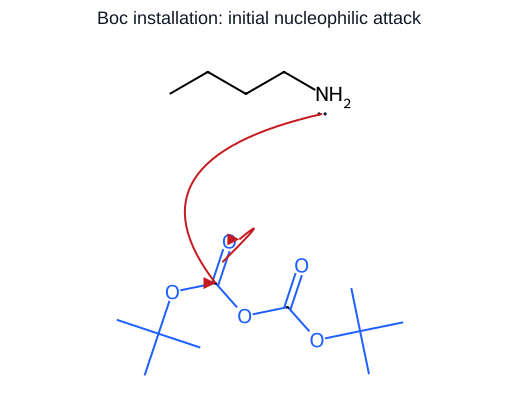
For Boc installation, the amine attacks one carbonyl of Boc₂O. The formal tetrahedral intermediate has N⁺ and O⁻. Collapse expels the carbonate leaving fragment; proton transfers and its decarboxylation give the protected amine, CO₂ and tert-butanol. Triethylamine is an auxiliary base, not a carbon donor to the amine. Boc₂O and Et₃N provide mild installation conditions.
For Boc removal, acid promotes loss of the tert-butyl-containing fragment and formation of a carbamic-acid intermediate, which loses CO₂. In excess TFA, the released amine is protonated. Do not label the acid-stage product as a neutral free amine without a separate workup.
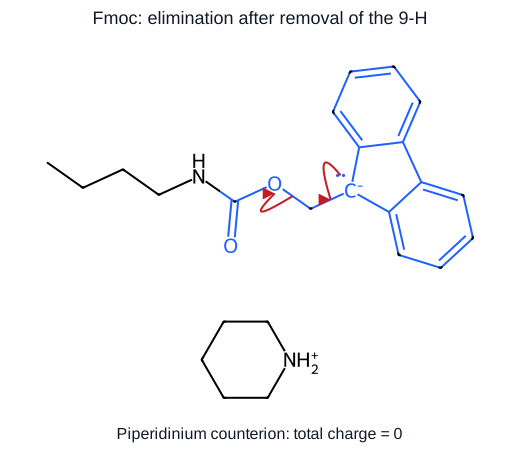
For Fmoc removal, base removes the proton at fluorene’s 9-position. Elimination cleaves the linker C–O bond, giving dibenzofulvene and a carbamate fragment that releases CO₂. Proton transfer restores the amine; excess piperidine also traps the reactive fulvene. This is a base-promoted elimination pathway, rather than simple acid hydrolysis of a carbamate.
Scope, limits and traps
- Choose conditions for the whole molecule. TFA may remove other acid-labile groups; basic Fmoc-removal conditions can promote other base-sensitive reactions. Orthogonal protection is conditional on that compatibility.
- Keep the original carbon skeleton. Installing Boc adds a removable carbamate on nitrogen; removing it does not shorten the butyl chain.
- Distinguish salt from free base. Butan-1-aminium under TFA and neutral butan-1-amine after a suitable workup are different protonation states.
- Locate the Fmoc proton correctly. The formal elimination starts with the fluorene 9-H, not an aromatic H or the linker CH₂ hydrogen.
- Read the arrows literally. The two mechanism figures illustrate different processes, not consecutive steps of one reaction. Fmoc installation is not part of the sequence shown here.
Worked examples
Example 1: remove Boc with acid
tert-Butyl N-butylcarbamate treated with TFA in CH₂Cl₂ gives butan-1-aminium trifluoroacetate under the acidic conditions shown. Neutralizing the salt in a separate appropriate workup can give butan-1-amine.
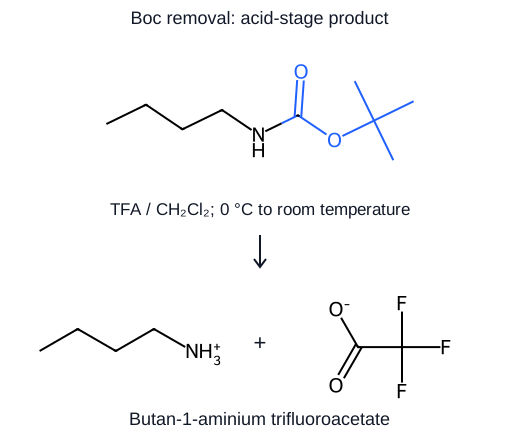
All four butyl carbons remain attached to the same nitrogen. The Boc-derived carbonyl is removed as CO₂; it does not become an extra carbon in the amine chain.
Example 2: remove Fmoc with base
(9H-Fluoren-9-yl)methyl N-butylcarbamate, the Fmoc-protected form of butan-1-amine, gives butan-1-amine on treatment with piperidine in DMF. Unlike the TFA example, the product is represented as the free base in this basic medium.
Compare and contrast
| Protected amine | Typical removal | Amine form shown | Planning limit |
|---|---|---|---|
| N-Boc carbamate | TFA / CH₂Cl₂ | Ammonium trifluoroacetate | Other acid-labile groups may also react. |
| N-Fmoc carbamate | Piperidine / DMF | Free amine | Other base-sensitive groups may also react. |
Tools
- Open Reaction Solver Pro for manual product practice. Enter butan-1-amine and Boc₂O with triethylamine; this link does not preload the example.
- Open the Mechanism Solver for mechanism practice.
- Use the IUPAC Namer to practice carbamate and amine names.