Strecker synthesis: alpha-aminonitriles
The Strecker reaction combines an aldehyde, an ammonia source and a cyanide source to make an α-aminonitrile. The carbonyl carbon gains NH₂ and a new C–CN bond; cyanide supplies the extra carbon. Converting that nitrile into an amino acid requires a separate hydrolysis step.
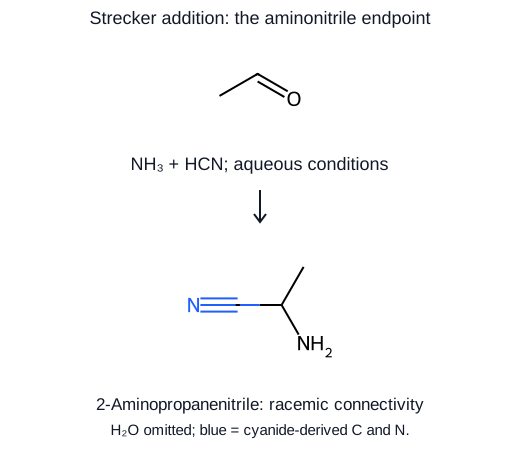
At a glance
- Reagents and conditions: Ammonia or an ammonium source with a cyanide source, commonly in aqueous or aqueous-alcohol media. Protonation conditions must permit both condensation and cyanide capture.
- Product: An α-aminonitrile, R–CH(NH₂)–CN, for the aldehyde/ammonia examples shown.
- Mechanism class: Carbonyl–ammonia condensation followed by cyanide addition to an imine/iminium electrophile.
- Stereochemistry: The ordinary achiral examples below are represented as racemic R/S mixtures.
- Key exam point: Count the cyanide carbon. The aminonitrile is one carbon longer than the aldehyde and is not yet an amino acid.
Mechanism
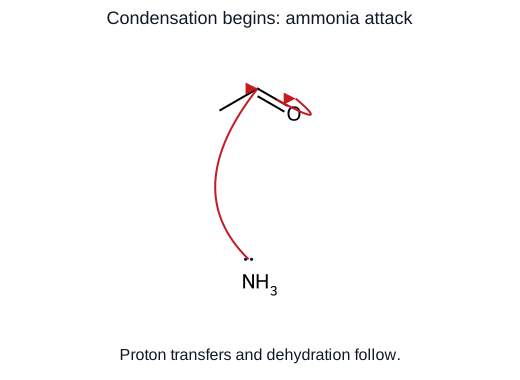
Ammonia adds to the carbonyl, producing a tetrahedral carbinolamine-related intermediate. Proton transfers and loss of water generate the imine/iminium system. The first figure isolates the initial addition so that both electron-pair movements are clear.
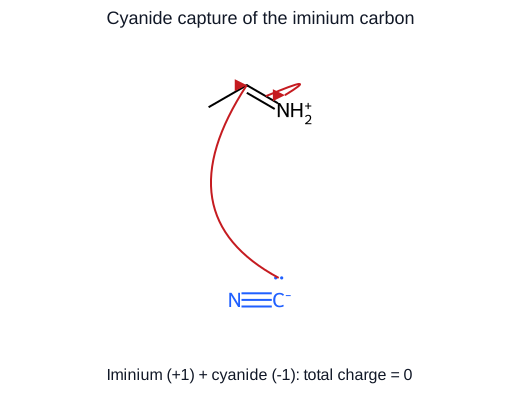
In the formal ionic capture picture, the carbon end of CN⁻ attacks the iminium carbon while the C=N π pair returns to nitrogen. The planar C=N unit has two faces; no chiral reagent or catalyst selects one enantiomer in the examples drawn. Solvent and proton relays participate in the overall condensation; the figures do not claim a unique microscopic sequence or universal rate-determining step.
Scope, limits and traps
- Stop at the stated endpoint. Nitrile hydrolysis can subsequently give an α-amino acid, but it is a separate reaction with its own conditions.
- Do not substitute cyanohydrin formation. Cyanide addition to a carbonyl without an ammonia source can give R–CH(OH)–CN. It does not install the NH₂ group of a Strecker product.
- Keep the atom origins straight. Ammonia supplies the amino nitrogen; the cyanide source supplies both atoms of the nitrile group. The aldehyde oxygen leaves in the water balance.
- Treat protonation as a balance. Excessively acidic conditions can suppress available ammonia/cyanide; “more strong acid” is not a universal improvement.
- Do not infer asymmetric synthesis. Chiral catalysts, auxiliaries or selective resolution can change the stereochemical outcome; none is part of these racemic examples.
Worked examples
Example 1: ethanal gives a three-carbon aminonitrile
Ethanal with ammonium chloride and a cyanide source gives 2-aminopropanenitrile after the aminonitrile-forming stage. The two configurations at its new stereocenter are shown explicitly.
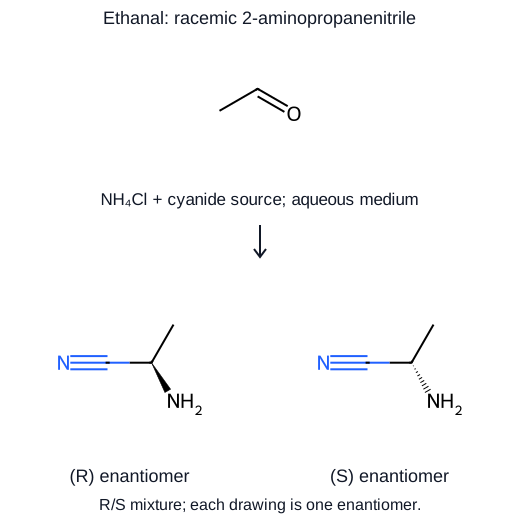
Product numbering begins at the nitrile carbon: CN is carbon 1, so NH₂ is on carbon 2. The methyl group is carbon 3. The figure shows the neutral organic endpoint; protonation and spectator ions depend on the workup.
Example 2: benzaldehyde gives phenylglycinonitrile
Benzaldehyde, ammonia and HCN give 2-amino-2-phenylacetonitrile, also called phenylglycinonitrile. Ammonium/cyanide salts can similarly form this aminonitrile before later acid hydrolysis; the hydrolysis is not included in the transformation drawn here.
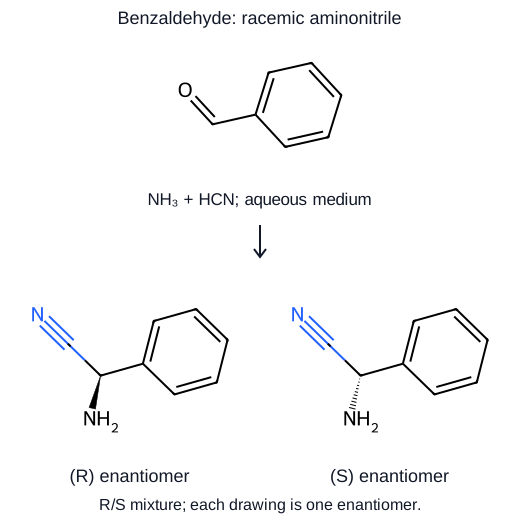
The six ring carbons stay intact. Benzaldehyde’s seventh carbon becomes the α-carbon, and the cyanide-derived carbon is the eighth. Changing NH₃/HCN to suitable salt sources does not change those atom origins.
Tools
- Open Reaction Solver Pro for manual product practice. Enter ethanal, ammonium chloride and cyanide as the participants; this link does not preload the example.
- Open the Mechanism Solver for mechanism practice.
- Use the IUPAC Namer to practice aminonitrile names.